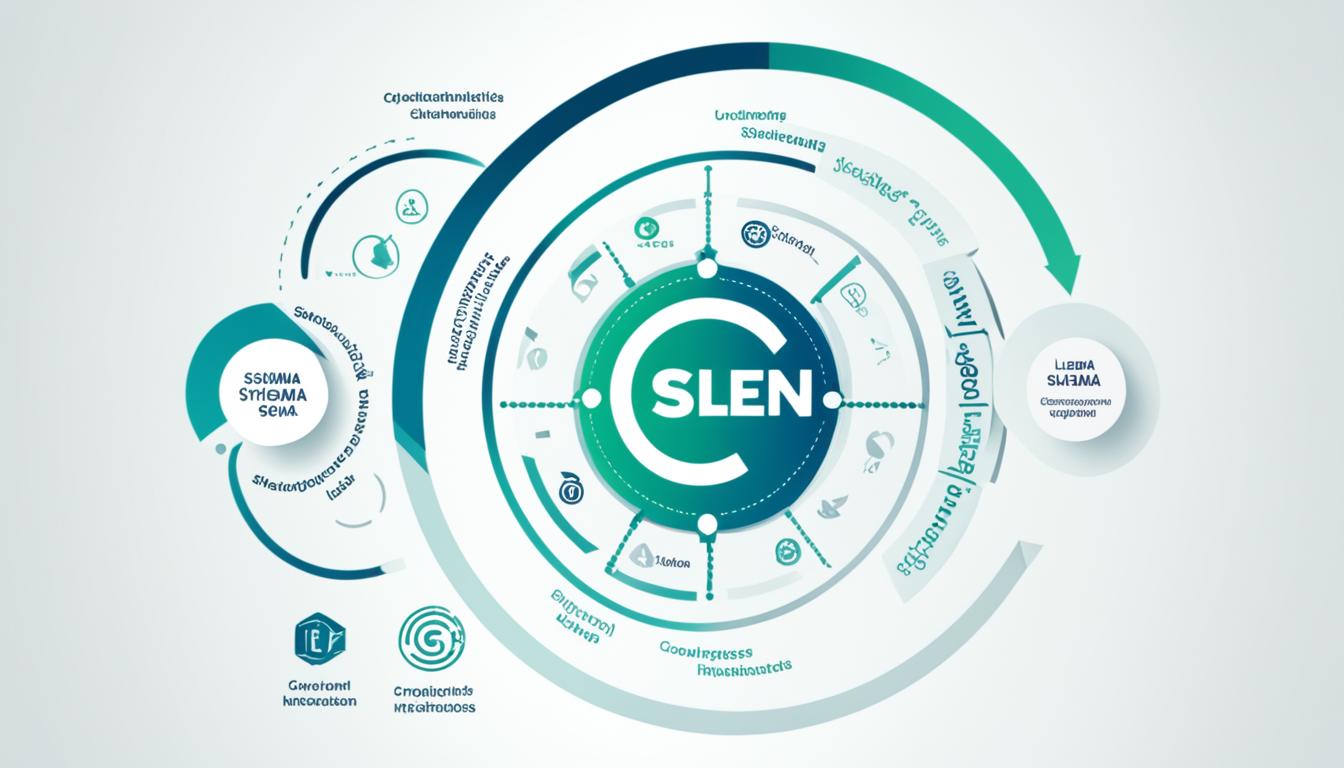
Did you know that companies that integrate Lean and Six Sigma methodologies achieve up to 50% improvement in process efficiency? That’s right, the combination of Lean, focused on eliminating waste and improving flow, and Six Sigma, aimed at reducing variation and improving process yield, creates a powerful synergy that drives significant results.
In today’s competitive business landscape, organizations are constantly striving to enhance their operational performance and deliver superior results. Implementing standalone Lean or Six Sigma programs can yield positive outcomes, but the integration of both methodologies offers a comprehensive improvement roadmap that addresses all types of process problems.
In this article, we will explore the benefits and strategies of integrating Lean and Six Sigma, understand their complementary nature, and highlight the power of Lean Six Sigma in achieving cost reduction, quality improvement, and customer satisfaction.
Key Takeaways:
- Integrating Lean and Six Sigma can lead to up to 50% improvement in process efficiency.
- Combining Lean and Six Sigma methodologies creates a comprehensive improvement roadmap.
- The integration of Lean and Six Sigma addresses all types of process problems.
- Lean focuses on eliminating waste and improving flow, while Six Sigma reduces variation and improves process yield.
- Lean Six Sigma enables organizations to achieve cost reduction, quality improvement, and customer satisfaction.
The Importance of Lean and Six Sigma Integration
Companies such as Toyota, General Electric, and Motorola have recognized the immense value of integrating Lean and Six Sigma methodologies into their business processes. By combining these two powerful approaches, organizations can unlock efficiency and strive for excellence in their operations.
Lean methodology focuses on waste reduction and flow improvement, aiming to eliminate non-value-added activities and create smooth and efficient processes. On the other hand, Six Sigma methodology is centered around reducing process variation and enhancing process yield through problem-solving and statistical tools.
Integrating Lean and Six Sigma offers a comprehensive approach to address process problems and achieve impactful results. This integration allows businesses to optimize their processes, resulting in significant cost reduction, improved quality, and enhanced time efficiency.
By integrating Lean and Six Sigma, organizations can:
- Minimize waste and streamline processes
- Reduce defects, errors, and variations
- Improve product and service quality
- Optimize resource utilization
- Enhance customer satisfaction
- Drive operational and financial performance
Lean and Six Sigma integration provides a holistic approach to process improvement, enabling organizations to achieve sustainable success and remain competitive in today’s dynamic business environment.
“Integrating Lean and Six Sigma methodologies is a strategic move that can lead to significant improvements in process efficiency, cost reduction, and quality improvement.” – Industry Expert
| Benefits of Lean and Six Sigma Integration |
|---|
| Process Improvement |
| Cost Reduction |
| Quality Improvement |
| Time Efficiency |
Understanding Lean and Six Sigma Methodologies
In order to successfully integrate Lean and Six Sigma into an improvement program, it is crucial to have a clear understanding of the principles and tools associated with these methodologies. Lean methodology is primarily focused on eliminating waste and improving the flow of processes. It emphasizes the identification and elimination of non-value-added steps, while preserving necessary non-value-added steps to ensure smooth operations. By implementing Lean principles, organizations can streamline their processes and improve overall efficiency.
On the other hand, Six Sigma methodology aims to reduce process variation and improve process capability. It follows the DMAIC roadmap, which stands for Define, Measure, Analyze, Improve, and Control. This systematic approach allows organizations to identify and solve process problems systematically, ensuring that the improvements made are sustainable over time.
When it comes to process design and redesign, the DFSS roadmap (Define, Measure, Analyze, Design, Verify) is used. This roadmap provides a structured framework for creating new processes or improving existing ones, integrating Lean and Six Sigma principles and tools to ensure the highest level of efficiency and quality.
Understanding the nuances of Lean and Six Sigma methodologies is essential for successful integration. By combining the waste reduction and flow improvement concepts of Lean with the statistical analysis and problem-solving approach of Six Sigma, organizations can address a wide range of process issues and achieve significant improvements in cost, quality, and time.
By utilizing the Lean and Six Sigma tools and following the DMAIC and DFSS roadmaps, organizations can establish a solid foundation for process improvement and drive continuous enhancement throughout their operations.
Complementary Nature of Lean and Six Sigma
Lean and Six Sigma are two powerful methodologies that, when integrated, create a comprehensive approach to process improvement. Lean focuses on eliminating waste and improving flow, while Six Sigma aims to reduce variation and improve process capability. By combining these complementary methodologies, organizations can effectively address all types of process problems and achieve optimal results.
Lean principles provide practical recommendations for improvements, emphasizing the identification and elimination of waste throughout the entire value stream. By eliminating waste, organizations can streamline processes, reduce lead time, and improve overall efficiency.
Six Sigma, on the other hand, follows a problem-solving approach that relies on statistical analysis to reduce process variation. By identifying and addressing the root causes of variation, organizations can improve process capability, reduce defects, and enhance customer satisfaction.
When Lean and Six Sigma are integrated, organizations have access to a comprehensive toolkit that combines practical recommendations and problem-solving techniques. This enables them to drive process improvement initiatives, eliminate waste, and reduce variation simultaneously, resulting in more impactful and sustainable outcomes.
“The combination of Lean and Six Sigma allows organizations to systematically eliminate waste, reduce variation, and improve overall process performance. This integration creates a powerful synergy that can drive significant improvements in cost, quality, and customer satisfaction.”
The complementary nature of Lean and Six Sigma is evident in their shared goal of achieving process excellence and delivering added value to customers. While Lean focuses on eliminating waste to create flow and efficiency, Six Sigma emphasizes reducing process variation to enhance quality and consistency.
The integration of Lean and Six Sigma also promotes a culture of continuous improvement within organizations. By combining the practicality of Lean principles with the analytical problem-solving approach of Six Sigma, employees at all levels can participate in identifying improvement opportunities, implementing solutions, and driving sustained results.
As organizations strive for excellence, the complementary nature of Lean and Six Sigma provides a comprehensive approach to process improvement, eliminating waste, reducing variation, and achieving optimum performance.
Benefits of Integrating Lean and Six Sigma
Integrating Lean and Six Sigma offers numerous benefits for organizations. By combining these methodologies, you can unlock the full potential of process improvement, leading to cost reduction and quality improvement. Let’s explore the specific benefits in more detail:
- Process Improvement: Integrating Lean and Six Sigma allows you to optimize your processes by eliminating waste and reducing variation. This leads to streamlined operations, increased efficiency, and improved overall performance.
- Cost Reduction: By eliminating waste and improving process efficiency, Lean Six Sigma helps organizations achieve significant cost savings. With a focus on enhancing value-added activities and reducing non-value-added activities, you can identify and eliminate unnecessary expenses.
- Quality Improvement: The integration of Lean and Six Sigma enables you to reduce process variation and improve overall quality. By implementing rigorous problem-solving techniques and statistical analysis, you can identify root causes of defects and implement preventive measures to ensure consistent, high-quality outputs.
- Customer Satisfaction: By optimizing your processes and improving quality, Lean Six Sigma helps enhance customer satisfaction. With fewer defects, shorter lead times, and improved product/service quality, you can exceed customer expectations and build strong, long-lasting relationships.
- Organizational Efficiency: Integrating Lean and Six Sigma drives organizational efficiency by increasing productivity and employee satisfaction. By eliminating waste and improving processes, employees can focus on value-added activities, resulting in higher job satisfaction and improved overall efficiency.
In addition to these benefits, integrating Lean and Six Sigma also supports strategic planning and supply chain management. In summary, Lean Six Sigma provides a comprehensive approach that creates value for customers, drives business growth, and ensures your organization remains competitive in today’s dynamic market.
| Benefits | Description |
|---|---|
| Process Improvement | Optimize processes by eliminating waste and reducing variation. |
| Cost Reduction | Achieve significant cost savings by eliminating unnecessary expenses. |
| Quality Improvement | Reduce process variation and improve overall product/service quality. |
| Customer Satisfaction | Exceed customer expectations and build strong relationships. |
| Organizational Efficiency | Increase productivity and employee satisfaction. |
Integrating Lean and Six Sigma provides a powerful framework for continuous improvement and business success. By harnessing the benefits of these methodologies, your organization can achieve remarkable results and thrive in today’s competitive landscape.
Developing an Integrated Improvement Program
When it comes to developing an integrated improvement program, there are several key factors that need to be taken into consideration. By utilizing both Lean and Six Sigma tools, incorporating Business Process Management (BPM) strategies, and following a well-defined Lean Six Sigma roadmap, organizations can effectively drive process improvement and achieve optimal results.
Project Selection:
One of the crucial steps in developing an integrated improvement program is project selection. It is important to carefully choose projects that align with the organization’s goals and objectives. During the initial phase, emphasis should be placed on Lean projects, which are typically focused on waste reduction and can generate quick wins. By starting with Lean projects, organizations can build momentum and demonstrate the tangible benefits of Lean Six Sigma to key stakeholders.
Customized Training:
Training plays a critical role in the success of an integrated improvement program. It is essential to provide training that covers both Lean and Six Sigma principles, as well as the specific tools associated with each methodology. The content of the training should be customized to the organization’s needs, taking into account the industry requirements and the different approaches of Lean and Six Sigma. By delivering tailored training, organizations can ensure that employees have the necessary knowledge and skills to effectively contribute to process improvement initiatives.
Alignment with Organization’s Vision:
An integrated improvement program should align with the organization’s vision and strategic direction. It is essential to have a clear understanding of the organization’s goals and objectives and how the integration of Lean and Six Sigma can contribute to achieving them. By aligning the improvement program with the organization’s vision, it becomes easier to gain buy-in from leaders and ensure that efforts are focused on areas that will have the greatest impact.
Pipeline of Projects:
An effective integrated improvement program should incorporate a pipeline of projects. By developing a pipeline of projects, organizations can ensure a continuous flow of improvement initiatives and maintain the momentum created by the initial Lean projects. This pipeline should include a balanced mix of Lean and Six Sigma projects, allowing the organization to address both waste reduction and process variation effectively.
Support and Resources:
Support and resources are vital for the success of an integrated improvement program. Organizations should provide the necessary resources, such as dedicated improvement teams and access to Lean and Six Sigma tools. Additionally, ongoing support from leadership is crucial to sustain the program and overcome any challenges that may arise.
By developing an integrated improvement program that incorporates these key factors, organizations can establish a robust framework for driving process improvement and achieving sustainable results.
| Key Factors for Developing an Integrated Improvement Program |
|---|
| Project Selection |
| Customized Training |
| Alignment with Organization’s Vision |
| Pipeline of Projects |
| Support and Resources |
Business Process Management and Lean Six Sigma
Business Process Management (BPM) strategies are designed to enhance performance by focusing on process improvement and automation. By streamlining and optimizing workflows, organizations can achieve greater efficiency and effectiveness in their operations. When combined with Lean Six Sigma, BPM becomes even more powerful in driving continuous improvement and delivering exceptional results.
Lean Six Sigma complements BPM by utilizing statistical analysis techniques to drive quality improvement and Lean principles to eliminate waste and enhance process flow. The integration of these methodologies results in a holistic approach to process improvement that addresses both quality and efficiency simultaneously.
When organizations incorporate Lean Six Sigma into their BPM strategies, they can realize several benefits:
- Enhanced Process Efficiency: Lean Six Sigma helps identify bottlenecks, redundancies, and inefficient processes that hinder productivity. By eliminating waste and optimizing workflow, organizations can achieve significant improvements in process efficiency.
- Automation: Integrating Lean Six Sigma with BPM enables the identification of suitable opportunities for automation. By automating repetitive and low-value tasks, organizations can reduce manual errors, improve accuracy, and save valuable time.
- Quality Improvement: Leveraging Lean Six Sigma tools and techniques ensures a data-driven approach to quality improvement. By reducing process variation and enhancing process capability, organizations can deliver higher-quality products and services, resulting in increased customer satisfaction and loyalty.
The combination of Lean Six Sigma and BPM also facilitates the identification of areas for improvement and helps develop a pipeline of projects that can be addressed using Lean or Six Sigma tools. By analyzing processes, organizations can identify pain points, assess opportunities for improvement, and prioritize projects accordingly.
Embedding Lean Six Sigma principles into BPM strategies requires a structured approach:
- Step 1: Aligning Goals: Define clear goals and objectives that align with the organization’s overall vision and strategic direction. This alignment ensures that the integration of Lean Six Sigma and BPM supports the organization’s desired outcomes.
- Step 2: Process Analysis: Conduct a thorough analysis of existing processes to identify areas of improvement. Utilize Lean Six Sigma tools such as process mapping and value stream analysis to gain insights into process inefficiencies and identify opportunities for optimization.
- Step 3: Creating a Roadmap: Develop a roadmap for the integration of Lean Six Sigma and BPM, outlining the sequence of improvement initiatives and establishing clear timelines and milestones for each project.
- Step 4: Training and Collaboration: Provide comprehensive training to employees, enabling them to understand the principles of Lean Six Sigma and BPM. Foster a collaborative environment where employees can actively contribute to process improvement initiatives and share their expertise.
- Step 5: Continuous Improvement: Implement a system for continuous monitoring and evaluation of process performance. Regularly collect and analyze data to identify areas for further improvement and adjust strategies accordingly.
By integrating Lean Six Sigma with BPM, organizations can achieve a balanced approach to process improvement and organizational growth. The integration facilitates efficient and effective operations that drive superior performance, customer satisfaction, and competitive advantage.
Case Study: Improved Order Processing Time
Let’s consider a real-life example of how integrating Lean Six Sigma with BPM can lead to substantial improvements. ABC Manufacturing, a leading manufacturer of consumer electronics, identified order processing as a critical area for improvement. The process involved several handoffs, frequent errors, and long lead times, leading to customer dissatisfaction and missed delivery deadlines.
ABC Manufacturing decided to integrate Lean Six Sigma principles with their BPM strategy to address these challenges. The following steps were taken:
- The order processing process was thoroughly analyzed using value stream mapping to identify bottlenecks, waste, and areas for improvement.
- Key performance indicators (KPIs) were established to measure the efficiency and effectiveness of the order processing process, including cycle time, error rate, and customer satisfaction.
- Lean principles were applied to eliminate waste and streamline the process. Redundant activities were identified and removed, and standardized work procedures were implemented.
- Six Sigma tools, such as statistical process control and root cause analysis, were used to reduce process variation and improve process capability.
- Automation was introduced to eliminate manual errors and reduce lead times. An integrated order management system was implemented to streamline communication and improve visibility throughout the process.
- Regular review and monitoring of the process were conducted to ensure continuous improvement. Feedback from customers and employees was taken into account to make further adjustments.
As a result of integrating Lean Six Sigma with BPM, ABC Manufacturing achieved significant improvements in their order processing process:
| Outcome | Before Integration | After Integration |
|---|---|---|
| Order Processing Time | 7 days | 3 days |
| Error Rate | 8% | 2% |
| Customer Satisfaction | 75% | 95% |
The integration of Lean Six Sigma with BPM empowered ABC Manufacturing to reduce order processing time by 57%, decrease the error rate by 75%, and improve customer satisfaction by 20%. These improvements resulted in enhanced customer loyalty, increased profitability, and a competitive advantage in the consumer electronics market.
By adopting a similar approach and integrating Lean Six Sigma with BPM, organizations across industries can drive performance, optimize processes, and achieve exceptional results.

Lean and Six Sigma Training and Application
In order to successfully implement Lean and Six Sigma methodologies, training plays a vital role. The training programs are designed to equip individuals with the knowledge and skills needed to effectively apply Lean principles and the Six Sigma DMAIC process. It is through training that organizations can empower their employees to drive process improvement and achieve optimal results. Let’s explore the different aspects of Lean and Six Sigma training and how it contributes to the application of tools and industry-specific adjustments.
Lean Principles Training
Lean principles training focuses on instilling a deep understanding of the fundamental concepts and philosophy behind Lean. Participants learn how to identify waste, streamline processes, and achieve flow optimization. This training empowers individuals to make practical recommendations for process improvement and waste elimination. Through interactive workshops and hands-on exercises, trainees gain practical experience in applying Lean principles to real-world situations.
Six Sigma DMAIC Training
Six Sigma DMAIC training follows a structured approach that enables individuals to systematically improve processes and reduce variation. The DMAIC process consists of five stages: Define, Measure, Analyze, Improve, and Control. Each stage is thoroughly covered in training sessions, providing trainees with the necessary tools and techniques to identify process problems, collect data, conduct root cause analysis, and implement sustainable solutions. The training ensures that employees are equipped with problem-solving skills and statistical analysis methods essential to the Six Sigma approach.
Application of Tools
Lean and Six Sigma training go hand in hand with the application of tools. During the training sessions, participants are introduced to a wide range of tools and techniques that serve as problem-solving aids. These tools include but are not limited to value stream mapping, Kanban systems, 5S methodology, process capability analysis, statistical process control, and failure mode and effects analysis. The practical application of these tools allows individuals to effectively analyze data, identify areas for improvement, and implement solutions that drive process efficiency and quality improvement.
Industry-Specific Adjustments
While Lean and Six Sigma principles and methodologies remain consistent across industries, it is crucial to make industry-specific adjustments during training. Industry-specific training modules enable participants to relate Lean and Six Sigma concepts to their specific work environment, facilitating a deeper understanding and practical application of the methodologies. Through industry-specific adjustments, training programs can address the unique challenges, processes, and requirements of different industries, ensuring that individuals are equipped with the necessary knowledge to drive process improvement within their specific context.
By incorporating Lean and Six Sigma training into organizational development programs, companies can cultivate a culture of continuous improvement and equip their employees with the necessary skills to identify and eliminate waste, reduce variation, and optimize processes. Training serves as the foundation for the successful application of Lean and Six Sigma principles and tools, allowing organizations to achieve tangible results and drive sustainable growth.
Integrating Lean and Six Sigma Roadmap
In order to effectively integrate both Lean and Six Sigma methodologies, organizations can benefit from following an integrated roadmap. This roadmap provides a structured approach to guide the implementation process, ensuring that both Lean principles and the Six Sigma process are seamlessly integrated into improvement initiatives. By following this roadmap, organizations can achieve significant results and drive continuous improvement.
The integrated roadmap for Lean and Six Sigma implementation should include:
- Project Selection: The roadmap begins with the careful selection of projects based on value stream mapping. This step ensures that improvement efforts are focused on areas that will yield the greatest results. By identifying and prioritizing projects that align with the organization’s goals and objectives, organizations can maximize the impact of their improvement initiatives.
- Lean Principles Implementation: During the initial phase of the roadmap, emphasis is placed on implementing Lean principles. Lean focuses on eliminating waste and improving flow in processes, and by implementing Lean principles first, organizations can quickly achieve “quick wins.” These early successes not only demonstrate the effectiveness of Lean principles but also generate enthusiasm and support for the integration of Lean and Six Sigma.
- Six Sigma Process: After implementing Lean principles, the roadmap progresses to the implementation of the Six Sigma process. Six Sigma aims to reduce process variation and improve process capability. It follows the DMAIC roadmap, which stands for Define, Measure, Analyze, Improve, and Control. By following this systematic approach, organizations can identify and solve complex process problems, leading to improved performance and outcomes.
- Training: Comprehensive training is a critical component of the integration process. It is important that training covers both Lean and Six Sigma principles to ensure a thorough understanding of both methodologies. However, customization of training based on the specific needs of the organization is essential. Training should be tailored to address the unique challenges and requirements of the organization, allowing employees to develop the necessary skills and knowledge to drive successful implementation.
By integrating Lean and Six Sigma through a well-defined roadmap, organizations can effectively align their improvement efforts, capitalize on the strengths of both methodologies, and achieve significant results in terms of process optimization, cost reduction, quality improvement, and customer satisfaction.
| Benefits of an Integrated Lean and Six Sigma Roadmap |
|---|
| 1. Streamlined implementation process |
| 2. Focused project selection for maximum impact |
| 3. Quick wins through the implementation of Lean principles |
| 4. Identification and resolution of complex process problems through the Six Sigma process |
| 5. Customized training to develop the required skills for successful implementation |
The Power of Lean Six Sigma
Lean Six Sigma offers a powerful approach to process improvement that combines waste reduction, process optimization, and customer satisfaction. By integrating Lean and Six Sigma methodologies, you can unlock efficiency, reduce costs, improve quality, and streamline processes.
“The power of Lean Six Sigma lies in its ability to address all types of process problems and drive continuous improvement.”
- Eliminating waste: With Lean Six Sigma, you can identify and eliminate non-value-added activities, reducing costs and improving resource utilization.
- Improving process efficiency: By analyzing and optimizing processes using Six Sigma tools, you can minimize variations, enhance process efficiency, and achieve consistent results.
- Enhancing customer satisfaction: Lean Six Sigma focuses on understanding customer requirements and delivering products and services that meet or exceed their expectations, resulting in greater customer satisfaction and loyalty.
- Reducing costs: Lean Six Sigma helps identify and eliminate activities that do not add value, leading to significant cost savings and increased profitability.
- Improving quality: By reducing variations and defects in processes, Lean Six Sigma improves product and service quality, resulting in higher customer satisfaction and reduced rework or waste.
Through waste reduction, process optimization, and customer-focused principles, Lean Six Sigma empowers organizations to achieve operational excellence. It provides a structured framework for continuous improvement and enables data-driven decision-making.
Implementing Lean Six Sigma:
To implement Lean Six Sigma successfully, organizations need to:
- Align strategic goals: Ensure that Lean Six Sigma efforts align with the organization’s strategic goals and priorities, focusing on areas with the most significant impact.
- Establish a culture of continuous improvement: Foster a culture that encourages employees at all levels to actively participate in process improvement initiatives and embrace Lean Six Sigma methodologies.
- Provide training and resources: Develop a comprehensive training program to equip employees with the necessary Lean Six Sigma knowledge and skills. Allocate resources to support project teams and provide ongoing coaching and mentoring.
- Define clear project goals and metrics: Clearly define the goals of each Lean Six Sigma project and establish relevant metrics to measure progress and success.
- Monitor and sustain improvements: Regularly review and monitor the effectiveness of implemented improvements to ensure long-term sustainability. Continuously refine processes and capture best practices.
By harnessing the power of Lean Six Sigma, organizations can drive operational excellence, achieve higher customer satisfaction, reduce costs, and improve quality. It is a proven methodology that empowers organizations to stay competitive in today’s dynamic business environment.
| Benefits of Lean Six Sigma | Description |
|---|---|
| Waste Reduction | Identify and eliminate non-value-added activities to reduce costs and optimize resource utilization. |
| Process Improvement | Analyze and optimize processes to minimize variations, improve efficiency, and achieve consistent results. |
| Customer Satisfaction | Deliver products and services that meet or exceed customer expectations, resulting in greater satisfaction and loyalty. |
| Cost Reduction | Identify and eliminate activities that do not add value, leading to significant cost savings and increased profitability. |
| Quality Improvement | Reduce variations and defects in processes, resulting in higher quality products and services. |
Conclusion
Integrating Lean and Six Sigma offers organizations a comprehensive approach to achieving process improvement, cost reduction, and quality improvement. By combining the principles and tools of both methodologies, companies can unlock their full potential and strive for excellence in their business operations.
Through careful planning, project selection, training, and customization, the integration of Lean and Six Sigma can deliver significant results. This powerful combination enables organizations to enhance efficiency, increase customer satisfaction, and improve overall performance.
By leveraging Lean principles to eliminate waste and Six Sigma methodologies to reduce process variation, businesses can achieve optimal outcomes. This integration supports their continuous improvement journey, leading to impactful cost savings, streamlined processes, and enhanced product and service quality.
In a highly competitive landscape, organizations that integrate Lean and Six Sigma gain a strategic advantage. They can drive process improvement, cost reduction, and quality improvement, ultimately delivering greater value to their customers and positioning themselves as industry leaders.
FAQ
What is the importance of integrating Lean and Six Sigma?
Integrating Lean and Six Sigma allows organizations to unlock efficiency, reduce costs, improve quality, and streamline processes, leading to significant improvements in overall performance.
How do Lean and Six Sigma complement each other?
Lean focuses on eliminating waste and improving flow, while Six Sigma aims to reduce variation and improve process capability. By combining both approaches, organizations can effectively address all types of process problems.
What are the benefits of integrating Lean and Six Sigma?
Integrating Lean and Six Sigma enables process improvement, cost reduction, quality improvement, customer satisfaction, and organizational efficiency. It also supports strategic planning and supply chain management.
How can organizations develop an integrated improvement program?
Developing an integrated improvement program requires careful planning, project selection, training, and customization to the specific needs of the organization. Business Process Management (BPM) strategies and a structured roadmap should be incorporated.
How does Lean Six Sigma complement Business Process Management (BPM)?
Lean Six Sigma complements BPM by using statistical analysis to drive quality improvement and Lean principles to eliminate waste. The integration of Lean Six Sigma and BPM provides a holistic approach to process improvement and performance.
What is the training approach for Lean and Six Sigma implementation?
Lean and Six Sigma training should cover both principles and tools, with customization based on the specific needs of the organization. Lean training focuses on practical recommendations, while Six Sigma training emphasizes the problem-solving approach.
What is the roadmap for integrating Lean and Six Sigma?
The roadmap for integrating Lean and Six Sigma should include project selection based on value stream mapping, emphasis on Lean projects for quick wins, comprehensive training, and customization to the organization’s specific needs.
What is the power of Lean Six Sigma?
Lean Six Sigma combines waste reduction, process optimization, and customer satisfaction to achieve significant cost savings, improved product and service quality, and overall value delivery to customers.