
Embark on an exploration of the Global Manufacturing Hubs, where innovation meets productivity to fuel economies worldwide. These top industrial hubs in the world are more than mere destinations; they are the pulsating heartbeats of global commerce, engineering marvels, and employment generators. As you traverse through these manufacturing hotspots around the globe, gain insights into how they shape livelihoods, propel advancements, and orchestrate the flow of goods across continents.
Key Takeaways
- Understand the pivotal role of Global Manufacturing Hubs in driving economic growth and trade.
- Recognize the strategic importance of manufacturing hotspots around the globe in international relations and market dynamics.
- Discover the core qualities that distinguish the top industrial hubs in the world from their contemporaries.
- Learn about the intricate networks that interlink these hubs, underscoring their global significance.
- Appreciate the synergistic impact of geographic location, technological prowess, and skilled labor in sustaining these industrial centers.
The Role of Global Manufacturing Hubs in the World Economy
As pillars of the global economy, manufacturing locations worldwide have become the lifeline for trade and development. These key production centers globally not only stand as monuments of human innovation but also as vital cogs in the machinery that fuels our daily lives. With every product that comes off the line, these leading industrial zones echo with the rhythms of progress and prosperity.
The Impact of Manufacturing on Global Trade
The sheer scale at which these hubs operate can often be undervalued, yet their contribution to global trade is nothing short of monumental. From automobiles in Germany’s Stuttgart to electronics in South Korea’s Seoul, manufacturing locations worldwide are continuously spinning the reels of international commerce, pushing forth the engines of global trade with every shipment that sets sail.
How Manufacturing Hubs Contribute to Economic Growth
Leading industrial zones are not merely production sites; they are fertile grounds for innovation and job creation. By fostering opportunities and paving the way for growth, these zones are at the forefront, driving the welfare of nations and setting the stage for a future built on robust economic foundations.
The Interconnectivity of Global Supply Chains
In the intricate web of the global marketplace, the key production centers globally are the nodes that keep the supply chains thriving. Their interconnectivity forms a resilient network that ensures the seamless flow of goods and services across continents, solidifying the dynamics of market reliance and shared growth opportunities.
Identifying the Top Industrial Hubs in the World
Within the matrix of global manufacturing, certain regions stand apart as the undisputed titans of industry. These Global Manufacturing Hubs not only drive disproportionate productivity but are also the cradles of innovation and economic powerhouses. Let’s delve into some of the most prominent locales that have earned the title of being the top industrial hubs in the world.
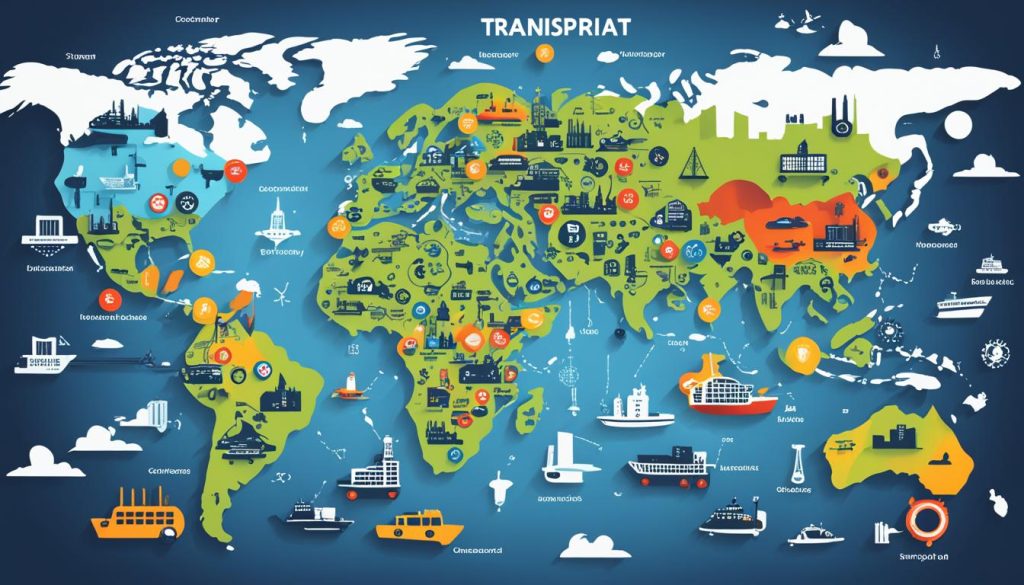
The Pearl River Delta in China, with its vast network of factories and state-of-the-art technology, is a testament to the country’s manufacturing might. Meanwhile, Germany’s Ruhr region continues to uphold its longstanding tradition of industrial prowess, particularly in automotive and engineering sectors. And over in the United States, Silicon Valley’s reputation as a global tech hub remains unchallenged, contributing significantly to the high-tech manufacturing spectrum.
When assessing these manufacturing locations worldwide, one can’t help but note their impact on regional development and global trade flows. Each hub boasts unique characteristics:
- The Pearl River Delta’s integration of manufacturing with global logistics
- The Ruhr region’s transition from heavy industry to high-tech endeavors
- Silicon Valley’s synergistic blend of research, development, and manufacturing
These attributes are not only markers of current success but are also indicators of future sustainability and adaptability in a rapidly evolving global market. The following table provides a snapshot of these regions:
| Region | Core Industries | Innovation Factors | Economic Impact |
|---|---|---|---|
| Pearl River Delta, China | Electronics, Textiles, Automotive | Supply Chain Integration, Export-Oriented Growth | Major contributor to China’s GDP |
| Ruhr Region, Germany | Machinery, Chemicals, Steel | High-skilled Labor Force, Advanced Research Facilities | Stabilizing force in EU’s industrial output |
| Silicon Valley, USA | High-Tech, Biotechnology, Software | Cutting-edge R&D, Venture Capital Presence | Significant Venture Capital Investments |
It’s clear from this overview that the manufacturing locations worldwide like these are not just the backbone of their respective nations, but also substantial pillars in the architecture of global commerce and innovation.
The Evolution of Manufacturing Locations Worldwide
Understanding the development of key production centers globally requires a look back through the centuries of industry, as well as an appreciation for the transformative power of technology and the growing impact of new players on the world stage. As manufacturing hotspots around the globe continually shift and adapt, you can witness the legacy and future of manufacturing unfold.
Historical Transitions in Global Manufacturing
The distant echoes of the Industrial Revolution have given way to the ultra-modern landscapes of today’s Global Manufacturing Hubs. You can almost feel the pulsating energy of production lines that have historically evolved from steam-powered machinery in Britain to sprawling automotive plants in Detroit. The transformation is as palpable as it is profound, marking each era with innovation and escalating productivity.
Shifts Due to Technological Innovations
Robotics, the Internet of Things (IoT), and Artificial Intelligence (AI) – these aren’t just buzzwords; they’re the revolutionary forces redrawing the map of manufacturing hotspots around the globe. Technological advancements have paved the way for unprecedented efficiency, precision, and quality, making the once labor-intensive processes a symphony of automated mastery.
Emerging Markets and Their Growing Influence
The competitive landscape of global manufacturing now includes burgeoning players challenging traditional powerhouses. Nations like India, with its Make in India initiative, and Vietnam, with its rapid industrialization, are becoming manufacturing hotspots to be reckoned with, carving out their own niches in a globalized economy.
| Region | Historical Significance | Technological Innovation | Emerging Market Status |
|---|---|---|---|
| Britain (18th Century) | Birthplace of the Industrial Revolution | Steam Power | N/A |
| United States (20th Century) | Automotive Industry Boom | Automation and Mass Production | N/A |
| China (21st Century) | Global Manufacturing Leader | Integration of AI and IoT | N/A |
| India (21st Century) | Growing Technological Hub | Advancements in Software & IT Services | Rising Manufacturing Economy |
| Vietnam (21st Century) | Rapid Industrialization | Focus on Consumer Electronics | Significant Market Expansion |
As you dissect the intricate weave of our world’s manufacturing history, it becomes clear that the hubs of production have not just evolved—they have revolutionized the way we live. From the dense fog of coal-fired England to the sleek automation in modern factories, manufacturing remains a testament to human innovation and our relentless pursuit to redefine the boundaries of possibility.
Analyzing the Factors That Designate Leading Industrial Zones
The crux of understanding what makes a Global Manufacturing Hub stand out hinges on a multitude of factors that, when combined, elevate a region’s status as a key production center globally. These factors are not only diverse but also critical in ensuring the sustainability and growth of leading industrial zones. Let’s delve into what distinguishes these industrial bastions.
Infrastructure and Accessibility
Impeccable infrastructure forms the backbone of productive manufacturing hubs. To qualify as a top-tier industrial zone, a locale must offer comprehensive access to state-of-the-art facilities and logistical networks. This includes advanced transport systems like highways, railways, ports, and airports, which together facilitate swift and efficient movement of goods. Additionally, the presence of high-tech communication systems and uninterrupted power supply is paramount in maintaining operational continuity in these zones.
Government Policies and Incentives
In seeking to attract substantial industrial investments, nations often devise favorable policies and incentives. Such strategies may encompass tax reductions, subsidies, and the creation of special economic zones, all meant to entice leading corporations to set up shop. By providing a nurturing business climate, government initiatives become a pull factor, shaping the competitiveness and allure of manufacturing hubs on the global stage.
Labor Market and Local Expertise
The availability and caliber of the local workforce are instrumental in the rise of a robust manufacturing sector. Investment in human capital, upskilling programs, and vocational training institutions are core elements that supply industries with adept and innovative personnel. A thriving community with rich expertise and labor specializations is, therefore, an indispensable feature of premier industrial zones.
| Component | Role in Industrial Success | Examples |
|---|---|---|
| Transportation | Facilitates distribution of goods | Shanghai Yan, Schiphol-Rijk |
| Technology | Drives innovation and efficiency | Shenzhen, Silicon Valley |
| Government Support | Provides economic stability and growth | Singapore, Hsinchu |
| Skilled Workforce | Enhances productivity and quality | Stuttgart, Bengaluru |
When you take these factors into account, it becomes clear why certain zones stand out. They are not just hubs of activity but represent the concerted efforts of communities and governments aligning towards the common goal of industrial preeminence. Such synergy between infrastructure, policy, and human expertise defines the success stories of modern Global Manufacturing Hubs.
Conclusion
In the intricate dance of global commerce, Global Manufacturing Hubs take center stage, orchestrating the movements of trade and industry across continents. Your journey through this article has illuminated the essential role these hubs play, not just in their capacity as top industrial hubs in the world but as the lifeblood of market economies and drivers of innovation. The foundations of these manufacturing locations worldwide span more than the physical—they are cornerstones of financial growth and technological advancement, reflecting humanity’s enduring spirit of progress.
From the bustling factory lines in China’s Pearl River Delta to the innovative corridors of Silicon Valley, each hub contributes uniquely to the tapestry of global economics. Their influence extends far beyond their geographical limits, acting as beacons that attract investment, create jobs, and, most importantly, connect human talent and creativity with the creation of goods that propel society forward. Your appreciation for these hubs should now encompass a recognition that they are more than contributors to economic statistics; they are culturally rich, dynamically evolving entities that reflect our collective drive for a prosperous future.
Indeed, as the world becomes ever more interconnected, the health and vitality of these manufacturing locations worldwide are crucial to the well-being of global trade networks. Their evolution and resilience are a reminder of our interconnectedness and our shared stake in the global economy. The next time you encounter a product labeled “Made in…” take a moment to consider the vast network of Global Manufacturing Hubs that brought that item to your grasp. It is through the collective efforts and strategic location of these hubs that our global village thrives in commerce and innovation.
FAQ
What defines Global Manufacturing Hubs?
Global Manufacturing Hubs are defined by their massive production capabilities, contribution to the global economy, and advanced infrastructure that support large-scale manufacturing. They often feature extensive industrial zones where trade, innovation, and economic activity converge, making them vital for international commerce.
How do Global Manufacturing Hubs impact global trade?
Manufacturing Hubs have a significant impact on global trade by enabling large volumes of goods to be produced and exchanged internationally. They support complex supply chains, foster trade relationships between countries, and can be influential in geopolitics and global economic shifts.
What are some of the top industrial hubs in the world?
Some of the top industrial hubs include China’s Pearl River Delta, Germany’s Ruhr region, and the United States’ Silicon Valley. These regions are recognized for their high production output, technological innovation, economic impact, and strategic importance in global trade.
How does the interconnectivity of global supply chains relate to manufacturing hubs?
Global supply chains are highly interdependent and rely on the efficient operation of manufacturing hubs to function properly. The hubs serve as key nodes in these chains, and any disruption can have wide-ranging impacts on global economic stability and trade. Their interconnectedness emphasizes the importance of reliability and cooperation across manufacturing locations worldwide.
How has the manufacturing landscape changed throughout history?
The manufacturing landscape has undergone significant changes from the Industrial Revolution to the present day. Advances in technology and changes in geopolitical conditions have shifted the centers of manufacturing around the globe, from early industrialized nations to today’s emerging economies that are rising as new key production centers.
What role do government policies and incentives play in developing leading industrial zones?
Government policies and incentives are crucial in shaping leading industrial zones. They can attract foreign investment, encourage the establishment of manufacturing facilities, and boost technological innovation. Tax breaks, subsidies, creating special economic zones, and regulatory support are ways governments can promote and sustain industrial growth.
Why is infrastructure critical for manufacturing hubs?
Infrastructure, including transportation systems, utilities, and telecommunications, is essential for manufacturing hubs to operate efficiently. Good infrastructure allows for smooth movement of goods, reduces production and shipping costs, and enhances a region’s connectivity to global markets, reinforcing its position as a manufacturing hotspot.
What factors have led to the rise of emerging markets in manufacturing?
Emerging markets have risen in manufacturing due to competitive labor costs, demographic advantages, ongoing investment in infrastructure, and proactive government policies. Improvement in education and skill-building, along with technological advancements, have also enabled these regions to climb up the value chain in global manufacturing.
How important is the local labor market and expertise in maintaining a manufacturing hub’s competitiveness?
The local labor market and expertise are extremely important for maintaining competitiveness. A skilled workforce ensures high productivity and quality control in manufacturing processes. Additionally, local expertise in specialized sectors can give a manufacturing hub a competitive edge in those industries, attracting more business and investment.