Have you ever wondered how a product goes from an idea to a fully functional, market-ready creation? What are the principles and processes involved in designing a product that meets user needs and business goals?
In this article, we will take you on a journey through the world of product design in manufacturing. We will explore the fundamentals of product design, the principles that drive manufacturing design, and the product development process that turns ideas into reality. We will delve into the concept of design thinking and discover the techniques used in industrial design. We will also explore the intersection of product design with manufacturing engineering concepts and the software tools used by product designers. Finally, we will uncover the guidelines for designing products for manufacturing.
Get ready to dive deep into the world of product design and discover the secrets behind creating successful and innovative products.
Key Takeaways:
- Product design is the process of creating and refining a product to make it ready for the end user.
- Good product design delivers higher returns to shareholders and higher revenues compared to industry benchmarks.
- Product designers play a crucial role in overseeing the design stage of the product development lifecycle.
- Product design involves a combination of creative thinking, technical knowledge, and collaboration with stakeholders.
- Design thinking and industrial design techniques shape the product design process.
What is Product Design?
Product design is a multifaceted process that involves imagining, conceptualizing, testing, iterating, and refining a wide range of products, services, and experiences. It is the creative and strategic endeavor of bringing ideas to life and creating tangible solutions for user needs and business goals.
A product can be a physical item found on a shelf, such as a smartphone or a piece of furniture. It can also be an intangible like software or services, such as a mobile app or a digital platform. In essence, a product is the end result of a product designer’s work, encompassing various forms and functionalities.
Industrial design is a more traditional term that specifically refers to the design of physical goods. However, product design has evolved to include both physical and intangible products, expanding its scope beyond traditional industrial design practices.
Product design is driven by a deep understanding of user needs and aspirations. It goes beyond aesthetics and encompasses user experience, functionality, and the overall value a product brings to its users.
The essence of product design is to bridge the gap between user expectations and business objectives, creating products that are not only visually appealing but also deliver real value and meaningful experiences.
Product designers work closely with internal stakeholders and target market users to gather insights and align design decisions with user and business goals. This collaborative approach ensures that the end product fulfills its intended purpose and resonates with its intended audience.
Industrial Design vs. Product Design
While industrial design primarily focuses on physical goods and their aesthetics, product design encompasses a broader spectrum. It embodies the iterative process of creating and refining products, whether they are physical or intangible. Product design takes into account the entire user experience, from the initial concept to the final delivery.
By embracing both industrial design principles and the broader scope of product design, designers can create innovative and user-centric solutions that meet the demands of today’s evolving market.
| Industrial Design | Product Design |
|---|---|
| Focuses on physical goods | Encompasses physical and intangible products |
| Emphasizes aesthetics | Considers user experience, functionality, and value |
| Primarily concerns form and appearance | Addresses the entire user journey |
Why is Product Design Important for Your Business?
Great product design delivers a strong return on investment (ROI) and drives positive business outcomes. According to the McKinsey Design Index, businesses that excel in product design experience higher returns to shareholders and increased revenues compared to industry benchmarks. Investing in good product design is essential for creating a competitive advantage and achieving sustainable growth.
The McKinsey Design Index
The McKinsey Design Index analyzed design practices and financial performance across 300 businesses across various industries. The results showed that companies that prioritize product design are more likely to outperform their competitors.
“Businesses that prioritize product design deliver higher returns to shareholders and higher revenues, proving that good design is a catalyst for success.”
It’s no wonder that forward-thinking companies are placing a strong emphasis on product design. It’s not just about creating beautiful and functional products; it’s about creating experiences that resonate with users and drive customer satisfaction and loyalty.
Good design improves the overall user experience by solving problems and creating frictionless interactions. By understanding user needs and aligning with business goals, product designers can create innovative solutions that delight customers.
Additionally, a well-designed product can differentiate your brand from competitors, making it more attractive to potential customers and strengthening your market position.
Benefits of Product Design
- Higher ROI and increased revenues
- Improved user experience and customer satisfaction
- Enhanced brand reputation and differentiation
- Increased customer loyalty and retention
- Competitive advantage in the market
- Ability to charge premium prices
Ultimately, investing in product design is an investment in the long-term success of your business. By prioritizing good design practices, businesses can create products that not only meet user needs but also drive financial growth and deliver tangible business outcomes.
| Benefits of Product Design | Key Statistics |
|---|---|
| Higher ROI and increased revenues | +25% higher returns to shareholders |
| Improved user experience and customer satisfaction | +25% increase in customer satisfaction |
| Enhanced brand reputation and differentiation | +42% higher brand association scores |
| Increased customer loyalty and retention | +56% higher customer retention rates |
| Competitive advantage in the market | +40% higher market share |
| Ability to charge premium prices | +24% higher profit margins |
Investing in product design is a strategic decision that can lead to significant business growth and success. By prioritizing good design practices, businesses can create products that not only meet user needs but also drive financial growth and deliver a powerful return on investment.
The Role of a Product Designer
Product designers play a crucial role in the product design process. They are responsible for overseeing the design stage of the product development lifecycle, ensuring that the final product meets both user needs and business goals. With their creative and technical abilities, product designers bring innovative ideas to life while considering the practical aspects of manufacturing and functionality. They rely on user research and testing to inform their design decisions and ensure a user-centered approach.
Product designers collaborate with various professionals throughout the design process. They work closely with UX designers to create seamless user experiences and visual designers to ensure an aesthetically pleasing product. They also collaborate with project managers to maintain project timelines and budgets, and user researchers to gain valuable insights into user behavior and preferences. Altogether, this collaborative effort results in well-rounded and successful product designs.
Product designers work on a range of projects, including developing brand new product designs and improving existing products. They continuously iterate and refine their designs based on user feedback and market trends, striving to create products that exceed customer expectations. With their versatile skill set and ability to balance creativity with technical considerations, product designers are essential contributors to successful product development.
Product Designer vs. Product Manager
In the world of product development, two key roles play a crucial part in bringing innovative products to life: the product designer and the product manager. While their responsibilities may overlap at times, each role brings a unique perspective to the product development process.
Product Manager:
The product manager is the visionary behind the product, responsible for defining the product’s vision and strategy. They work closely with stakeholders, market researchers, and customers to understand user needs, market trends, and business goals. The product manager takes a holistic approach, considering factors such as market fit, competitive landscape, and revenue potential.
“As a product manager, your role is to ensure that the product aligns with the company’s overall vision and objectives. You are the bridge between the business side and the development team, guiding the product from concept to launch.”
Product Designer:
The product designer focuses on making the product work seamlessly for end users. They delve into user research, creating user personas, and mapping out user journeys. With a deep understanding of user needs, the product designer translates insights into functional and aesthetically pleasing designs. They collaborate closely with cross-functional teams, including engineers, marketers, and UX/UI designers.
“As a product designer, your role is to create meaningful experiences for users. You leverage your creative and technical skills to design products that meet user needs while aligning with the overall business objectives.”
Despite their distinct roles, product designers and product managers collaborate closely throughout the product development process. They work together to find solutions that address both user needs and business goals. The product manager’s vision and strategy guide the product designer’s creative process, ensuring the product meets the desired market fit.
The Importance of Collaboration
Collaboration between product designers and product managers enhances the overall outcome of a product. By combining their expertise and perspectives, they can create products that are both desirable and feasible. The product designer brings user-centric design thinking to the table, while the product manager provides strategic direction and market insights.
The collaboration between these two roles helps to align the product’s vision with the end user’s needs. Together, they navigate the complexities of the product development process, balancing technical considerations with user experience.
By fostering a collaborative environment, where product designers and product managers work hand in hand, businesses can ensure that their products are not only functional but also delightful to use.
| Product Designer | Product Manager |
|---|---|
| Focuses on user-centric design and aesthetics | Defines the product vision and strategy |
| Translates user needs into functional designs | Works closely with stakeholders and customers |
| Collaborates with cross-functional teams | Considers market trends and competitive landscape |
| Ensures seamless user experiences | Guides the product from concept to launch |
Product Design vs. Product Development
When it comes to bringing a product to life, understanding the difference between product design and product development is crucial. While these terms are often used interchangeably, they encompass distinct stages in the creation process.
Product design focuses on optimizing the function of a product to meet user needs. It is the initial step where ideas are shaped, concepts are refined, and prototypes are created. This stage involves research, ideation, and collaboration to ensure that the final product aligns with user expectations and business objectives. Product design involves a deep understanding of user psychology, usability principles, and aesthetic considerations.
On the other hand, product development involves taking the designed product and bringing it to market. This encompasses the entire product lifecycle, from manufacturing and distribution to marketing and sales. Product development ensures that the product is produced efficiently, meets quality standards, and generates a return on investment.
Product design and product development are interconnected, with each stage building upon the other. Effective product design lays a strong foundation for successful product development, enabling the creation of a product that not only meets user needs but also stays within the scope of manufacturing capabilities and business goals.
Product Design vs. Product Development: A Comparison
| Aspect | Product Design | Product Development |
|---|---|---|
| Focus | Optimizing product function, usability, and aesthetics | Bringing the designed product to market |
| Scope | Conceptualization, prototyping, user experience design | Manufacturing, marketing, distribution |
| Goals | User satisfaction, product-market fit | Efficient production, profitability |
| Critical Skills | Creative thinking, user research, prototyping | Project management, supply chain logistics, marketing |
Product design and product development are intertwined. Effective product design sets the stage for successful development, ensuring that products meet the needs and desires of end-users while considering manufacturing capabilities and business objectives.
To sum it up, product design and product development are integral parts of the product creation process. While product design focuses on understanding user needs and creating innovative solutions, product development ensures efficient production, marketing, and sales of the designed product. Both stages are necessary for turning ideas into tangible products that delight customers and drive business growth.
Product Design vs. UX Design
Product design and UX design are two closely related disciplines that play crucial roles in creating successful products and experiences. While they share similarities, they also have distinct focuses and areas of expertise.
Both product design and UX design involve user empathy and a deep understanding of user behavior. Both disciplines aim to create products that meet user needs and deliver exceptional experiences. However, there are key differences between the two.
Product designers have a wider remit that encompasses not only the user experience but also the overall aesthetics of the product and its alignment with the business brand. They bring together form, function, and marketability to create a cohesive and visually appealing product.
On the other hand, UX designers have a broader theoretical knowledge of human interaction and focus primarily on optimizing the usability and accessibility of a product. They are experts in designing intuitive interfaces, conducting user research, and ensuring a seamless user journey.
Product design professionals often come from careers as visual designers, bringing their expertise in aesthetics and artistic expression to the role. This background allows them to consider the product’s visual appeal and market positioning in addition to its functionality.
UX designers, on the other hand, can come from a range of backgrounds, including psychology, information science, or human-computer interaction. Their diverse skill sets enable them to analyze user behavior, conduct usability testing, and apply user-centered design principles effectively.
| Product Design | UX Design |
|---|---|
| Focuses on aesthetics and brand alignment | Focuses on usability and user experience |
| Considers marketability and visual appeal | Emphasizes intuitive interfaces and seamless user journeys |
| Often attracts professionals from visual design backgrounds | Attracts professionals from various disciplines, including psychology and human-computer interaction |
The collaboration between product designers and UX designers is essential to create products that are not only visually appealing but also meet the needs and expectations of end users. By combining their expertise and working together, these professionals can create products that are both aesthetically pleasing and user-friendly.
Ultimately, the goal of both product design and UX design is to create exceptional experiences that delight users and drive business success.
The Typical Product Design Process
In the world of product design, a systematic and well-defined process is crucial to ensure successful outcomes. The product design process involves several key steps that guide designers from research to manufacture.
To begin with, research plays a vital role in understanding the needs and desires of end users. Deep user empathy is crucial at this stage to gain valuable insights into their preferences, pain points, and behaviors. By engaging in market research, designers can also identify potential customer segments, market environments, and competitors.
Once sufficient research has been conducted, the next step is problem definition. This phase involves analyzing the research findings to identify the key problems or challenges that the product should address. By clearly defining the problem, designers set the stage for effective solutions.
With a clear problem statement in hand, the design process moves on to ideation. This phase is characterized by brainstorming sessions, creative thinking, and concept generation. Designers explore various ideas and concepts that have the potential to solve the identified problem. Collaboration and cross-functional communication are essential during the ideation phase.
After generating a pool of ideas, the focus shifts to prototype development. Prototyping allows designers to bring their concepts to life and test their viability. Through prototypes, designers can evaluate functionality, aesthetics, and user-friendliness. Depending on the nature of the product, multiple iterations of prototyping may be necessary to fine-tune the design.
Following the creation of a prototype, the design process progresses to the testing phase. Testing involves rigorous evaluation and feedback collection from potential users. Through user testing, designers can uncover any usability issues, identify areas for improvement, and gather valuable insights for further refinement of the product.
The final step in the product design process is manufacture. This phase involves translating the refined design into a tangible product that can be manufactured at scale. Designers collaborate with manufacturers, engineers, and production teams to ensure the product can be efficiently manufactured without compromising its design integrity.
“The product design process is an iterative one, where each phase informs the next and ultimately leads to the creation of a well-designed and user-centric product.” – [Author Name]
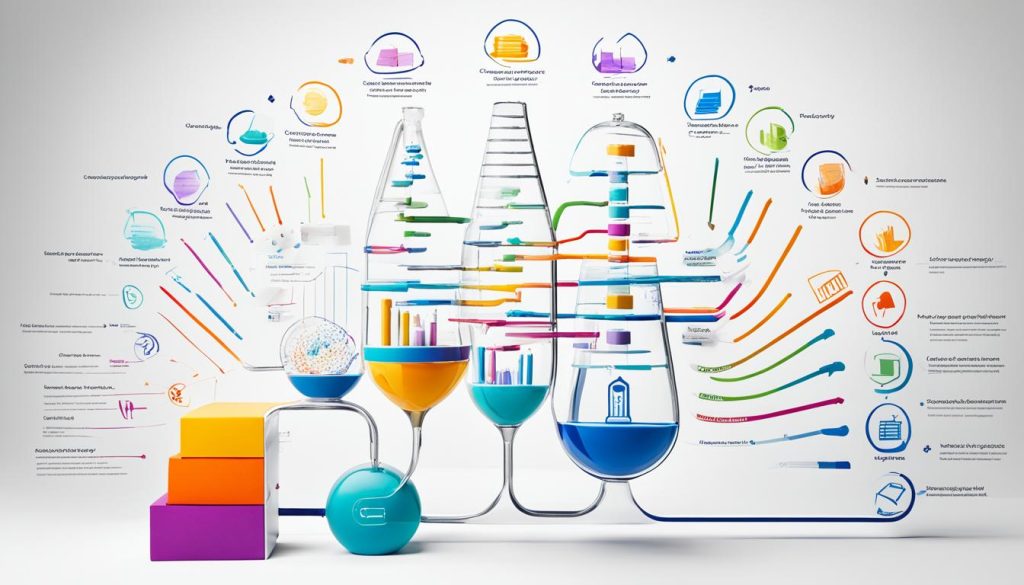
| Product Design Process | Description |
|---|---|
| Research | Deep user empathy, market research, and competitor analysis |
| Problem Definition | Clearly defining the key problems or challenges the product should address |
| Ideation | Brainstorming, concept generation, and creative thinking |
| Prototype Development | Creating tangible prototypes to evaluate functionality and aesthetics |
| Testing | Rigorous evaluation and feedback collection from potential users |
| Manufacture | Translating the refined design into a production-ready product |
Lean Product Design
Lean Product Design is a strategic approach that allows you to bring innovative products to market quickly and efficiently. By focusing on rapid iterations in the pre-coding product development phase, you can iterate and refine your product idea until it achieves the optimal solution.
One of the key principles of Lean Product Design is cross-functional collaboration. By bringing together experts from different disciplines such as design, engineering, and marketing, you can leverage diverse perspectives to create a product that meets user needs and business goals.
Rapid iterations are at the heart of Lean Product Design. Instead of spending months or even years developing a product without external input, Lean Product Design encourages you to get early feedback from users and stakeholders. This iterative process allows you to incorporate user feedback swiftly, making continuous improvements to your product along the way.
One of the main objectives of Lean Product Design is to achieve product-market fit. This means designing a product that perfectly aligns with the needs and preferences of your target market. By embracing rapid iterations and user feedback, you can fine-tune your product to ensure it meets the demands of the market.
“Lean Product Design empowers you to iterate quickly and make informed decisions based on real user feedback. It allows you to build products that people truly want, reducing the risk of investing time and resources in a product that doesn’t meet market demand.”
Implementing Lean Product Design methodologies can help you reduce the time and cost of product development, minimize the risk of failure, and increase the likelihood of creating a successful product. It promotes a culture of continuous learning and improvement, ensuring that your product stays relevant in a rapidly evolving market.
By adopting Lean Product Design principles, you can stay ahead of the competition and deliver innovative solutions that delight your customers. It is a safer and more efficient approach compared to traditional product development methods, allowing you to validate your ideas early and iterate rapidly until you find the winning formula.
With Lean Product Design, you have the tools and mindset to drive innovation, optimize your product designs, and achieve product-market fit.
Conclusion
Product design plays a vital and central role in the success of businesses. By understanding user needs, developing innovative solutions, and ensuring efficient manufacturing processes, product design has a significant impact on the overall quality and appeal of a product. Good design not only enhances the user experience but also attracts more customers, leading to higher revenues and shareholder returns.
In today’s world, sustainable product design is gaining importance, focusing on eco-friendliness and minimizing the environmental impact of products. Additionally, ergonomics plays a crucial role in designing products that fit and operate correctly, enhancing user comfort and usability.
Product designers utilize a range of tools throughout the design process, including computer-aided design (CAD) software, prototyping tools, and user testing platforms. These tools enable designers to bring their ideas to life, test them iteratively, and refine them based on user feedback.
The future of product design holds exciting possibilities. As technology continues to evolve and user behavior changes, product designers must stay updated and continuously learn new techniques and adapt their designs. By embracing emerging technologies and user-centered approaches, product designers can shape the future of design and create products that meet the evolving needs and desires of users.
FAQ
What is product design?
Product design is the process of imagining, conceptualizing, testing, iterating, and refining a product, service, or experience to make it ready for the end user.
Why is product design important for your business?
Good product design has been shown to deliver higher returns to shareholders and higher revenues compared to industry benchmarks. It improves user experience, solves user problems, and creates frictionless experiences leading to higher customer satisfaction and loyalty.
What is the role of a product designer?
Product designers are responsible for overseeing the design stage of the product development lifecycle. They have both creative and technical capabilities and collaborate with various professionals to ensure the product works well for end users.
What is the difference between a product designer and a product manager?
While a product manager owns the product vision and is responsible for the overall product development process, a product designer focuses on making sure the product works well for end users, ensuring functionality and aesthetics.
What is the difference between product design and product development?
Product design focuses on optimizing the function of a product to meet user needs, while product development involves bringing products to market and managing them through the product lifecycle.
How does product design differ from UX design?
While both disciplines involve user empathy and understanding user behavior, product design encompasses aesthetics and business brand alignment, while UX design has a broader theoretical knowledge of human interaction.
What are the steps involved in the product design process?
The product design process involves research, problem definition, ideation, prototype development, testing, and manufacture. Each phase is iterative and reviewed to ensure the project brief is met.
What is Lean Product Design?
Lean Product Design focuses on bringing innovative products to market quickly through rapid iterations in the pre-coding product development phase. It involves cross-functional collaboration, continuous learning, and swift incorporation of user feedback.
How important is sustainable product design?
Sustainable product design focuses on eco-friendliness and is increasingly important in today’s environmentally conscious world. It aims to minimize the negative impact of products on the environment.
What does the future hold for product design?
The future of product design lies in continuous learning and adapting to evolving technology and user behavior. Product designers need to stay updated with the latest tools and techniques to deliver innovative products.