As you navigate the evolving world of industrial production, you’ve likely heard the buzz about robotics in manufacturing. It’s a game-changer, bringing smart manufacturing robots to the forefront of technology, streamlining operations while enhancing quality and productivity. In the United States, companies across sectors are rapidly integrating robotic automation systems as a strategic move to maintain competitiveness within the global marketplace.
Industrial robotics offer an unrivaled precision that traditional labor simply cannot match, addressing not just the need for efficiency but also significantly reducing labor costs. The versatility and adaptability of these systems mean they can be deployed in various stages of manufacturing – from assembly lines to quality assurance checks. This is not just about building robots; it’s about creating a framework for smarter, more responsive production environments.
Key Takeaways
- Robotic automation systems are transforming the way companies across the United States produce goods.
- Adoption of industrial robotics is key to enhancing production quality and boosting overall productivity.
- Smart manufacturing robots reduce labor costs and perform tasks with higher precision and consistency.
- Versatile robotic systems are being used in multiple stages of production, providing comprehensive automation solutions.
- Partnering with experienced integrators is crucial for implementing robotics in manufacturing effectively.
The Emergence of Robotics in Manufacturing
The transformative journey of manufacturing industries through the industrial revolution saw a monumental leap with the introduction of robotics. This seismic shift aimed not merely at enhancing productivity but at restructuring the very essence of automation in production. From the forges of General Motors emerged Unimate, the herald of industrial robotics, propelling factories towards a future where artificial intelligence and mechanical precision coalesce.
Marking an indelible benchmark, the arc of robotics within the manufacturing domain sweeps grandly from Unimate’s initial deployment to present-day marvels of engineering—robots that fuse the robustness of steel with the nuance of artificial intelligence. We have borne witness to not just a timeline but a revolution that has democratized automation, making it indispensable for manufacturers irrespective of scale.
- Metal behemoths tethered to assembly lines have evolved into agile entities, interpreting and acting with a sophistication previously the sole domain of human ingenuity.
- The once unimaginable expertise imparted to automotive welding arms is now paralleled by intricate material handling and meticulous product packaging.
- The span of robotics now extends its reach across every echelon of manufacturing, exquisitely synchronizing with human effort and elevating the calibre of production to unprecedented heights.
Your lineage within the manufacturing fabric, whether a nascent venture or an established titan, is invariably intertwined with the embrace of robotics. It propounds a clarity of purpose, marrying the relentless pursuit of efficiency and cost-reduction with an allegiance to innovation and adaptation—a testament to the enduring legacy of the industrial revolution.
Entrenched in history, robotics’ ascent in the manufacturing realm delineates a narrative of ceaseless advancement. Amidst the clangor of industry, these automatons stand as sentinels, signifiers of a relentless march towards an automated dawn. And this is but the vanguard of a burgeoning symphony, as robotic arms delicately poised and sensors supremely attuned herald the maturation of a new industrial era.
Advancements in Robotic Technology and Vision Systems
Delving into the ever-evolving realm of manufacturing, it’s clear that advanced robotics technology has undergone transformative development, propelling industry capabilities forward. Among these, the precision and efficiency of AC servo motors and robotic vision systems play a pivotal role in enhancing the operation of high-precision industrial robotics.
The Evolution of AC Servo Motors
The transition from hydraulic systems to AC servo motors represents a significant leap in the sophistication of robotics. AC servo motors offer a new dimension of flexibility, matched with precise control over velocity, torque, and positioning. This leap in technology enables the creation of more complex and nuanced robotic systems that can handle tasks with extraordinary accuracy—a testament to the relentless pursuit of perfection in advanced robotics technology.
The Role of Vision Systems in Quality Control
Robotic vision systems have revolutionized the ability of machines to perceive their environment. Equipped with high-tech sensors like laser scanners, these systems grant robots the capability to “see”. This function is critical in quality control processes, where precision is paramount. Such robotics can select components with exceptional accuracy and execute quality inspections down to the minutest detail, often outperforming human abilities in terms of both speed and reliability.
From Hydraulic to High-Precision Robotics
Long gone are the days when hydraulic systems were the backbone of industrial robotics. Today, the synthesis of AC servo motors and ingenious vision systems has given rise to a new era of high-precision industrial robotics. These advanced machines perform with an agility and intelligence that embody the pinnacle of modern manufacturing, executing intricate production sequences that were unimaginable in the past. The results are clear: smarter, faster, and more reliable outcomes across all facets of production.
For those on the cusp of integrating these technological marvels, the journey toward enhanced manufacturing processes begins with a single, yet significant step towards automation. With the insights and technologies at hand, your operations are set to transform, marking a substantial upturn in productivity and quality.
Robotic Automation Systems and The Internet of Things
The fusion of robotic automation systems with IoT in manufacturing marks a revolutionary step in how factories operate, exemplifying the cutting-edge of Industry 4.0. This convergence facilitates a cohesive manufacturing ecosystem where every device and robot is interlinked, offering unrivaled oversight and capabilities for real-time monitoring and data integration. It’s where the physical precision of robotics meets the digital intelligence of IoT to create a synchronized manufacturing dance.

Connecting Manufacturing Operations with IoT
Imagine a factory floor where machines speak to each other, data flows like electricity, and each element exists in harmonious digital symmetry. That’s the power of IoT in the world of manufacturing. It enables robotic automation systems to communicate, adjust, and perform autonomously, allowing for more sophisticated control and efficiency. These connections make it possible to orchestrate entire supply chains with the finesse of a maestro and the analytics to back every decision.
Data Integration and Real-Time Monitoring
The ability to integrate data seamlessly across various manufacturing platforms ensures an unobstructed view of operations. It empowers you to detect inconsistencies in real-time, preemptively maintain equipment, and streamline your production line for optimal performance. With advanced algorithms at the helm, data from multiple sources is synthesized into actionable intelligence, facilitating timely decisions that keep production humming and businesses thriving.
Data integration and real-time monitoring converge to not only enhance operational efficiency but also to fortify the manufacturing process against unforeseen challenges. Through IoT, robotic automation systems become more than just tools; they transform into predictive analytics partners that safeguard the heartbeat of your manufacturing processes.
Intelligent Automation through AI in Manufacturing
The advent of AI in manufacturing has engendered a new era of intelligent automation, where manufacturing processes are not only automated but also empowered with the ability to learn and improve. This integration of learning algorithms into robotics is shaping robotics industry trends, carving a path for an innovative future in manufacturing.
As AI continues to evolve, robotics in manufacturing beat traditional performance measures by responding to adaptive learning cues with unprecedented speed. These smart systems demonstrate the capacity for independent operational adjustments, making real-time improvements without extensive human intervention.
Key Features of AI-Driven Robots in Manufacturing:
- Enhanced data analysis for predictive and preventive maintenance
- Capable of learning from minimal data to optimize production processes
- Flexibility to adapt and switch between diverse tasks with little downtime
This leap forward marks a significant stride in efficiency and productivity. For you, this means that preparing for and embracing intelligent automation is no longer a choice but a necessity to remain competitive.
| Traditional Automation | AI-Enhanced Intelligent Automation |
|---|---|
| Fixed programming for specific tasks | Adaptive programming with learning capabilities |
| Manual intervention for changes | Autonomous adjustment and evolution |
| Isolated systems | Integrated systems with cohesive data flow |
| Limited to repetitive tasks | Flexible to varied, nuanced operations |
| Scheduled maintenance | Predictive and proactive maintenance |
| Consistent quality | Continuous quality improvement |
The transformative influence of artificial intelligence in manufacturing spawns an ecosystem rich with intelligent robots that are not just labor substitutes but strategic enhancers. These machines—programmed with learning algorithms—work alongside human employees, expanding the scope of automated tasks and delivering a dynamic contribution to the day-to-day operations.
Your engagement with intelligent automation will not only redefine your production lines but also serve as the driving force for innovation, sustainability, and growth in an ever-changing industrial landscape.
Collaborative Robots Transforming the Workspace
The manufacturing sector has entered a new phase of efficiency and productivity with the advent of collaborative robots, commonly known as co-bots. These innovative robots have revolutionized the traditional factory floor, carving out a niche where human-robot collaboration is not just possible, but actively encouraged and designed for.
Unlike their larger, isolated predecessors, co-bots are built to coexist with human workers, often working alongside them to perform a variety of tasks that range from the mundane to the complex. Their integration into production lines reflects a profound shift in how manufacturing jobs are viewed and executed, offering a flexible tool that not only enhances smart manufacturing robots processes but also promotes a safer and more dynamic workplace environment.
- By taking on repetitive tasks, co-bots free up human workers to concentrate on areas that require a distinctively human touch—problem-solving, quality control, and innovation.
- With less intensive programming needs compared to traditional robots, co-bots are user-friendly, remaining accessible to workers lacking specialized training.
- Reconfiguration and adaptation to new processes are achieved with ease, vastly reducing downtime and enabling a more agile response to market changes.
These synergistic partnerships between workers and robots not only bolster efficiency but also pave the way for greater job satisfaction. Workers can engage in more meaningful and rewarding aspects of their roles, confident in the knowledge that co-bots handle the tedium with unerring accuracy and consistency.
| Benefit | Impact on Workspace |
|---|---|
| Human-Robot Collaboration | Increases safety, fosters teamwork between human and machine. |
| Labor Efficiency | Optimizes workforce, reallocating human resources to strategic tasks. |
| Mundane Task Handling | Improves focus on higher-level tasks, boosts overall productivity. |
| Seamless Integration | Co-bots easily adapt to existing workflows, minimizing transition periods. |
| Dynamic Interaction | Co-bots respond and adapt in real-time to human actions and needs. |
In essence, the role of collaborative robots in today’s manufacturing landscape cannot be overstated. They serve as a catalyst for innovation and a beacon for the advanced capabilities that Industry 4.0 promises. As businesses continue to adapt to the demands of a competitive global market, co-bots stand ready to elevate the human workforce, ushering in a new era of prosperity and technological harmony within the manufacturing domain.
Industrial Robotics: Applications and Flexibility
In today’s competitive market, the integration of industrial robotics applications into production processes offers unparalleled efficiency and a high degree of quality control. Manufacturing plants around the country have seen transformative changes, thanks in no small part to robotic automation.
Automating Repetitive Tasks for Consistency
When it comes to precision and steadfast consistency, nothing surpasses repetitive tasks automation. By embedding industrial robotics into the core of manufacturing systems, tasks such as material handling, pick-and-place activities, and the precise art of welding are carried out with unwavering accuracy. This level of automation not only ensures that each product meets high-quality standards but also significantly ramps up the speed of output. By streamlining these processes, robotics help in negating human errors and in enhancing the overall efficiency of production lines.
Adaptive Robotics for Tailored Manufacturing Needs
As the demands of custom manufacture grow, so does the role of adaptive robotic automation. These sophisticated systems provide a layer of flexibility to manufacturing that was once thought unattainable. Equipped with the latest in flexible manufacturing systems, robotic apparatus adjust to a variety of components and tasks with minimal reconfiguration time, making them essential for operations necessitating versatility and agility. Furthermore, the integration of remote monitoring and programmability adds heightened convenience, ensuring changes can be made swiftly and effectively, regardless of location.
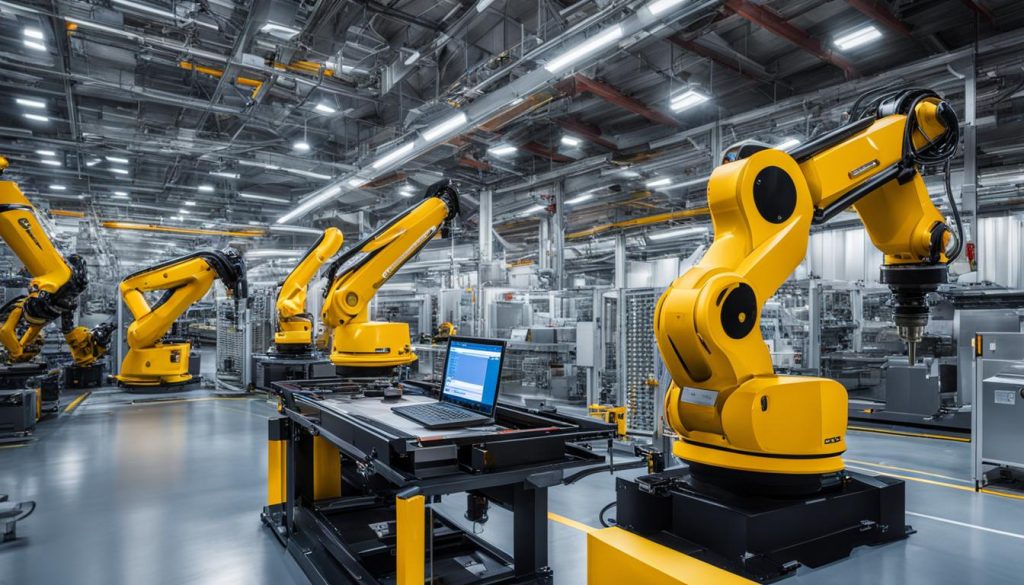
Robots are no longer just part of a production line; they are at the heart of a flexible and adaptive system designed to meet the complex manufacturing challenges of today and beyond. Their capabilities in handling a diverse array of tasks with precision make them indispensable tools for businesses seeking to maintain an edge in a fast-moving market.
- Material handling: Speedy and precise transfer and organizing of materials.
- Pick-and-place: Consistently placing items, boosting throughput and lowering cycle times.
- Welding and dispensing: High-quality, repeatable results that surpass manual efforts in speed and reliability.
Leverage the might of robotic automation and redefine your production scale and scope with systems that promise to raise the bar in quality and efficiency.
Cost-effectiveness and ROI of Manufacturing Robotics
As you delve into the realm of modern manufacturing, an area that cannot be overlooked is the cost effectiveness of robotics investment. These technological marvels have paved the way for drastic improvements in manufacturing productivity, becoming essential assets in factories across the United States. The initial investment in manufacturing robotics, while significant, has proven to yield substantial benefits, laying the groundwork for a high ROI (Return on Investment).
The measurable advantages of integrating robotics into production lines include boosted efficiency and the minimization of errors, which together contribute to a notable increase in product quality. Over time, these factors culminate in a decrease in production costs, directly reflecting the cost-effectiveness of this investment. The benefits are indeed multi-tiered, as robotic systems enhance nearly every aspect of operations.
Yet, the benefits extend beyond mere production metrics. Robotics notably curtails labor-related expenses by reducing the potential of unplanned downtime. Robotics operate continuously and unimpeded by human constraints such as fatigue, thus offering around-the-clock productivity without the need for overtime compensation or shift changes.
Smaller, more flexible robots—once thought to be the purview of large corporations with deep pockets—are now accessible to businesses of varied sizes. This democratization of technology brings scalability to the table, allowing companies to align their robotics investment closely with fluctuating production demands. Current market availability provides a selection of robots that align with a comprehensive array of applications, minimizing the barrier to adoption for entities looking to navigate through competitive markets confidently.
- Scalability: Adaptable robotic solutions scale with your business growth.
- Adaptability: Quick reconfiguration to new tasks equals reduced downtime.
- Consistency: Steady throughput ensures product quality and customer satisfaction.
- Reduction in Labor Costs: Robots offer a reduction in overall labor expenditures.
Manufacturers, upon embracing robotics, find that they are not merely investing in new machinery but are revamping their entire production ethos. Here lies the beauty of robotics in manufacturing: the machines tirelessly work toward your production goals while also offering insights critical to strategic decision-making. The coupling of automation with intensive data capture provides valuable analytics used for improving operational efficacy and planning for future production endeavors. This underscores a crucial element of why robotics investment is a cost-effective strategy—it not only augments your present capabilities but also equips you for future market challenges.
Your engagement with the realm of robotics signifies a commitment to not just maintain the status quo but to boldly ascend in operational excellence. Consider the prosperous future mapped out by the wise investment in robotics, where enhanced productivity and unwavering quality underpin your mission, securing a steadfast position in the manufacturing landscape.
Robotics Integration into Manufacturing Processes
The pathway to a streamlined and efficient manufacturing facility is increasingly paved by the strategic adoption of robotic integration. As business owners and plant managers, you are tasked with aligning the latest in robotic technologies with your unique production needs—a challenge deftly met by robotics integrators. These specialists provide the crucial expertise needed to ensure your investment in robotics strengthens your company’s operational effectiveness, uptime, and product quality.
Understanding the Value of Robotics Integrators
Embarking on the journey of robotic integration without seasoned guidance is akin to setting sail without a compass. Robotics integrators act as your navigational aides, selecting and customizing automation solutions that bolster your process efficiency and production capacity. With their deep knowledge of both hardware and software components, these integrators play a pivotal role in tailoring systems that fit seamlessly into your manufacturing workflow, enhancing every facet of the process.
Customization vs. Standardization in Robotics
Finding the balance between customization in robotics and the efficiencies of standardization lies at the heart of manufacturing process improvement. While customization allows robotics systems to be finely tuned to specific tasks, standardization can expedite integration and simplify operations, particularly in high volume environments. Your decision to customize or standardize will influence not only the robotics system’s cost and complexity but also its flexibility and scalability—crucial elements for long-term success.
| Customization | Standardization |
|---|---|
| Tailored systems optimized for specific processes | Uniform systems for broad application and ease of integration |
| Ideal for unique, complex tasks | Best suited for repetitive, high-volume tasks |
| Requires detailed planning and investment | Cost-effective with quicker deployment times |
| Highly adaptive to evolving production needs | May have limitations in adapting to new processes |
| Facilitates niche competitive advantages | Enhances overall operational efficiency |
Deciding between a customized or standardized robotic system is not simply a choice but a strategic consideration that affects every level of your manufacturing operations. By working with robot integrators, you can demystify the complexities surrounding robotic integration and confidently invest in the right technologies to refine your production lines—securing a competitive edge in today’s rapidly evolving industrial landscape.
Challenges and Solutions in Robotic Automation
Embarking on the journey of robotic automation brings forth its unique set of challenges. As you consider integrating automation solutions within your manufacturing processes, it’s crucial to acknowledge and address the initial costs, the complexity of programming, and the need to mesh these automated systems with existing legacy systems. Yet, despite these hurdles, the adoption of smart manufacturing strategies is not just a leap towards greater efficiency but also a step into the future of industrial prowess.
Advancements in user-friendly programming interfaces have alleviated some of the traditional challenges in robotic automation. Such intuitive controls have democratized the use of robotics, allowing for a scalable approach aligned with your business’s growth trajectory. The once daunting task of programming is now more accessible, fostering a smoother integration and facilitating a wider adoption.
Moreover, the implementation of robotic technologies carves out new job opportunities — crucial roles such as machine maintenance, systems engineering, and data analysis. By enriching the labor market with these indispensable skills, robotics contributes positively not only to your company’s operational success but also to the vibrancy of the local workforce.
- Initial Cost: Considered a barrier yet necessary for long-term gains.
- Complexity of Programming: Simplified through advanced software.
- Integration: Seamlessly blends with current systems, enhancing productivity.
- New Job Creation: Broadens the job market with tech-savvy positions.
- Scalable Solutions: Grow with your business, providing long-term value.
- Local Community Impact: Contributes to socio-economic development.
| Challenge | Solution | Outcome |
|---|---|---|
| High Initial Investment | Strategic Financial Planning | Long-Term ROI and Cost Savings |
| Technical Complexity | Intuitive Programming Systems | Lowered Barrier to Entry |
| System Integration | Streamlined Implementation | Enhanced Production Synergy |
| Workforce Displacement | Creation of Specialized Roles | New Opportunities and Growth |
As you venture deeper into the open sea of automation solutions, weigh the value of your investment against these formidable barriers. With a clear understanding of the challenges and the solutions provided by cutting-edge smart manufacturing strategies, robotic automation extends beyond mere machinery; it becomes an integral component of your overarching vision for innovation and progress.
The Impact of Robotics on Manufacturing Workforce
As automation technologies advance, the workforce impact in the manufacturing sector is profound, shaping a new landscape in which job roles and skills are evolving. With the implementation of industrial robotics, new paradigms in manufacturing jobs creation are emerging, pushing the envelope for what it means to work alongside intelligent machines.
Job Creation Beyond the Production Line
Robotic automation goes beyond refining production efficiency—it spawns a wide array of professional opportunities across various domains. These range from specialized roles in programming and engineering to system operation and data analytics. This workforce transformation generates manufacturing jobs creation, presenting sectors traditionally focused on manual labor with a diversified palette of career paths. Consequently, as robotics seamlessly integrate into the fabric of manufacturing, they cultivate a demand for a workforce that is equipped to navigate a high-tech environment.
Enhancing Workforce Skills Through Robotics
By adopting robotic systems, manufacturing facilities do more than just automate tasks; they create avenues for skill enhancement among their employees. Handling routine duties with pneumatic precision, robots liberate the human workforce to redirect their efforts towards more sophisticated aspects of production. Robotic workforce training becomes pivotal, nurturing an environment where workers can thrive, learn, and augment their skill sets. This strategic upskilling not only fuels job satisfaction but also fortifies the manufacturing industry’s overall resilience and adaptability in the face of constant technological upheaval.
FAQ
What are the main benefits of using robotics in manufacturing?
The benefits include increased productivity, improved quality, efficiency, and precision in production processes. Robotics also reduce labor expenses and enhance safety by conducting repetitive and potentially hazardous tasks.
How did the industrial revolution impact the development of robotics in manufacturing?
The industrial revolution kickstarted the integration of automation into manufacturing, leading to the development of the first industrial robots. This evolution has continued, with advancements in robotics technology playing a critical role in modern manufacturing.
What advancements in robotic technology have been most influential in manufacturing?
Key advancements include the development of AC servo motors for better control, implementation of robotic vision systems for precision in quality control, and the transformation from hydraulic to more accurate and flexible robotic systems.
How does the Internet of Things (IoT) enhance robotic automation systems in manufacturing?
IoT connects robotic systems to the internet, enabling data integration and real-time monitoring across the manufacturing process. This allows for more effective decision-making, predictive maintenance, and streamlined operations.
What role does AI play in the advancement of intelligent automation in manufacturing?
AI enhances the capabilities of robots by enabling them to learn from experience, perform complex tasks with greater autonomy, work alongside human employees, and contribute to preventative maintenance and quality control.
How are collaborative robots (co-bots) transforming manufacturing workspaces?
Co-bots are designed to work safely alongside human employees, taking on repetitive tasks and allowing the workforce to focus on more strategic, fulfilling activities. They bring increased flexibility and efficiency to production lines.
What are some applications of industrial robotics in manufacturing?
Applications include material handling, pick-and-place tasks, dispensing, welding, precision assembly, and quality inspection. Industrial robots can perform these tasks with a high degree of consistency and speed.
How cost-effective is the investment in manufacturing robotics?
The investment in manufacturing robotics delivers a high return on investment by increasing efficiency and quality while reducing labor costs. It can be a cost-effective solution even for small businesses due to the scalability of robots.
Why is robotics integration a strategic step in manufacturing processes?
Robotics integration requires careful planning and expert input to ensure that automation solutions align with a company’s specific production needs, quality standards, and efficiency goals. It can lead to significant improvements in productivity and product quality.
What challenges are associated with robotic automation, and how are they being addressed?
Challenges include the initial cost, complexity of programming, and integration with existing systems. However, advancements have led to more user-friendly interfaces, better training, and modular designs that accommodate growth and facilitate integration.
How does the rise of robotics affect manufacturing jobs and workforce skills?
Robotics creates new job roles in programming, maintenance, and analytics. It also allows workers to move away from mundane tasks and upskill to more advanced roles, enhancing job satisfaction and overall workforce capabilities.