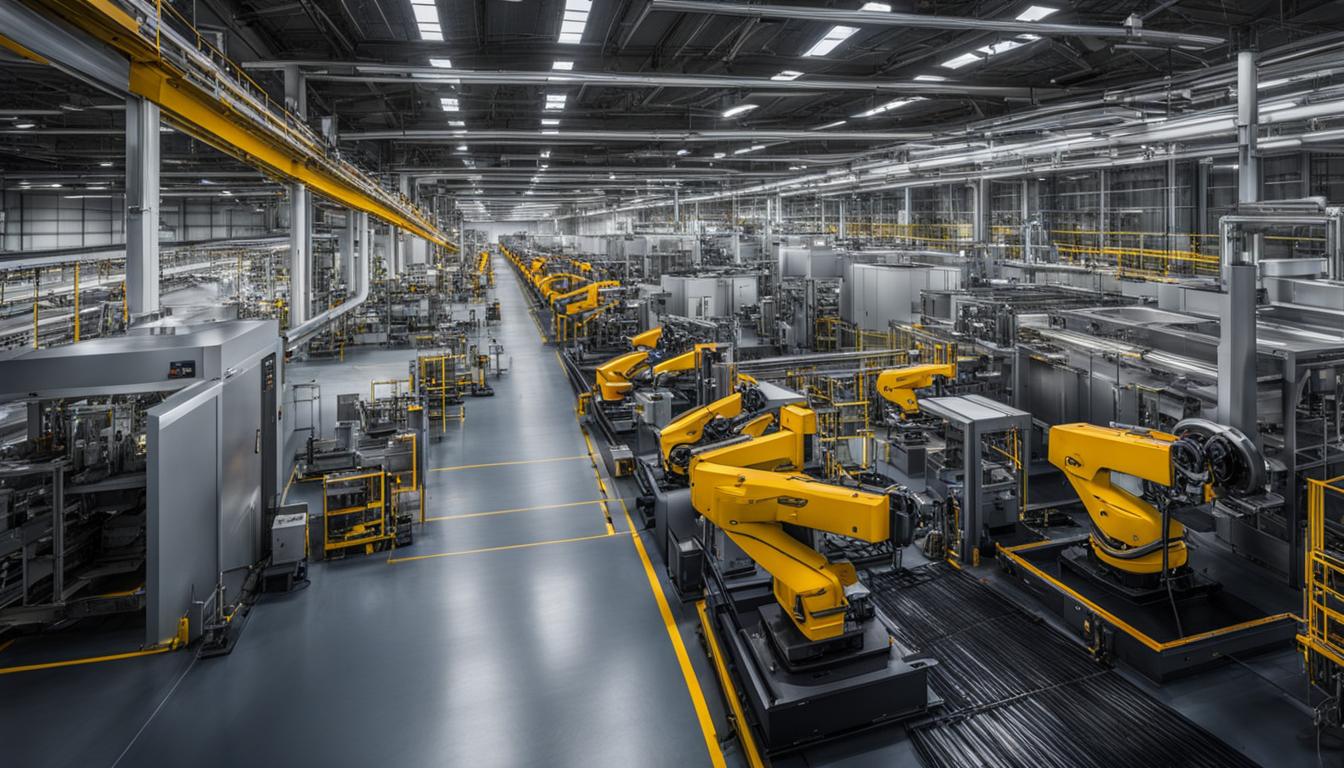
Welcome to the remarkable realm of the manufacturing and production industry, where the synergy of manufacturing technology, production processes, industrial automation, and supply chain management converge to create the products that define our everyday lives. As you navigate this sector, you’ll encounter intricate systems and sophisticated equipment designed to enhance efficiency and boost productivity.
Whether you’re a seasoned industry expert or a newcomer curious about how products come to be, you’ll discover that modern manufacturing is a far cry from its humble beginnings. With advancements in technology paving the way, today’s manufacturers are equipped with tools that transform raw materials into coveted goods with precision and speed.
Your awareness of the complexities and subtleties of this field can empower you to make informed decisions and identify opportunities for innovation. Stay with us as we delve deeper into the interconnected world of industry and technology.
Key Takeaways
- Understanding the intricate nexus of manufacturing technology and production processes is crucial.
- Industrial automation is revolutionizing factory floors, enabling businesses to soar to new efficiencies.
- Stellar supply chain management strategies are indispensable for peak industrial performance.
- Grasping the evolution of manufacturing methods can provide a competitive edge in the market.
- Adapting to dynamic manufacturing and production trends is key for future industry leadership.
- Implementing the latest manufacturing technologies can yield significant economic and quality benefits.
Understanding the Fundamentals of Manufacturing Production
The core of factory operations lies in understanding the concept of manufacturing production. This understanding is the cornerstone that supports the myriad of production processes necessary to turn raw materials into finished goods. In this exploration, encapsulating quality control practices and lean manufacturing principles, you will gain insight into how integral these concepts are for maintaining efficiency and optimizing output in the competitive market today.
What Exactly is Manufacturing Production?
Manufacturing production is the lifeblood of the industrial sector, encompassing a broad array of strategies and techniques aimed at efficiently creating and assembling products. Beyond mere assembly, it involves meticulous planning, sophisticated technology, and consistent execution of tasks to ensure that what reaches the consumer is of the highest quality.
The Role of Different Production Processes
Within the sphere of manufacturing, multiple production strategies are employed, each tailored to specific market demands and operational capabilities. These strategies include:
- Make to Stock (MTS): Orchestrating production based on demand forecasts, where goods are created and stored in anticipation of consumer needs.
- Make to Order (MTO): Initiating production solely upon confirmation of customer orders, catering to customization with the trade-off of longer wait times.
- Make to Assemble (MTA): Combining elements of MTS and MTO by stocking base parts to expedite assembly post order receipt, fostering a more responsive manufacturing process.
Impact of Variables on Manufacturing Production
Several dynamic variables can significantly influence manufacturing production. From the fluctuating costs of labor to the ebb and flow of marketplace demand, understanding these variables and their interplay is crucial in navigating the world of manufacturing. Chief among these are inventory management strategies such as Just-In-Time (JIT), which focuses on the delivery of components only as they are needed in the production process, significantly reducing unnecessary inventory costs.
| Strategy | Labor Costs | Inventory Control | Overhead | Customization | Production Speed |
|---|---|---|---|---|---|
| Make to Stock (MTS) | Variable | High | Dependent on forecasting accuracy | Low | Quick |
| Make to Order (MTO) | Higher due to customization | Improved | Variable | High | Dependent on order complexity |
| Make to Assemble (MTA) | Moderate | Moderate | Reduced with precise forecasting | Moderate to High | Rapid post-order |
In sum, the chosen production strategy plays a defining role in the performance of factory operations. By aligning the right processes with the demands of the market and the internal capabilities of the enterprise, firms can build a resilient foundation for their manufacturing activities. Embrace these fundamentals, and you elevate your understanding of the manufacturing production to new heights.
Insight into Manufacturing and Production Strategies
As you delve into the world of industrial engineering, understanding the spectrum of manufacturing and production strategies becomes essential to optimizing production processes. These frameworks are not merely about managing costs but about creating a harmonious flow within production lines. Let’s dissect the prevalent strategies that dictate the rhythm of manufacturing within various industries.
Make to Stock (MTS) is a classic strategy well-suited for products with consistent demand. By forecasting consumer needs, supply chain management is poised to match inventory, minimizing shortages and overproduction. The pitfall, however, lies in the forecasting itself—get it wrong, and you face excess inventory or missed sales.
The Make to Order (MTO) strategy shifts focus to the customer’s unique desires. Products begin their journey to creation only once the order is placed, paving the way for personalization and reduced inventory costs. Though advantageous, customer patience is tested as customization extends production time.
Combining elements from both MTS and MTO, Make to Assemble (MTA) keeps basic components at the ready, springing into action when an order arrives. This approach balances the need for rapid turnaround with the customization today’s consumers crave, epitomizing the agility in modern lean manufacturing practices.
But when inventory accuracy and waste reduction become paramount, just-in-time inventory systems steal the spotlight. These special strategies hinge on meticulous scheduling and robust electronic inventory systems—synchronize these elements, and you’ll watch inventory-related costs dwindle.
| Strategy | Inventory Accuracy | Customization Level | Customer Wait Time | Cost Management |
|---|---|---|---|---|
| Make to Stock (MTS) | Depends on accurate forecasting | Standardized products | Minimum | Can be cost-effective with precise demand predictions |
| Make to Order (MTO) | High | High customization | Increased due to production lead time | Saves on excess inventory costs |
| Make to Assemble (MTA) | Optimized for rapid assembly | Customizable final product | Shortened post-order | Efficient use of base parts reduces waste |
Indeed, your grasp of these strategies propels your capability to streamline industrial processes. Whether it’s managing a lean supply chain or innovating production methods, each strategy demands careful consideration to blend production processes, supply chain management, and customer satisfaction into a seamless, profitable enterprise. Embrace these principles, and you’re on course to command the industrial engineering battleground with expertise.
The Evolution of Manufacturing Technology
The manufacturing landscape has evolved dramatically from the days of handcrafted goods to an era where industrial automation is deeply integrated into factory operations. This transformation has brought about a significant uptick in production capabilities and has become the backbone of modern manufacturing technology. Today, as you wander through the heart of any modern factory, you bear witness to the striking symphony of machinery and computing power, all working in unison to deliver products with unprecedented efficiency and reliability.
From Hand Production to Advanced Machinery
Reflect for a moment on the profound shift that has occurred within the manufacturing industry. Where once human hands were the primary tools of creation, now advanced machinery and innovative technologies have taken the helm, steering the production process towards greater heights. The utilization of cutting-edge equipment allows for the mass production of goods with precision that manual efforts could never achieve, hence, revolutionizing the concept of lean manufacturing.
Incorporating Automation in Factories
The advent of industrial automation has not just reshaped the way we think about large-scale production; it has redefined it. Robots and automated systems now carry out tasks that were once the purview of human labor, from the sorting of components to the assembly of complex electronics. This shift doesn’t just signify an increase in speed and productivity; it heralds a new era of consistency and quality that is now the benchmark of modern manufacturing technology.
The principles of lean manufacturing have further propelled factories to seek methods that minimize waste and optimize every aspect of their operations. Automation plays a pivotal role in this quest, enabling businesses to adapt swiftly to changes in demand without the lag that traditional labor might incur. It’s clear that as factory operations continue to smarten up with technology, the manufacturing sector stands on the cusp of an ever brighter, more efficient future.
Supply Chain Management in the Manufacturing Arena
As you delve into the manufacturing industry, you’ll quickly discover that supply chain management is the backbone that supports streamlined production cycles. The sophistication of today’s production processes calls for an agile and efficient supply chain that not only handles the procurement of raw materials but also seamlessly orchestrates the distribution of finished products. From the concept phase to delivery, every step is a testament to precision planning and execution.
Advancements in manufacturing technology have transformed traditional supply routes into dynamic networks capable of adapting to rapid market changes. The role of industrial automation within these networks is critical; it enhances real-time inventory tracking, quality control, and ensures that raw materials turn into finished goods with a lower margin for error. And as your production facilities continue to embrace these technologies, they remain integral components in maintaining current and future market relevancy.
Your engagement with supply chain management in the manufacturing realm extends beyond overseeing logistics. It is about nurturing relationships with a host of partners, suppliers, and distributors, ensuring every link in the supply chain is robust and reliable. Such strategic alliances are essential for the timely delivery of components necessary to keep your production processes running at peak efficiency. A well-managed supply chain sharpens your competitive edge and prepares you for the evolving demands of a globalized marketplace.
FAQ
What is the manufacturing and production industry?
The manufacturing and production industry encompasses various strategies, methodologies, and activities necessary to create and assemble products for sale. It involves coordination of multiple factors, including raw material availability, demand, labor costs, inventory costs, and the operation of human and machine labor, as well as biological and chemical processes, to transform raw materials into finished goods ready for the market. The industry leverages manufacturing technology, production processes, and industrial automation, in tandem with effective supply chain management, to ensure efficiency and productivity in creating goods.
What Exactly is Manufacturing Production?
Manufacturing production refers to the strategies and techniques employed to efficiently produce and assemble goods that are intended for sale. This involves various production processes, with an emphasis on balancing critical variables such as market demand, labor costs, and inventory management, to maximize efficiency, profitability, and maintain high-quality standards.
How do different production processes impact factory operations?
Production processes impact factory operations by determining the workflow, layout, and machinery required to produce goods. They influence everything from the speed and volume of production to the need for skilled labor and quality control practices. Adopting lean manufacturing techniques can streamline operations and reduce waste, while integrating advanced production processes often leads to increased efficiency and precision in manufacturing.
What variables significantly impact manufacturing production?
Significant variables that impact manufacturing production include marketplace demand, labor costs, raw materials supply, inventory levels, production capacity, and technological advancements. Each of these factors can influence decision-making regarding production planning, cost management, and the choice of manufacturing strategies.
What insights can be gained by understanding manufacturing and production strategies?
By understanding manufacturing and production strategies, insights can be gained on how businesses can achieve optimal production efficiency, manage costs, and respond effectively to customer demands. Strategies such as Make to Stock, Make to Order, and Make to Assemble, as well as inventory management approaches like just-in-time, allow companies to tailor their production processes to meet specific market needs while employing lean manufacturing principles and strong supply chain management.
How has the evolution from hand production methods to advanced machinery affected the industry?
The shift from hand production methods to the use of advanced machinery has drastically transformed the manufacturing industry by increasing productivity, enhancing precision, and allowing for complex production tasks to be completed with greater consistency. This evolution has facilitated the development of new industrial engineering techniques and the efficient scale-up of production operations.
Why is incorporating automation in factories significant?
Incorporating automation in factories is significant because it enables manufacturers to lower labor costs, increase production speeds, and maintain consistent quality in their products. Automation also supports lean manufacturing practices by reducing the potential for error and waste, and it can adapt quickly to changes in production requirements, making factory operations more adaptable and resilient.
What role does supply chain management play within the manufacturing industry?
Supply chain management plays a crucial role within the manufacturing industry by ensuring a smooth flow of raw materials to the production line and finished goods to the market. It involves optimizing procurement, production scheduling, inventory management, and distribution, all of which are integral to maintaining effective manufacturing operations and meeting customer demands on time. Effective supply chain management is supported by industrial automation and advanced manufacturing technology which aids in streamlining the entire process, from raw material acquisition to product delivery.