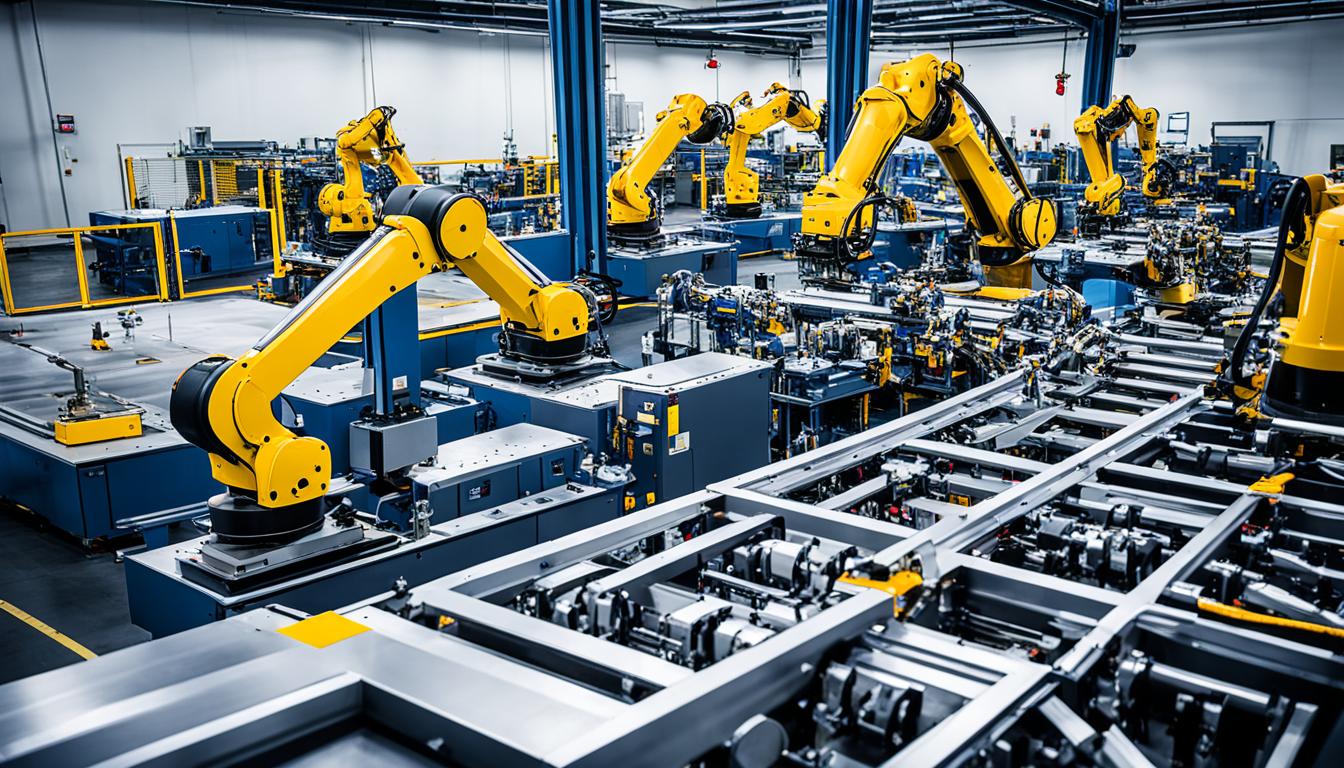
Did you know that U.S. manufacturing employment has dropped from around 14 percent of the workforce in 1996 to almost 8 percent now? The manufacturing industry has undergone significant changes due to technological advancements, particularly automation and robotics. This digital transformation has reshaped the workforce, leading to both disruption and opportunity.
Key Takeaways:
- Technology has significantly impacted manufacturing jobs, leading to changes in employment patterns.
- The rise of automation and robotics has increased productivity but not necessarily resulted in a significant increase in manufacturing jobs.
- There is a growing need for workers with STEM skills as the nature of manufacturing jobs evolves.
- The policy challenges for manufacturing require investment in infrastructure, tax reform, and promoting trade and globalization.
- Technological advancements in manufacturing have improved product quality, supply chain optimization, and workforce transformation.
The Rise of Automation and Robotics
Automation and robotics have revolutionized various sectors, including manufacturing. From restaurants utilizing robots for food delivery to self-ordering kiosks, technological advancements have reshaped the workforce. In manufacturing, the increasing presence of automation and robotics has led to significant changes in production processes.
The number of industrial robots has been steadily rising, with estimates projecting it to reach 1.9 million by next year. These robots are becoming more sophisticated and cost-effective, enhancing productivity and efficiency. Advanced robotic systems enable precise and repetitive tasks to be performed with accuracy and speed, freeing human workers to focus on more complex and creative endeavors.
However, it is important to note that while automation and robotics have improved manufacturing processes, they have not necessarily resulted in a significant increase in manufacturing jobs. These technological advancements have led to workforce disruption and job displacement, as machines replace certain routine tasks previously performed by human workers.
“The introduction of new technologies and automation in manufacturing has undoubtedly streamlined operations and increased productivity. However, it is crucial to assess the impact on the workforce and ensure that measures are in place to address potential job displacement and provide new opportunities for growth and upskilling.” – John Smith, Manufacturing Expert
This shift towards greater automation and robotics highlights the need for workforce adaptation and development. To thrive in this evolving landscape, workers need to acquire the necessary skills and knowledge to work alongside advanced technologies. Upskilling and reskilling efforts are crucial in equipping individuals with the capabilities to operate and maintain automated systems, ensuring a seamless integration of humans and machines in manufacturing processes.
The Benefits of Automation and Robotics in Manufacturing
While the rise of automation and robotics presents challenges, it is important to acknowledge the significant benefits they bring to the manufacturing industry:
- Increased productivity: Automation and robotics enable faster and more efficient production processes, leading to higher output levels.
- Enhanced precision and quality: Automated systems can perform tasks with greater accuracy, resulting in higher product quality and consistency.
- Improved safety: Robots can handle dangerous or repetitive tasks, reducing the risk of workplace accidents and injuries.
- Cost savings: By streamlining processes and reducing human labor requirements, businesses can potentially lower production costs and improve profitability.
Embracing automation and robotics in manufacturing has the potential to revolutionize the industry, driving innovation, and enabling companies to stay competitive in a global marketplace. However, a comprehensive approach that considers the implications for the workforce is essential to ensure a smooth transition and maximize the benefits these technologies offer.
The Slow Growth of Manufacturing Jobs
Despite the advancements in technology, the manufacturing sector has experienced a sluggish growth in jobs. From 2010 to 2016, the increase in manufacturing employment has only been between 2 to 5 percent. This slow growth has far-reaching implications for employment patterns and the overall workforce.
Economists predict that if current trends continue, a significant portion of middle-aged men could face job displacement within a generation. This worrisome trend has already resulted in political and social consequences, as evidenced by the 2016 elections. Additionally, manufacturing jobs are projected to decrease further by 2022, posing challenges for the industry.
Job displacement, coupled with the advent of Industry 4.0, has significantly transformed the labor market in manufacturing. As automation and technology continue to evolve, traditional manufacturing jobs are being replaced by more cost-effective and efficient alternatives.
“The advent of Industry 4.0 has disrupted the manufacturing sector, leading to job displacement and workforce challenges.”
As we delve deeper into the era of Industry 4.0, it becomes imperative to address the slow growth of manufacturing jobs and its impact on the workforce. It is crucial to find innovative solutions that balance technological advancements with the creation of new employment opportunities. Upskilling and reskilling efforts can equip workers with the necessary skills to adapt to the changing landscape of manufacturing.
The Need for STEM Skills
As the manufacturing industry experiences a decline in job opportunities, the demand for workers with STEM skills is on the rise. Future job projections indicate that most job creation will come from the health care and professional services sectors. To meet this evolving demand, schools need to update their curricula and provide better training in science, technology, engineering, and math.
STEM skills are crucial in adapting to the workforce changes driven by technological advancements in manufacturing. With automation and robotics becoming increasingly prevalent, workers need to possess the knowledge and expertise to operate and maintain these technologies effectively.
By equipping students with STEM skills, educational institutions can prepare them to fill the gaps in the job market and meet the demands of the evolving manufacturing landscape. STEM education plays a vital role in developing a highly skilled and qualified workforce capable of driving innovation, productivity, and growth in the industry.
Furthermore, STEM skills are not limited to the manufacturing sector alone. They are highly sought-after in various industries, including engineering, information technology, healthcare, and research. By fostering STEM education, schools can empower students with the necessary skills for a wide range of career opportunities.
“By equipping students with STEM skills, educational institutions can prepare them to fill the gaps in the job market and meet the demands of the evolving manufacturing landscape.”
Investing in STEM education is not only beneficial for individuals but also for the overall economic growth of a nation. A workforce with strong STEM skills can drive innovation, boost competitiveness, and attract investments in research and development.
In conclusion, with the declining number of manufacturing jobs, the need for workers with STEM skills is becoming increasingly critical. Schools and educational institutions must prioritize STEM education to bridge the skills gap and ensure a well-prepared workforce capable of meeting the demands of the ever-changing manufacturing industry.
Policy Challenges for Manufacturing
In order for the manufacturing industry to thrive and stay competitive in the evolving landscape, there are significant policy challenges that need to be addressed. These challenges include the need for infrastructure investment, tax reform, and promoting trade and globalization.
Infrastructure investment plays a crucial role in supporting the growth and stability of the manufacturing sector. By improving roads, bridges, ports, and communication networks, manufacturers can have better access to markets and resources, reducing transportation costs and increasing overall efficiency. This investment would create jobs and stimulate economic growth.
Additionally, tax reform is essential to create an environment that encourages manufacturing businesses to invest in research, development, and innovation. By implementing tax policies that provide incentives for companies to upgrade their technologies and adopt advanced manufacturing processes, manufacturers can enhance productivity and competitiveness.
Furthermore, trade and globalization play a vital role in the success of the manufacturing industry. By fostering trade agreements and opening up global markets, manufacturers can access new customers, suppliers, and opportunities for growth. However, it is crucial to ensure that trade policies are fair and protect domestic industries from unfair competition.
Small firms and businesses, in particular, face unique challenges when it comes to policy issues. They often struggle to adopt advanced manufacturing technologies due to limited resources and financial constraints. Additionally, small manufacturers find it difficult to attract and retain skilled workers, who are often attracted to larger companies.
Companies that embrace technology and innovation will have a competitive edge in the evolving manufacturing landscape. By investing in infrastructure, reforming tax policies, and promoting trade and globalization, policymakers can create an environment that fosters growth, job creation, and long-term success in the manufacturing industry.

Technological Advancements in Manufacturing
Technological advancements in manufacturing have revolutionized the industry, streamlining processes and driving productivity improvement. From automation and robotics to artificial intelligence, these innovations have reshaped the way manufacturers operate, offering numerous benefits that make production more efficient, flexible, and cost-effective.
CAD/CAM technologies play a crucial role in optimizing product design and planning. With Computer-Aided Design (CAD), manufacturers can digitally prototype and visualize products, ensuring accurate dimensions and reducing errors. Computer-Aided Manufacturing (CAM) takes it a step further by automating manufacturing processes, generating precise instructions for machinery and minimizing human intervention. This integration streamlines manufacturing workflows and ensures consistent quality throughout production.
Furthermore, big data analysis and the Internet of Things (IoT) have revolutionized real-time data analysis and supply chain management. Manufacturers can now collect and analyze vast amounts of data, allowing them to identify trends, optimize processes, and make data-driven decisions. By leveraging IoT devices, production facilities can monitor machines, track inventory levels, and enhance operational efficiency. This data-driven approach leads to better inventory management, reduced downtime, and improved overall performance.
Technology has transformed the manufacturing landscape, allowing companies to streamline operations, boost productivity, and gain a competitive edge. With automation, robotics, and digital advancements, manufacturers can achieve greater efficiency and meet the ever-increasing demands of the market.
Moreover, these technological advancements have facilitated the integration of various manufacturing processes and improved collaboration across teams. For example, advanced sensors and monitoring systems ensure product quality at every stage, detecting flaws in real-time and maintaining exceptional standards. Additionally, the emergence of 3D printing has revolutionized prototyping and customization, enabling manufacturers to produce highly intricate designs, reduce lead times, and meet diverse consumer demands.
To summarize, the combination of automation, robotics, big data analysis, and IoT in manufacturing has transformed the industry, streamlining operations and driving productivity improvement. With CAD/CAM technologies, manufacturers can optimize product design and planning. Real-time data analysis and IoT enable better supply chain management. These advancements empower manufacturers to operate more efficiently, adapt to market demands, and deliver high-quality products.
Enhanced Product Quality
Technology solutions have revolutionized the manufacturing industry, driving significant advancements in product quality and accuracy. Manufacturers now have access to innovative tools and techniques that allow them to exceed customer expectations and deliver flawless goods. Two key areas that have contributed to this product quality improvement are advanced sensors and 3D printing.
Advanced Sensors for Real-time Flaw Detection
Incorporating advanced sensor technology in the manufacturing process has enabled real-time flaw detection and quality control. These sensors are capable of identifying even the most minute defects and deviations, ensuring that only perfect goods reach the market. With real-time feedback, manufacturers can rectify quality issues promptly, leading to improved overall product quality.
“The integration of advanced sensors has revolutionized how we monitor and control the quality of our products,” says Jane Evans, Quality Assurance Manager at XYZ Manufacturing.
“We can now detect defects in real-time, allowing us to take immediate corrective actions and maintain exceptionally high product standards.”
3D Printing for Customized Precision
Another technological breakthrough that has significantly impacted product quality is 3D printing. This additive manufacturing process allows for the creation of intricate and customized designs, resulting in precise and accurate products. With 3D printing capabilities, manufacturers can produce prototypes quickly, test different variations, and make necessary modifications before the final production phase.
3D printing technology has revolutionized industries such as aerospace and healthcare by enabling the production of complex parts and customized medical devices. This level of precision not only ensures top-notch quality but also provides opportunities for creative and innovative product development.
| Benefits of Enhanced Product Quality |
|---|
| Improved customer satisfaction and loyalty |
| Reduced returns and warranty claims |
| Enhanced brand reputation and market competitiveness |
| Increased operational efficiency and cost savings |
By leveraging advanced sensors and 3D printing technology, manufacturers can elevate their product quality to new heights. This not only benefits the end-users by providing them with superior products but also helps maintain a competitive edge in today’s dynamic marketplace. The focus on enhancing product quality continues to drive innovation and push the boundaries of what is achievable in the manufacturing industry.
Supply Chain Optimization
Technology has revolutionized the field of supply chain management, enhancing efficiency and transparency in the manufacturing industry. With the integration of blockchain technology and data analytics, manufacturers can streamline their supply chain processes and ensure business continuity.
Blockchain technology provides secure and tamper-proof transactions, allowing for improved traceability and accountability throughout the supply chain. By leveraging blockchain, manufacturers can create an immutable ledger of transactions, reducing the risk of fraud and enhancing trust between stakeholders.
Data analytics plays a crucial role in optimizing supply chain management. Real-time tracking and analysis of data enable manufacturers to monitor inventories, track shipments, and make informed decisions. By leveraging data analytics, manufacturers gain valuable insights into consumer demand, inventory optimization, and transportation efficiency.
With the implementation of blockchain technology and data analytics, supply chains become more robust and resilient. Manufacturers can proactively identify potential bottlenecks and inefficiencies, ensuring smooth operations and quick response to any disruptions.
To illustrate the impact of technology on supply chain optimization, consider the following example:
Example
A leading automobile manufacturer, XYZ Motors, leverages blockchain technology and data analytics to optimize its supply chain. By using blockchain, XYZ Motors ensures transparency and trust among its suppliers, verifying the authenticity of parts and reducing the risk of counterfeit products. Additionally, real-time data analytics enables XYZ Motors to forecast demand accurately, manage inventories efficiently, and make data-driven decisions for cost-effective transportation and distribution. As a result, XYZ Motors minimizes supply chain disruptions, improves customer satisfaction, and maintains a competitive edge in the market.
| Benefits of Technology in Supply Chain Management | Examples |
|---|---|
| Enhanced transparency | Blockchain technology enables real-time visibility of transactions, improving trust among stakeholders. |
| Improved traceability | Blockchain ensures accurate tracking of products, reducing the risk of counterfeit goods and enhancing accountability. |
| Optimized inventory management | Data analytics helps in forecasting demand, optimizing inventory levels, and reducing carrying costs. |
| Cost-effective transportation | Real-time data analysis enables manufacturers to identify efficient transportation routes and minimize logistics expenses. |
| Quick response to disruptions | The integration of technology allows for proactive identification and resolution of supply chain disruptions. |
Table: Benefits of Technology in Supply Chain Management
Workforce Transformation
Automation has had a profound impact on the manufacturing industry, resulting in significant changes to the workforce. As technology continues to advance, traditional manufacturing roles are being redefined, requiring workers to adapt and acquire new skills to remain relevant in the industry.
The rise of automation has created a need for upskilling and reskilling efforts among workers. To effectively work alongside automated systems and robots, employees must develop a deeper understanding of technology and how it can be integrated into manufacturing processes. By gaining new skills, workers can take on more complex tasks that require human judgment and problem-solving abilities.
One of the most notable developments in automation is the emergence of collaborative robots, often referred to as cobots. Unlike traditional industrial robots, cobots are designed to work alongside humans, enhancing productivity and safety in the workplace. These robots can perform repetitive and physically demanding tasks, allowing human workers to focus on more strategic and creative aspects of production.
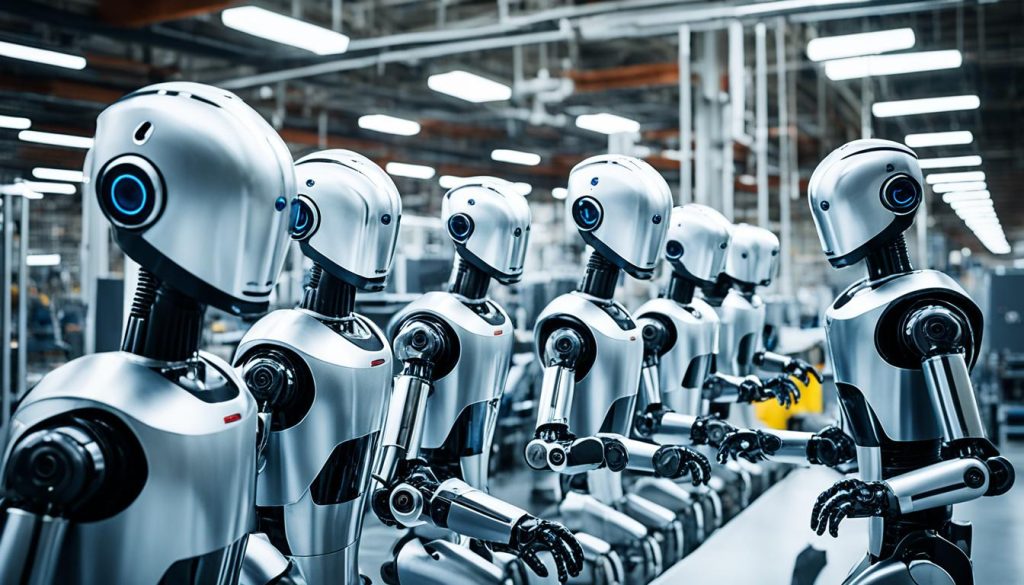
“Collaborative robots optimize productivity and safety by working alongside humans in smart production.”
Upskilling and Reskilling Efforts
To meet the demands of automation’s impact on the workforce, companies and educational institutions are investing in upskilling and reskilling programs. These initiatives aim to equip workers with the necessary skills to operate and manage advanced manufacturing technologies.
- Offering training programs and certifications in automation and robotics.
- Partnering with technical schools and vocational institutions to provide specialized training.
- Implementing apprenticeship programs where workers can learn on the job.
- Encouraging continuous learning through online courses and professional development opportunities.
The Benefits of Collaborative Robots
The integration of collaborative robots in manufacturing brings numerous benefits to both workers and companies:
- Increased productivity: Cobots can work 24/7, leading to higher production output without compromising quality.
- Improved safety: Collaborative robots are designed to work in close proximity to humans, minimizing the risk of workplace accidents.
- Efficient resource allocation: Cobots can perform repetitive and physically demanding tasks, allowing human workers to focus on more complex responsibilities.
- Flexibility and adaptability: Collaborative robots can be easily reprogrammed and configured to perform different tasks, enabling manufacturers to respond quickly to changing production needs.
| Benefits of Collaborative Robots |
|---|
| Increased Productivity |
| Improved Safety |
| Efficient Resource Allocation |
| Flexibility and Adaptability |
The Changing Nature of Manufacturing Jobs
Technological advancements have had a profound impact on the manufacturing workforce. As the industry evolves, the nature of manufacturing jobs is also changing. Today, skilled manufacturing jobs require specialized talent and expertise to design and produce complex products. The days of traditional blue-collar roles are giving way to highly trained white-collar professions.
The skills gap in the manufacturing industry is a growing concern. With the rapid technological evolution, there is a shortage of qualified applicants for skilled positions. This skills gap represents a missed opportunity for the industry, as potential manufacturing jobs remain unfulfilled.
Manufacturing engineers play a critical role in the technological evolution of the industry. They are responsible for developing and implementing innovative manufacturing processes, leveraging the latest technologies and automation systems. With their expertise, these skilled engineers ensure that manufacturing operations remain efficient, productive, and competitive in the global market.
Furthermore, the rise of digitalization and the Internet of Things (IoT) has introduced new job roles in manufacturing. Data analysts, cybersecurity specialists, and automation engineers are now in high demand to effectively leverage emerging technologies and optimize manufacturing processes.
Manufacturing Jobs in Transition
The shift from traditional manufacturing jobs to highly skilled roles is evident across various sectors. Here are a few examples:
“Manufacturing has evolved from manual assembly lines to sophisticated automated systems. Skilled technicians and engineers are vital in programming, maintaining, and overseeing these complex operations.”
| Traditional Manufacturing Jobs | Skilled Manufacturing Jobs |
|---|---|
| Assembly Line Worker | Robotics Programmer |
| Machine Operator | CNC Machinist |
| Line Supervisor | Lean Manufacturing Specialist |
| Quality Inspector | Six Sigma Black Belt |
This transition emphasizes the need for specialized skills in areas such as robotics programming, computer-aided design (CAD), data analytics, and process optimization. It is essential for professionals in the manufacturing industry to adapt to these changes and continuously upskill to meet the demands of the evolving job market.
The image above illustrates the skills gap in the manufacturing industry, showcasing the need for skilled professionals to fill the evolving job roles.
Manufacturing companies must invest in training and development programs to bridge the skills gap effectively. Collaborations between educational institutions and industry leaders can help in imparting the necessary skills and knowledge to the next generation of manufacturing professionals. This collaborative effort will ensure a steady supply of skilled talent to sustain the industry’s growth and competitive edge.
Conclusion
The manufacturing industry has undergone a significant evolution driven by technology. Automation, robotics, and other technological advancements have had a profound impact on employment, production efficiency, supply chain management, and product quality.
While technology has increased productivity, it has not necessarily led to a substantial increase in manufacturing jobs. The industry is currently facing policy challenges and a skills gap. Investment in infrastructure, tax policy reforms, and promoting STEM education are crucial to address these challenges and ensure future growth.
To remain competitive in this evolving landscape, manufacturers must embrace technology and innovation. By adopting advanced manufacturing technologies, leveraging big data analysis, and utilizing the Internet of Things (IoT), they can streamline processes, optimize productivity, and improve decision-making.
The manufacturing industry continues to evolve, and technology will undoubtedly play a crucial role in shaping its future. By adapting to these changes, manufacturers can position themselves for success in a dynamic and increasingly digital world.
FAQ
How has technology impacted manufacturing jobs?
Technology, particularly automation and robotics, has had a significant impact on manufacturing jobs. While it has increased productivity and efficiency in the industry, it has not necessarily resulted in a significant increase in manufacturing jobs.
What is the role of automation and robotics in the workforce?
Automation and robotics have become increasingly prevalent in various sectors, including manufacturing. These technologies have streamlined processes and improved productivity, but they have also led to job displacement and workforce disruption.
Why has there been slow growth in manufacturing jobs?
Despite advancements in technology, manufacturing jobs have only seen a minimal increase in recent years. This slow growth has significant implications for employment patterns and the overall workforce.
What skills are needed for the future of manufacturing?
The future of manufacturing requires workers with STEM skills. Job projections indicate that most job creation will come from healthcare and professional services, highlighting the need for better training in science, technology, engineering, and math.
What are the policy challenges faced by the manufacturing industry?
The manufacturing industry faces substantial policy challenges, including the need for infrastructure investment, tax reform, and boosting trade and global markets. Small firms, in particular, struggle to adopt advanced manufacturing technologies and compete for skilled workers.
What are the technological advancements in manufacturing?
Technological advancements in manufacturing include automation, robotics, and artificial intelligence. CAD/CAM technologies optimize product design, while big data analysis and IoT enable real-time data analysis and better supply chain management.
How has technology improved product quality in manufacturing?
Technology solutions, such as advanced sensors and monitoring systems, have improved product quality and accuracy in manufacturing. Real-time flaw detection ensures flawless goods, and 3D printing allows for quick prototyping and customized production.
How has technology optimized supply chain management in manufacturing?
Technology has significantly impacted supply chain management in manufacturing. Blockchain technology ensures safe and transparent transactions, while real-time tracking and data analytics allow for better inventory management and informed decision-making.
How has the workforce been transformed by technology?
Automation and robots have changed the responsibilities of human employees in manufacturing. Workers now need to acquire new skills through upskilling and reskilling efforts to remain relevant. Collaborative robots, or cobots, optimize productivity and safety by working alongside humans in smart production.
How have manufacturing jobs changed in nature?
The nature of manufacturing jobs has shifted from blue-collar to highly trained white-collar professions. Skilled talent and engineers are now required to design and produce complex products, leading to a skills gap and a shortage of qualified applicants for these positions.