Did you know that the global market for collaborative robots, also known as cobots, is projected to reach a staggering $9.7 billion by 2027? That’s a remarkable growth rate of over 44% from 2020 to 2027! This statistic clearly illustrates the immense impact and potential of cobot technology in the world of automation.
Cobots are transforming traditional industrial processes by enabling seamless collaboration between humans and robots. With their sensitive sensors and advanced safety features, cobots can work alongside humans without the need for restrictive safety measures. This breakthrough technology is revolutionizing the way industries operate and opening up new possibilities for increased productivity, improved quality, and enhanced workplace safety.
In this article, we will delve into the world of collaborative robots, exploring their definition, benefits, impact on workers, programming capabilities, costs, and different brands available in the market. We will also highlight key applications and use cases that showcase the immense potential of cobots across various industries.
Key Takeaways:
- Collaborative robots, or cobots, are transforming automation processes by enabling safe and efficient human-robot collaboration.
- Cobots offer numerous benefits, including increased productivity, improved quality, and enhanced workplace safety.
- They are versatile, easy to program, and can adapt to different tasks and production requirements.
- Cobots have a significant impact on workers by freeing them from repetitive tasks and allowing them to focus on more meaningful work.
- Choosing the right brand and tools for cobot automation is essential for maximizing efficiency and achieving cost-effective solutions.
What are Cobots?
When it comes to automation, collaborative robots, or cobots, are the new superheroes on the block. These robots are designed specifically for human-robot interaction, allowing them to work side by side with humans without the need for safety barriers. With their advanced sensors and intelligent software, cobots ensure safe behavior and prevent any unplanned encounters with humans or objects. They bring a whole new level of flexibility and versatility to the world of automation, making them suitable for businesses of all sizes.
Unlike their traditional industrial counterparts, cobots offer a unique blend of automation and human touch. They seamlessly integrate into your production environment, working alongside your employees as trusted teammates. This collaboration revolutionizes the way tasks are accomplished, combining the precision and efficiency of robotic automation with the problem-solving abilities and adaptability of human workers.
One of the key advantages of cobots is their ability to adapt to changing needs. Whether it’s picking and placing objects, assembling components, or even packaging products, cobots can be programmed to perform a wide range of tasks. They easily learn new operations and can be reprogrammed effortlessly, making them ideal for businesses with frequently changing production requirements.
“Cobots bring together the best of both worlds – the power of automation and the ingenuity of human workers.”
In addition to their flexibility, cobots offer enhanced safety features that prioritize the well-being of both humans and machines. With built-in sensors and advanced algorithms, these robots can detect and respond to their surroundings, ensuring a safe working environment. They can even collaborate directly with humans without the need for cumbersome safety barriers, increasing efficiency and reducing the need for complex safety infrastructure.
But what truly sets cobots apart is their user-friendly nature. Unlike their more complex industrial counterparts, cobots are designed to be easily programmed and operated by anyone, regardless of technical expertise. Intuitive software interfaces and graphical programming tools make it a breeze to teach cobots new tasks, saving time and minimizing the learning curve. This accessibility opens up the world of automation to businesses that may not have had the resources or expertise to implement traditional robotic systems.
The Versatility of Cobots
The versatility of cobots is not limited to their programming capabilities. They can be equipped with various tools and accessories that expand their functionality and empower them to take on different tasks. From grippers for picking up objects to vision systems for object recognition, cobots can be customized to suit the specific needs of your production environment. This adaptability makes cobots a valuable asset in industries such as manufacturing, logistics, healthcare, and many more.
| Cobots | Human-Robot Collaboration | Automation Potential | Industry Applications |
|---|---|---|---|
| Universal Robots | High | Extensive | Manufacturing, Electronics, Automotive |
| Techman Robot | Advanced | Flexible | Logistics, Warehousing, Food & Beverage |
| Fanuc | Collaborative | Diverse | Automotive, Aerospace, Medical |
| Franka Emika | Innovative | Adaptable | Pharmaceuticals, Research, Education |
Table: Leading Brands of Cobots and Their Applications
Benefits of Cobots
When it comes to revolutionizing your business with automation, collaborative robots, or cobots, are the game-changers you need. These innovative robots bring a host of benefits that can enhance productivity, improve product quality, and ultimately drive success. Let’s take a closer look at the advantages cobots offer:
Compact and Versatile
Cobots are designed to fit seamlessly into various areas of production without taking up excessive space. Their compact size allows you to optimize your workspace while still enjoying the benefits of automation. With cobots, you can maximize efficiency without compromising on productivity.
Easy Installation and User-Friendly Programming
You don’t have to be a technical expert to harness the power of cobots. These robots are incredibly easy to install and program, making them accessible to users of all skill levels. With user-friendly interfaces and intuitive software, you can quickly set up your cobots and get them up and running in no time.
Adaptive and Agile
Cobots have the remarkable ability to learn new operations and adapt to different tasks in the production process. Whether it’s handling intricate assembly processes, performing quality inspections, or assisting with packaging, cobots can seamlessly transition between various functions. Their agility allows you to meet changing customer demands with ease.
Precision and Consistent Quality
With cobots, you can say goodbye to human error and welcome precision and consistent quality. These robots perform actions with incredible accuracy, ensuring that each task is executed flawlessly. By eliminating human inconsistencies, cobots help maintain high product standards and customer satisfaction.
Empowerment and Satisfaction
Cobots aren’t here to take jobs away; they’re here to enhance them. By taking over monotonous and dangerous tasks, cobots free up your employees to focus on more creative and fulfilling work. This empowerment improves employee satisfaction and engagement, fostering a positive and motivated workforce.
Cost Reduction
Implementing cobots can lead to significant cost savings for your business. By automating repetitive tasks, cobots reduce the need for manual labor, allowing you to allocate your workforce more efficiently. Additionally, the use of cobots can help minimize errors and waste, leading to cost reductions and improved overall profitability.
Benefits of Cobots
| Benefit | Description |
|---|---|
| Compact and Versatile | Cobots are designed to fit seamlessly into various areas of production without taking up excessive space. |
| Easy Installation and User-Friendly Programming | Cobots are incredibly easy to install and program, making them accessible to users of all skill levels. |
| Adaptive and Agile | Cobots have the remarkable ability to learn new operations and adapt to different tasks in the production process. |
| Precision and Consistent Quality | Cobots perform actions with incredible accuracy, ensuring that each task is executed flawlessly. |
| Empowerment and Satisfaction | Cobots free up employees to focus on more creative and fulfilling work, improving satisfaction and engagement. |
| Cost Reduction | Cobots reduce the need for manual labor and minimize errors and waste, leading to cost savings. |
With these benefits on your side, cobots can transform your business operations, boosting productivity, improving quality, and elevating employee satisfaction. Don’t miss out on the opportunity to automate with cobots and unlock a new era of success.
Impact of Cobots on Workers
Cobots, or collaborative robots, have revolutionized the work environment by transforming the roles and responsibilities of workers. With their ability to handle monotonous and repetitive tasks, cobots free up employees to focus on more engaging and meaningful work. This shift not only enhances productivity but also empowers workers to exercise their creativity and problem-solving abilities.
The introduction of cobots into the workplace has led to the development of diverse and flexible work environments. By delegating mundane tasks to cobots, companies can create a more dynamic and fulfilling workplace. This, in turn, boosts employee engagement and satisfaction, leading to improved overall performance.
“Cobots have completely transformed the way we work. With the manual tasks taken care of, we now have the freedom to explore new ideas and innovate within our roles. It’s like having a reliable and tireless teammate by our side!” – Sarah Johnson, Production Supervisor.
Not only do cobots streamline operations, but they also contribute to a more creative and collaborative workflow. By alleviating workers from repetitive tasks, cobots enable them to focus on more productive and mentally stimulating activities. This increased engagement fosters a culture of innovation, where employees can explore new ideas, improve processes, and contribute their unique perspectives to the organization.
Benefits of Cobots on Workers:
- Enhanced Productivity: With cobots handling repetitive tasks, workers can dedicate their time and energy to more value-added activities, resulting in increased productivity levels.
- Empowered Creativity: The liberation from monotonous work allows employees to tap into their creativity and problem-solving skills, fostering a more innovative work environment.
- Improved Employee Engagement: By eliminating mundane tasks, cobots contribute to higher job satisfaction and engagement among workers, leading to increased motivation and commitment.
- Efficient Resource Allocation: With cobots handling repetitive tasks, human resources can be directed towards more complex and strategic activities, optimizing resource allocation within the organization.
The impact of cobots on workers is undeniable. By optimizing work processes, promoting creativity, and enhancing job satisfaction, cobots create a harmonious synergy between humans and robots in the workplace.
| Benefits | Impact |
|---|---|
| Enhanced Productivity | Increased efficiency and output |
| Empowered Creativity | Promotes innovation and problem-solving |
| Improved Employee Engagement | Higher job satisfaction and motivation |
| Efficient Resource Allocation | Optimized utilization of human resources |
Programming Cobots
When it comes to programming, collaborative robots, or cobots, save you from the headaches of complex algorithms and intricate code. Say goodbye to those programming nightmares that keep you up at night. With cobots, it’s refreshingly simple and user-friendly.
You don’t need to be a coding genius or a tech wizard to get your cobot up and running. The user-friendly software and mobile applications make programming a breeze. It’s like having your own personal robot assistant that understands your commands with ease.
Just imagine this: you can manually move the cobot into the desired positions, instruct it to perform specific tasks, and store those instructions in the software for future reference. It’s like giving your cobot a library of knowledge that it can access whenever you need it.
Programming cobots is a walk in the park. With a few simple clicks and commands, you can teach your cobot new actions and tasks. It’s like training a loyal sidekick who’s always ready to lend a hand.
“Programming cobots is so simple, it’s like coding for dummies—except you’re the genius behind it all.”
The simplicity of programming cobots allows for quick implementation and seamless integration into your automation workflow. Whether it’s repetitive assembly tasks or complex pick and place operations, your cobot has got you covered.
So, say goodbye to the days of spending hours trying to decipher lines of code. Say hello to the era of user-friendly programming and effortless automation with cobots.
The Benefits of User-Friendly Programming:
- Easy implementation into your automation workflow
- Quick training for new actions and tasks
- Effortless adaptation to changing production needs
- Increased productivity and efficiency
- Reduced downtime for programming and maintenance
Costs of Cobot Automation
When it comes to implementing cobot automation, weighing the costs and benefits is crucial. While collaborative robots, or cobots, offer numerous advantages, it’s important to conduct a thorough cost analysis to determine the true value they bring to your business.
Automation costs encompass various factors, including upfront expenses and ongoing maintenance. Here’s a breakdown of the key cost considerations:
- The Robot Itself: The initial investment involves purchasing the cobot, which varies in price depending on the brand, model, payload capacity, and reach.
- Grippers and Tooling: Cobots often require specialized grippers and end-of-arm tooling (EOAT) to perform specific tasks effectively. These additional components contribute to the overall cost.
- Frames and Sensors: Depending on the application, you may need to invest in frames and sensors to ensure the cobot’s safety and optimize its performance.
- Safety Devices: Implementing the necessary safety devices, such as emergency stop buttons and protective barriers, is a critical expense to ensure a secure working environment.
- Design, Build, and Implementation: Designing, building, and integrating the cobot system involve labor costs, engineering expertise, and installation expenses. It’s important to consider these costs when evaluating the total investment.
Once you have a clear understanding of the costs involved, it’s time to compare cobot automation with alternative options like hiring additional staff or outsourcing tasks. Consider the long-term advantages, increased productivity, improved safety, and reduced errors that cobots bring to your production processes. A comprehensive cost analysis will help you determine the most cost-effective and valuable solution for your business.
Remember, while cobot automation requires an upfront investment, the long-term benefits can outweigh the initial costs. It’s an investment in increased efficiency, enhanced productivity, and improved profitability.
Collaborative Robots vs. Industrial Robots
Collaborative robots, or cobots, and industrial robots may share some characteristics, but it’s the unique features of cobots that make them more suitable for a wide range of applications. While industrial robots have traditionally operated separately from humans behind safety barriers, cobots can directly collaborate with humans without the need for such barriers.
Industrial robots excel in large-scale standardized production scenarios, where high-speed and repetitive tasks are prominent. However, cobots offer a different approach, providing flexibility and cost-effectiveness that smaller companies with varying production needs can leverage to their advantage.
“Cobots can safely work alongside humans, enabling a new wave of human-robot collaboration.”
Collaborative robots are ideal for dynamic environments where frequent human interaction is required. They adapt easily to changing tasks and can seamlessly switch between working with humans and independently completing automated processes. This flexibility makes cobots suitable for various industries such as manufacturing, healthcare, and logistics.
Both cobots and industrial robots have their strengths and applications, making them complementary in different industrial scenarios.
The Advantages of Collaborative Robots
Cobots have numerous advantages over their industrial counterparts. Here are some key benefits that make them the preferred choice for certain applications:
- Ability to collaborate directly with humans
- No need for safety barriers
- Flexible and adaptable to changing tasks
- Easy to program and integrate into existing workflows
- Cost-effective solution for small and medium-sized businesses
- Improved ergonomics and enhanced worker safety
The Role of Industrial Robots
Industrial robots remain crucial for large-scale production processes where speed, precision, and repeatability are paramount. They excel at tasks that don’t require close human interaction and can operate continuously for extended periods.
It’s important to carefully assess your specific needs and production requirements to determine whether a collaborative robot, an industrial robot, or a combination of both would be the most appropriate solution for your business.
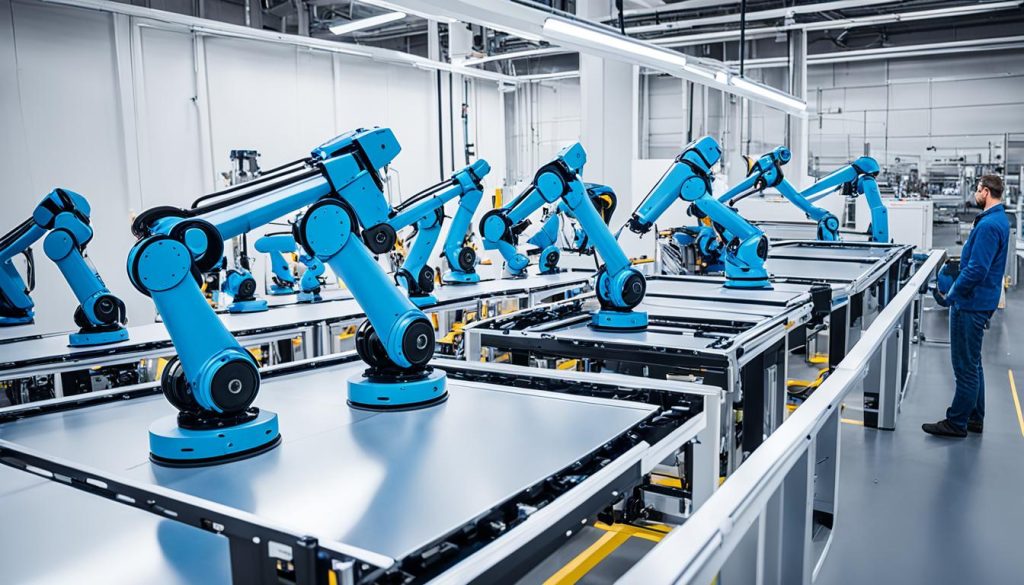
Comparison of Collaborative Robots and Industrial Robots
| Collaborative Robots (Cobots) | Industrial Robots | |
|---|---|---|
| Interaction with Humans | Work closely and collaboratively with humans without safety barriers | Operate separately from humans behind protective barriers |
| Flexibility | Can easily adapt to changing tasks and work alongside humans | Primarily designed for specific repetitive tasks |
| Cost-effectiveness | More affordable and suitable for smaller companies | Higher initial investment, best for large-scale production |
| Programming | Easy to program, often with intuitive user interfaces | Complex programming required for specific tasks |
| Safety | Designed with built-in safety features for direct collaboration with humans | Require safety barriers to safeguard human workers |
Different Brands of Cobots
When it comes to collaborative robots, or cobots, there are several manufacturers specializing in the development and production of these innovative machines. Let’s take a closer look at some of the top cobot manufacturers and what sets them apart:
1. Universal Robots
Universal Robots is a global leader in the cobot industry, offering a wide range of models with different payloads and ranges. Their cobots are known for their ease of use and versatility, making them suitable for various applications. Universal Robots cobots are designed to work collaboratively with humans, enhancing efficiency and productivity in the workplace.
2. Techman Robot
Techman Robot specializes in cobots with integrated vision systems, making them incredibly user-friendly. These cobots are designed to simplify programming tasks, eliminating the need for extensive coding knowledge. With Techman Robot cobots, you can quickly set up automation processes and enjoy seamless human-robot collaboration.
3. Fanuc
Fanuc cobots are renowned for their extensive options, higher payload capacity, extended reach, and increased speed. These cobots are designed to handle demanding tasks in various industries. Fanuc cobots offer advanced automation capabilities, empowering businesses to optimize their production processes and achieve higher levels of productivity.
4. Franka Emika
Franka Emika is known for its advanced cobots that prioritize sensitivity and precision. These cobots are designed to work seamlessly alongside humans, providing intuitive and safe collaboration. With Franka Emika cobots, businesses can achieve high levels of accuracy and efficiency in their operations.
Choosing the right brand of cobot depends on specific requirements and application needs. Whether you prioritize ease of use, advanced automation capabilities, or precision, there is a cobot manufacturer out there to meet your needs.
“Collaborative robots are revolutionizing the industrial landscape, and with a diverse range of manufacturers, businesses have the freedom to choose the cobot that best aligns with their unique requirements.” – Your Name
| Brand | Specialization | Key Features |
|---|---|---|
| Universal Robots | Wide range of models | Ease of use, versatility |
| Techman Robot | Integrated vision systems | User-friendly, simplified programming |
| Fanuc | Extensive options, higher payload capacity, extended reach, increased speed | Advanced automation capabilities |
| Franka Emika | Sensitivity and precision | Intuitive and safe collaboration |
In the next section, we will delve into the different tools that can be used with cobots, further enhancing their capabilities and applications.
Different Tools for Cobots
Cobots are incredibly versatile robots that can be equipped with a variety of tools to enhance their capabilities and suit different automation needs. From grippers to vision systems, these tools allow cobots to perform a wide range of tasks with precision and efficiency. Let’s explore some of the key tools that can be used with cobots:
Grippers
Grippers are essential tools that enable cobots to grasp, pick up, and manipulate objects. They come in various designs and configurations to accommodate different shapes, sizes, and materials. With the right grippers, cobots can handle delicate components, heavy objects, and everything in between.
End of Arm Tooling (EOAT)
End of Arm Tooling, or EOAT, refers to specialized attachments that can be fitted at the end of a cobot’s arm. These custom-designed tools enable cobots to perform specific tasks such as welding, assembly, packaging, and even writing. With EOAT, cobots become highly adaptable and efficient in carrying out intricate operations.
Vision Systems
Vision systems provide cobots with the ability to see and identify objects in their environment. By integrating cameras, sensors, and advanced algorithms, cobots can perform tasks that require visual perception and recognition. Whether it’s inspecting products, locating parts, or navigating complex environments, vision systems enhance a cobot’s adaptability and autonomy.
Software
Software plays a crucial role in programming and controlling cobots. User-friendly software interfaces allow operators to easily configure cobots, define tasks, and customize robot behavior. With intuitive programming environments, even those with minimal technical expertise can quickly teach cobots new actions and automate processes.
Safety Systems
Ensuring the safe collaboration between cobots and humans is of utmost importance. Safety systems, such as sensors, emergency stop buttons, and protective barriers, help prevent accidents and create secure work environments. These systems constantly monitor the cobot’s surroundings and respond to any potential hazards, ensuring the well-being of everyone involved.
Cobots equipped with these tools become powerful allies in the automation journey. Their versatility, combined with the flexibility of grippers, EOAT, vision systems, software, and safety systems, opens up endless possibilities for streamlining operations, enhancing productivity, and achieving efficient and safe human-robot collaboration.

FANUC Collaborative Robots
When it comes to collaborative robots, FANUC is a name that stands out. As a leading manufacturer in the industry, FANUC offers a range of high-precision cobot models that cater to various applications. With their cutting-edge technology and precision engineering, FANUC cobots are designed to deliver exceptional performance and reliability.
What sets FANUC apart is their commitment to providing businesses with cobots that offer different payload capabilities and reaches. This allows companies to choose the most suitable option for their unique production environment. Whether you need a cobot with a higher payload capacity or extended reach, FANUC has got you covered.
FANUC cobots are known for their versatility and adaptability. They can seamlessly work in almost any production environment without the need for safety guarding or fencing. This opens up new possibilities for collaboration between humans and cobots, enabling greater efficiency and agility in your operations.
With over 50 years of experience in the robotics industry, FANUC understands the diverse needs of production environments. They have a deep understanding of the challenges businesses face and are committed to providing efficient and cost-effective solutions. When you choose FANUC, you can trust that you’re investing in a brand that continuously strives to exceed expectations.
Experience the power of FANUC collaborative robots and unlock a new level of productivity and innovation in your business.
Key Features of FANUC Collaborative Robots
| Features | Benefits |
|---|---|
| High-precision engineering | Ensures accuracy and reliability in performance |
| Multiple payload options | Allows for customization based on specific application needs |
| Extended reach capabilities | Enables cobots to access hard-to-reach areas |
| No safety guarding required | Fosters direct collaboration between humans and cobots |
| Efficient and cost-effective | Delivers maximum value and return on investment |
With their exceptional features and commitment to innovation, FANUC collaborative robots are revolutionizing industries across the globe. Don’t miss out on the opportunity to elevate your production capabilities and stay ahead of the competition with FANUC.
Conclusion
Collaborative robots, or cobots, are the future of automation. These ingenious machines are transforming the manufacturing industry by enabling seamless collaboration between humans and robots. Cobots offer a wide range of benefits, including increased productivity, improved product quality, and adaptability to changing market demands.
One of the greatest advantages of cobots is their positive impact on employee satisfaction and engagement. By taking over monotonous tasks, cobots free up workers to focus on more fulfilling and creative work. This not only boosts productivity but also enhances the overall work environment.
Cobots are easy to program and can be quickly integrated into existing workflows. Their versatility allows them to perform multiple tasks, making them suitable for various applications. And thanks to their cost-efficiency, cobots are accessible to businesses of all sizes.
As the market continues to grow, collaborative robots are becoming an essential component of modern manufacturing. Their ability to improve efficiency, quality, and employee satisfaction makes them an indispensable tool for businesses looking to stay competitive in the age of automation.
FAQ
What are collaborative robots, or cobots?
Collaborative robots, or cobots, are robots specifically designed for direct human-robot interaction within a shared space. They can work in close proximity with humans without the need for safety barriers, thanks to their sensors and software that ensure safe behavior and prevent accidental contact.
What are the benefits of using cobots?
Cobots offer several unique benefits. They are compact and versatile, making them suitable for various areas of production. They are easy to install and program, allowing users of all technical expertise levels to operate them. Cobots can learn new operations and adapt to different tasks, resulting in increased productivity and improved quality. They also have a positive impact on employee satisfaction by reducing monotonous tasks and allowing workers to focus on more fulfilling work. Additionally, cobots can help reduce production costs and improve the overall bottom line.
How do cobots impact workers?
Cobots transform the roles and work environment of workers. By taking over monotonous or repetitive tasks, cobots free up employees to focus on more engaging and meaningful work, allowing them to develop their skills, creativity, and problem-solving abilities. This shift leads to increased productivity, employee satisfaction, and overall business performance.
Is programming cobots difficult?
No, programming cobots is easy. They can be programmed using user-friendly software and mobile applications. Users can manually move the cobot into desired positions and store them in the software for future reference. The simplicity of programming allows for quick implementation and the ability to perform different tasks with ease.
How do I evaluate the costs and benefits of cobot automation?
When considering the implementation of cobot automation, it is important to evaluate the total cost of automation, including start-up costs and maintenance costs. This includes the cost of the robot itself, grippers, tooling, frames, sensors, safety devices, and the time spent designing, building, and implementing the system. It is crucial to compare the costs of cobot automation with other options, such as hiring additional staff or outsourcing tasks, to determine the most cost-effective solution for your business.
What is the difference between collaborative robots and industrial robots?
Collaborative robots, or cobots, can directly collaborate with humans without the need for safety barriers. They offer flexibility and cost-effectiveness for smaller companies with varying production needs. On the other hand, industrial robots traditionally work separately from humans and are best suited for large-scale standardized production. Both types of robots have their advantages and can complement each other in different industrial scenarios.
Which brands specialize in the development and production of cobots?
Several manufacturers specialize in collaborative robots, or cobots. Universal Robots is one of the largest cobot suppliers globally, offering a range of models. Techman Robot focuses on cobots with integrated vision systems, making them user-friendly. Fanuc cobots stand out for their extensive options, higher payload capacity, and increased speed. Franka Emika offers advanced cobots known for their sensitivity and precision. Choosing the right brand depends on specific requirements and application needs.
What tools can cobots be equipped with?
Cobots can be equipped with various tools to expand their capabilities. Grippers allow cobots to pick up and manipulate objects. End of arm tooling (EOAT) enables cobots to perform specific tasks, such as welding, assembly, or packaging. Vision systems provide cobots with the ability to see and identify objects, making them more adaptable to different environments. Software and range extenders enhance cobots’ programming and reach, respectively. Safety systems ensure the safe collaboration between humans and cobots.
What are FANUC collaborative robots?
FANUC is a leading manufacturer of collaborative robots, offering a range of high-precision cobot models for various applications. FANUC cobots can work in almost any production environment without the need for safety guarding or fencing. With 50 years of experience in the robotics industry, FANUC provides efficient and cost-effective solutions for diverse production environments.
What are the benefits of using collaborative robots?
Collaborative robots, or cobots, revolutionize automation by enabling human-robot collaboration. They offer numerous benefits, including increased productivity, improved product quality, and the ability to adapt to changing customer demands. Cobots also have a positive impact on employee satisfaction and engagement by eliminating monotonous tasks and allowing workers to focus on more meaningful work. Additionally, cobots are easy to program, versatile, and cost-effective, making them an essential component of the manufacturing industry.