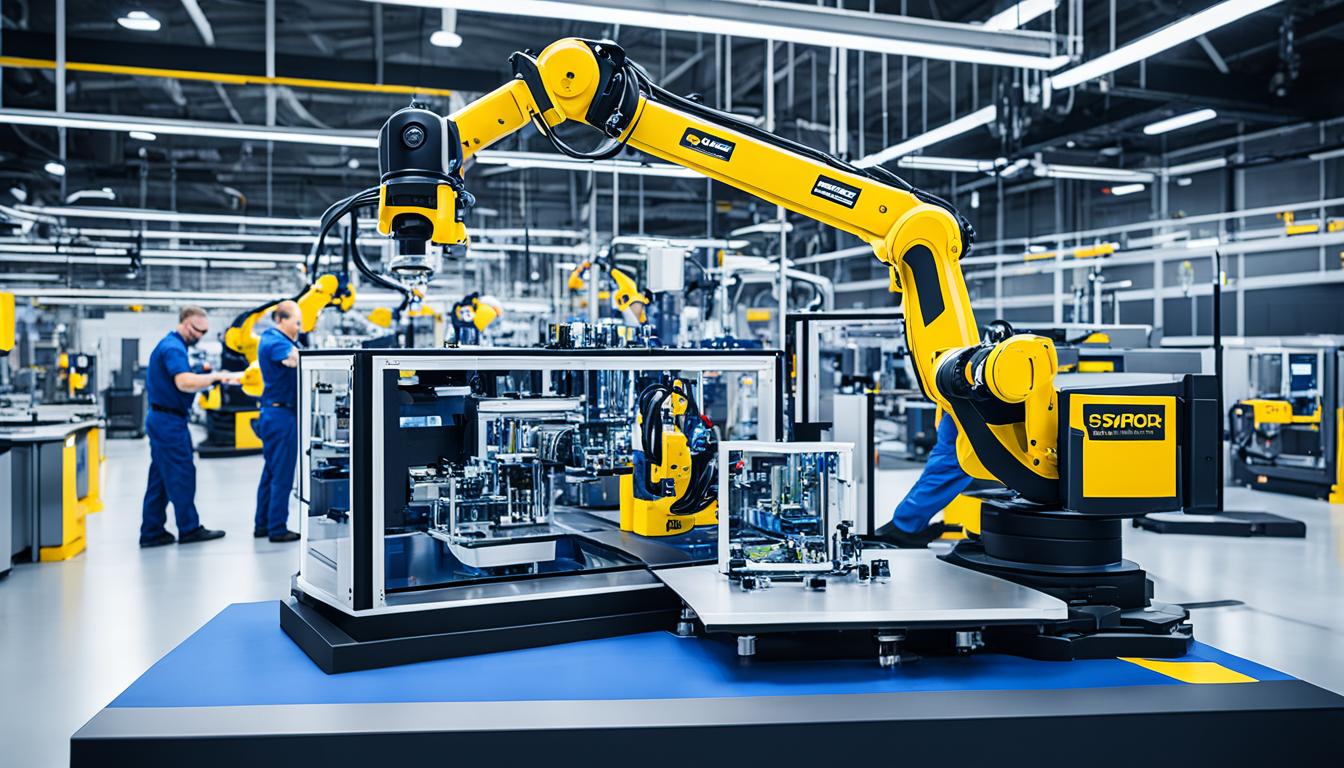
Did you know that more than one-third of US manufacturers either already use VR technology or plan to do so in the next three years? The adoption of augmented reality (AR) and virtual reality (VR) in manufacturing is on the rise, as companies recognize the potential for these immersive technologies to drive digital transformation and enhance productivity.
AR and VR are not just fantasy concepts anymore; they are becoming transformative tools in the manufacturing industry. With applications ranging from product design and development to safety training and maintenance operations, these technologies are reshaping the way manufacturers operate.
The Transformative Potential of Extended Reality in Manufacturing
Augmented reality (AR) and virtual reality (VR) have the potential to revolutionize the manufacturing industry. These immersive technologies create virtual simulations of manufacturing processes, unlocking a world of possibilities for improved productivity, reduced costs, and non-disruptive performance.
In manufacturing, where downtime results in revenue loss, AR and VR offer continuous production capabilities and enhanced worker safety. With the ability to simulate product designs, optimize plant layouts, streamline inventory management, and improve equipment maintenance and assembly training, AR and VR provide valuable solutions to enhance efficiency and innovation in manufacturing.
Imagine designing and refining your products in a virtual environment before physically building them. AR and VR allow manufacturers to visualize and test their designs, saving time and resources on multiple design iterations and enabling effective collaboration among designers, manufacturers, and customers.
Moreover, AR and VR technology empowers manufacturing companies to optimize their plant layouts and streamline inventory management. By creating virtual representations of plants and warehouses, manufacturers can identify bottlenecks and optimize space utilization, resulting in more efficient operations.
Equipment maintenance is another area where AR and VR shine. These immersive technologies provide step-by-step guidance and real-time information to technicians, making maintenance more efficient and reducing the chance of errors and downtime.
AR and VR also offer valuable training opportunities. With immersive training experiences, manufacturers can equip their workforce with the necessary skills and knowledge without exposing them to real-world risks. Whether it’s onboarding new employees, enhancing safety training, or improving manufacturing skills, AR and VR present innovative solutions to enhance productivity and bridge the skills gap in the manufacturing industry.
By embracing AR and VR, manufacturers can tap into the transformative potential of extended reality. These technologies not only enhance productivity and efficiency but also enable manufacturers to stay at the forefront of digital transformation and Industry 4.0. In an increasingly competitive landscape, AR and VR hold the key to unlocking manufacturing productivity enhancements and driving the next wave of innovation in the industry.
| Benefits of AR and VR in Manufacturing |
|---|
| Improved productivity through virtual simulations and optimized processes |
| Reduced costs by minimizing downtime and optimizing inventory management |
| Enhanced worker safety through immersive training experiences and remote assistance |
| Improved equipment maintenance and reduced errors |
| Innovative product design and collaboration |
“Virtual reality is like dreaming with your eyes open.” – Brenda Laurel
Use Cases of Augmented and Virtual Reality in Manufacturing
In the manufacturing industry, the applications of augmented reality (AR) and virtual reality (VR) are vast and versatile. Let’s explore some of the most compelling use cases:
1. Product Design and Development
AR and VR technology allows manufacturers to create virtual simulations of product designs, enabling them to visualize and test prototypes before investing in physical production. This immersive experience helps identify design flaws, make necessary iterations, and refine products to perfection. By saving time and resources, AR and VR accelerate the product development cycle.
2. Safety and Manufacturing Skills Training
Manufacturing workers can undergo virtual reality training to develop essential skills and knowledge without being exposed to real-world risks. VR simulations provide an immersive environment where employees can practice complex tasks, handle hazardous situations, and learn safety protocols. By enhancing training effectiveness and minimizing workplace accidents, AR and VR contribute to a safer manufacturing industry.
3. Maintenance and Equipment Operations
AR and VR offer invaluable support in maintenance, repair, and equipment operations. Technicians can receive remote assistance through AR applications that provide real-time information, overlay digital instructions, and guide them step-by-step in complex repair procedures. This ensures swift and accurate equipment maintenance, minimizing downtime and optimizing productivity in the manufacturing process.
4. Manufacturing Simulation and Process Optimization
AR and VR simulations enable manufacturers to optimize their assembly processes and streamline production. By visualizing the manufacturing workflow in a virtual environment, companies can identify bottlenecks, optimize plant layouts, and make informed decisions that enhance efficiency. Additionally, AR-guided simulations help reduce errors, improve quality control, and ensure precise assembly.
These are just a few examples of the many ways AR and VR are revolutionizing manufacturing. Let’s take a closer look at real-world examples that demonstrate the tangible benefits of these technologies in the industry.
Advantages of Augmented and Virtual Reality in Manufacturing
Augmented and virtual reality (AR and VR) technology is transforming the manufacturing industry, offering a multitude of advantages for companies. By incorporating AR and VR into their operations, manufacturers can unlock a range of benefits that improve efficiency, reduce costs, and enhance product quality. Let’s explore some of these advantages in detail:
Streamlined Product Design and Review
One of the key advantages of AR and VR in manufacturing is the ability to streamline the product design and review process. With AR and VR technology, manufacturers can create virtual simulations of their products, enabling designers to iterate and refine designs quickly and accurately. By visualizing the design in a simulated environment, designers can identify and address any potential flaws or improvements before the product reaches the production stage. This not only saves time and resources but also enhances collaboration among designers and ensures that the final design meets the specifications of both manufacturers and customers.
Enhanced Safety Measures
AR and VR applications in manufacturing play a crucial role in enhancing safety measures within the industry. Through virtual simulations, manufacturers can create immersive environments that allow workers to practice tasks and operations in a controlled setting, minimizing the risks associated with real-world scenarios. By identifying potential hazards and addressing them in a simulated environment, manufacturers can significantly reduce the likelihood of accidents and injuries on the factory floor. Additionally, AR and VR can provide step-by-step instructions and guidance, ensuring that workers adhere to proper safety protocols during their tasks.
Improved Manufacturing Accuracy
AR and VR technologies offer manufacturers a way to enhance the accuracy of their manufacturing processes. By providing workers with precise instructions and real-time information through AR and VR interfaces, manufacturers can minimize errors and improve the overall quality of their products. Whether it’s assembly processes, quality control inspections, or equipment maintenance, AR and VR enable workers to perform tasks with precision and efficiency, resulting in higher-quality products that meet or exceed customer expectations.
Reduced Costs and Increased Efficiency
The adoption of AR and VR in manufacturing can lead to significant cost savings and increased operational efficiency. By streamlining product design, manufacturers can reduce the time and resources spent on design iterations, ultimately speeding up the production process. Additionally, the enhanced accuracy and precision offered by AR and VR can minimize costly errors and rework, leading to substantial cost savings. Moreover, through immersive training experiences and real-time information access, AR and VR can improve worker productivity, optimizing manufacturing operations and maximizing overall efficiency.
Advantages of AR and VR in Manufacturing
| Advantages | Benefits |
|---|---|
| Streamlined Product Design and Review | Improved collaboration among designers, reduced design iterations, detailed design representations |
| Enhanced Safety Measures | Identification of potential hazards, reduced risks, adherence to safety protocols |
| Improved Manufacturing Accuracy | Higher precision in assembly processes, quality control inspections, and equipment maintenance |
| Reduced Costs and Increased Efficiency | Time and resource savings, minimized errors and rework, enhanced productivity |
With these advantages, it’s clear that the integration of AR and VR technology into manufacturing processes is a game-changer. By harnessing the power of AR and VR, manufacturers can unlock new levels of productivity, safety, and product quality, ultimately gaining a competitive edge in the evolving landscape of the manufacturing industry.
Implementation Challenges and Considerations for Augmented and Virtual Reality in Manufacturing
While the benefits of AR and VR in manufacturing are evident, there are several challenges and considerations that may arise during their implementation. Some manufacturers may hesitate to adopt these technologies due to a perceived lack of practical applications and concerns about costs. Integrating AR and VR with existing legacy equipment can also present technical challenges. Furthermore, ensuring employee support and adequate training is crucial for successful implementation and adoption.
However, as the technology continues to advance and become more accessible, these challenges can be overcome. The key is to approach AR and VR implementation strategically and thoughtfully. Starting with pilot projects allows manufacturers to assess the outcomes and identify potential areas for improvement. By gradually scaling up based on the results, companies can minimize risks and maximize the benefits of AR and VR in manufacturing.
Best Practices for AR and VR Implementation:
- Evaluate the specific needs and requirements of your manufacturing processes before implementing AR and VR.
- Start with pilot projects to assess the effectiveness and feasibility of these technologies within your organization.
- Ensure employee buy-in by providing comprehensive training and support throughout the implementation process.
- Identify any necessary hardware and software upgrades or modifications to integrate AR and VR seamlessly.
- Regularly evaluate the outcomes and performance of AR and VR initiatives to make informed decisions.
- Collaborate with industry experts and vendors to leverage their expertise and stay up-to-date with the latest advancements.
By following these best practices and embracing the potential of AR and VR, manufacturers can navigate the implementation challenges successfully and unlock the transformative power of these technologies for enhanced productivity, efficiency, and innovation in the manufacturing industry.
| Challenges of AR and VR Implementation in Manufacturing | Possible Solutions |
|---|---|
| Perceived lack of practical applications | Conduct thorough research to identify specific use cases and applications most relevant to your manufacturing processes. |
| Cost concerns | Investigate the long-term cost savings and return on investment that AR and VR can offer, such as reduced downtime, increased productivity, and improved worker safety. |
| Integrating with legacy equipment | Collaborate with specialists and vendors who can provide expertise on integrating AR and VR with existing systems, ensuring compatibility and seamless operation. |
| Employee support and training | Offer comprehensive training programs and resources to educate employees about the benefits and functionalities of AR and VR, addressing any concerns or resistance. |
| Technical challenges | Work closely with IT professionals and AR/VR experts to overcome technical hurdles, leveraging their knowledge and experience to troubleshoot and optimize system performance. |
By acknowledging these challenges and implementing the appropriate strategies, manufacturers can effectively overcome barriers to successful AR and VR implementation in the manufacturing industry.
Real-World Examples of Augmented and Virtual Reality in Manufacturing
When it comes to embracing the power of AR and VR in manufacturing, many companies have already taken the leap and are enjoying the numerous benefits these technologies offer. Let’s explore some real-world examples of how AR and VR are transforming the manufacturing industry:
Vision Picking at DHL:
DHL, the global logistics giant, implemented AR technology in its inventory management through a pilot program called “vision picking.” This innovative initiative has significantly increased efficiency and reduced errors in the picking process. With AR headsets guiding warehouse workers in real-time, they can accurately identify and locate products, improving speed and accuracy.
VR in Vehicle Design and Testing:
Automakers like Ford and Hyundai have embraced VR technology for vehicle design and testing. By creating virtual simulations, designers and engineers can visualize and evaluate vehicle prototypes in a cost-effective and time-efficient manner. This allows for more accurate product development, resulting in improved design iterations and reduced time to market.
Maintenance and Assembly Training:
AR and VR are revolutionizing training programs in the manufacturing sector. Companies are utilizing these technologies to provide maintenance and assembly workers with step-by-step guidance and immersive training experiences. This approach enhances productivity and empowers employees to perform complex tasks with precision, resulting in improved efficiency and reduced errors.
“AR and VR are unlocking new opportunities in manufacturing, from optimizing the warehouse workflow to revolutionizing vehicle design and assembly. The potential for innovation and productivity enhancements is truly remarkable.”
Factory Floor Planning with AR:
AR is proving to be immensely valuable in factory floor planning. By overlaying digital models onto physical spaces, manufacturers can optimize their plant layouts, ensuring efficient workflows and minimizing bottlenecks. This technology enables organizations to identify potential issues and make informed decisions, streamlining operations and maximizing productivity.
Enhanced Worker Safety:
AR and VR are significantly improving worker safety in manufacturing. Companies are leveraging these technologies to create realistic simulations of hazardous scenarios, providing employees with hands-on training experiences in a safe environment. By proactively preparing workers for potential risks, organizations can reduce injuries and ensure a safer work environment.
With the implementation of AR and VR technologies across various aspects of manufacturing, companies are experiencing increased efficiency, improved worker safety, and the development of better-quality products. The impact of these technologies in the manufacturing industry is undeniable, and their potential for future growth and innovation is truly exciting.

| Company | AR/VR Application | Benefits |
|---|---|---|
| DHL | AR in inventory management (Vision Picking) | Increased efficiency, reduced errors |
| Ford, Hyundai | VR in vehicle design and testing | Improved accuracy, cost-effective product development |
| Various Manufacturers | AR/VR in maintenance and assembly training | Enhanced productivity, reduced errors |
| Various Manufacturers | AR in factory floor planning | Optimized workflows, improved efficiency |
| Various Manufacturers | AR/VR in worker safety training | Reduced injuries, safer work environment |
Future Trends of Augmented and Virtual Reality in Manufacturing
As the use of Augmented Reality (AR) and Virtual Reality (VR) continues to gain traction in the manufacturing industry, we can expect to see exciting future trends and advancements in these immersive technologies. With AR and VR becoming more affordable and accessible, their adoption is projected to increase significantly in the coming years, revolutionizing the manufacturing landscape.
One of the key trends we anticipate is the widespread availability of VR on all phones and devices. This development will open up new possibilities for immersive experiences, allowing manufacturers to leverage VR technology without the need for specialized equipment. Imagine being able to visualize and interact with virtual simulations of manufacturing processes directly from your smartphone, making it easier than ever to optimize production workflows and streamline operations.
Furthermore, the integration of Artificial Intelligence (AI) algorithms and the Internet of Things (IoT) with AR and VR will enhance their capabilities and potential in manufacturing. By leveraging AI and IoT, manufacturers can create smart, connected environments that seamlessly integrate physical and virtual elements. This integration will enable real-time data analysis, predictive maintenance, and enhanced remote collaboration, leading to increased efficiency, productivity, and innovation.
In addition to hardware advancements, software developments will also play a crucial role in shaping the future of AR and VR in manufacturing. As software becomes more sophisticated and user-friendly, manufacturers will have access to a wider range of applications and tools to enhance their operations. From advanced plant layout design and optimization solutions to interactive training modules and digital work instructions, the possibilities for AR and VR in manufacturing are limitless.
As AR and VR technology continues to mature and evolve, commercial and professional applications will continue to grow in popularity. More manufacturers will recognize the significant benefits and cost savings that can be achieved through AR and VR integration, resulting in widespread adoption and implementation across the industry. The future trends of AR and VR in manufacturing are exciting, promising increased efficiency, enhanced productivity, and improved worker safety.
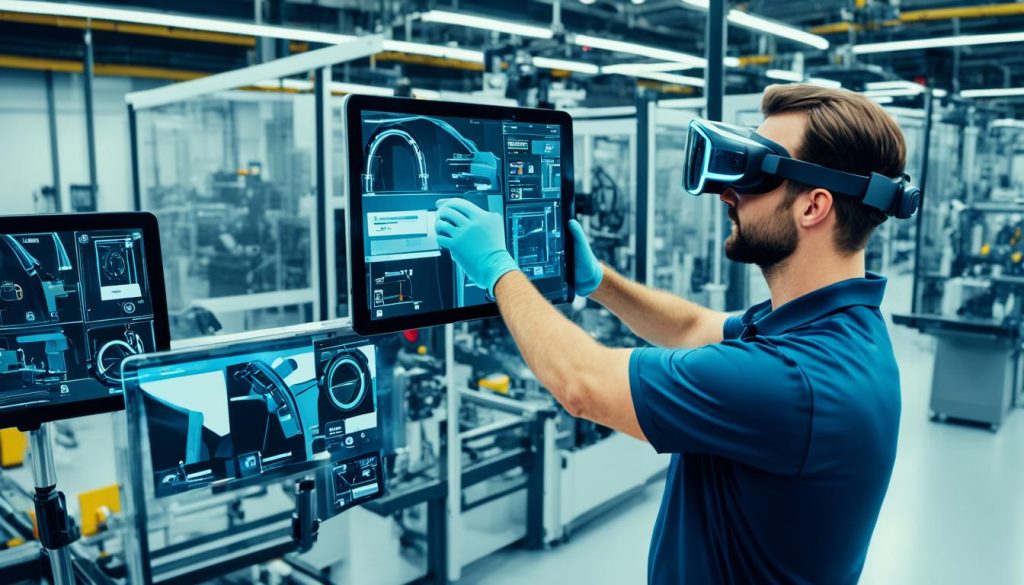
Overcoming Challenges and Maximizing the Benefits of Augmented and Virtual Reality in Manufacturing
To fully leverage the benefits of AR and VR in manufacturing, you need to address challenges and unlock the true potential of these transformative technologies. By doing so, you can optimize your operations, enhance productivity, and stay ahead in the competitive landscape of the industry.
Addressing Cost Concerns
One of the main challenges in adopting AR and VR technology is the perceived cost. However, it’s important to consider the long-term benefits and ROI that these technologies can bring to your manufacturing processes. By investing in AR and VR solutions, you can streamline operations, reduce errors, and ultimately save costs in the long run. Stay informed about the latest advancements in AR and VR hardware and software to find cost-effective options that suit your budget.
Identifying Suitable Applications
Another challenge is identifying the right applications for AR and VR in your manufacturing processes. Begin by assessing areas that can benefit from virtual simulations, such as product design, training, maintenance, and assembly. Conduct thorough evaluations and trials of AR and VR solutions to determine their effectiveness in addressing specific challenges. By selecting the most suitable applications, you can maximize the impact of AR and VR on your manufacturing operations.
Providing Employee Training and Support
Introducing AR and VR technology to your workforce requires proper training and support. Ensure that your employees are equipped with the necessary skills to operate and utilize AR and VR tools effectively. Offer comprehensive training programs to help them understand the potential and benefits of these technologies. By fostering a supportive environment and encouraging adoption, you can empower your workforce to embrace AR and VR, leading to increased productivity and innovation.
Integrating AR and VR with Existing Systems
Integration with existing systems can be a significant challenge when implementing AR and VR technology. Collaborate with IT specialists and solution providers to ensure seamless integration with your current infrastructure. This will enable smooth data exchange, real-time monitoring, and compatibility between AR and VR applications and other manufacturing systems. The successful integration of AR and VR with existing systems will unlock their full potential in improving productivity and operational efficiency.
Continuously Exploring New Uses and Advancements
AR and VR technology is constantly evolving. Stay up to date with the latest developments in these fields and continuously explore new use cases and advancements. Regularly assess your manufacturing processes to identify areas where AR and VR can provide innovative solutions. Adopt a forward-thinking mindset and be open to experimenting with new applications. By actively seeking opportunities for innovation, you can maximize the benefits of AR and VR in your manufacturing operations.
Embrace the challenges and possibilities of AR and VR technology in manufacturing to propel your business forward. Overcome cost concerns, identify suitable applications, provide training and support, integrate with existing systems, and continuously explore new advancements. By doing so, you can unlock the true benefits of AR and VR, optimizing productivity, efficiency, and innovation in your manufacturing processes.
The Impact of Augmented and Virtual Reality in Manufacturing
The impact of AR and VR in manufacturing is nothing short of revolutionary. These cutting-edge technologies have the power to revolutionize production processes, significantly improve worker safety, enhance efficiency, and drive innovation within the industry. By harnessing the capabilities of AR and VR, manufacturing companies can unlock a new realm of possibilities, leading to higher productivity, reduced costs, and the creation of better-quality products.
The implementation of AR and VR enables the creation of virtual simulations, providing manufacturers with invaluable insights into complex manufacturing processes. Through these simulations, companies can identify and rectify potential issues before they arise, resulting in smoother and more streamlined production. Additionally, the immersive training experiences offered by AR and VR allow workers to practice and refine their skills in a risk-free environment, thereby increasing their efficiency and confidence on the job.
“AR and VR provide manufacturers with the tools to create more efficient and productive work environments, optimizing not only their bottom line but also the well-being of their employees.”
Real-time information and data visualization play a pivotal role in the manufacturing industry, and AR and VR offer invaluable solutions in this aspect. These technologies enable workers to access crucial data and instructions in real-time, right in front of their eyes. Whether it’s receiving step-by-step guidance for equipment maintenance or accessing real-time metrics for process optimization, AR and VR empower workers with the information they need to perform their tasks more effectively and accurately.
Furthermore, the collaborative design processes made possible by AR and VR foster innovation and creativity within manufacturing companies. Design teams can work seamlessly across different locations, visualizing and modifying their product designs in real-time. This not only saves time but also ensures that all stakeholders are well-informed and aligned with design decisions, leading to the development of superior products.
The far-reaching impact of AR and VR in manufacturing extends beyond production processes and directly influences market competitiveness. In today’s rapidly evolving digital era, businesses need to adapt to stay ahead. By embracing AR and VR technologies, manufacturing companies position themselves at the forefront of Industry 4.0 and digital transformation, enabling them to capitalize on emerging opportunities and maintain a competitive edge.
Benefits of AR and VR in Manufacturing:
- Revolutionizing production processes
- Improving worker safety
- Enhancing efficiency and productivity
- Driving innovation and creativity
- Enabling virtual simulations and training experiences
- Providing real-time information and data visualization
- Fostering collaboration and remote design processes
- Gaining a competitive edge in the digital era
The future of manufacturing is undeniably intertwined with the transformative capabilities of AR and VR. As technology continues to advance and become more accessible, we can expect to witness even greater impact and widespread adoption of these game-changing technologies in the manufacturing industry. Manufacturers who embrace AR and VR today position themselves for long-term success and stand at the forefront of innovation and productivity in the evolving digital landscape.
Conclusion
Augmented and virtual reality are not just buzzwords in the manufacturing industry; they are transforming the way manufacturers operate. By harnessing the power of AR and VR, manufacturers can create virtual simulations that enhance worker safety, improve efficiency, and drive innovation.
Despite initial challenges, the undeniable benefits of AR and VR in manufacturing make them essential tools for manufacturers to stay competitive. As the technology continues to advance and become more accessible, we can expect to see greater adoption and creative applications in the industry.
Embracing the potential of AR and VR enables manufacturers to gain a competitive edge in the era of digital transformation and Industry 4.0. By leveraging these immersive technologies, manufacturers can unlock new levels of productivity, optimize processes, and deliver better-quality products.
In conclusion, AR and VR are paving the way for the future of manufacturing. They have the potential to revolutionize the industry by creating virtual simulations, enhancing worker safety, improving efficiency, and driving innovation. As manufacturers embrace the possibilities of AR and VR, they are positioning themselves for success in the ever-evolving landscape of digital transformation and Industry 4.0.
FAQ
What is augmented and virtual reality in manufacturing?
Augmented reality (AR) and virtual reality (VR) are immersive technologies that create virtual simulations in manufacturing processes, allowing for improved productivity, reduced costs, and non-disruptive performance.
How are AR and VR used in manufacturing?
AR and VR are used in various applications in manufacturing, including product design and development, safety and manufacturing skills training, maintenance and equipment operations, and remote collaboration.
What are the benefits of using AR and VR in manufacturing?
The benefits of using AR and VR in manufacturing include improved efficiency, enhanced worker safety, reduced costs, streamlined inventory management, and improved product quality.
What are the challenges and considerations of implementing AR and VR in manufacturing?
Some challenges and considerations of implementing AR and VR in manufacturing include practical application challenges, perceived costs, integration with legacy equipment, employee support and training, and assessing suitable applications.
Can you provide examples of AR and VR in manufacturing?
Examples of AR and VR in manufacturing include DHL using AR for inventory management, automakers using VR for vehicle design and testing, and AR and VR applications for maintenance and assembly training.
What are the future trends of AR and VR in manufacturing?
Future trends of AR and VR in manufacturing include increased accessibility and affordability, integration with AI algorithms and IoT, and continued growth and innovation in the industry.
How can manufacturers maximize the benefits of AR and VR in manufacturing?
Manufacturers can maximize the benefits of AR and VR in manufacturing by overcoming implementation challenges, staying informed about the latest developments in the technology, providing employee training and support, and actively seeking opportunities for innovation.
What is the impact of AR and VR in manufacturing?
The impact of AR and VR in manufacturing is significant. These technologies have the potential to revolutionize production processes, improve worker safety, enhance efficiency, and drive innovation.
How can AR and VR contribute to digital transformation in manufacturing?
AR and VR can contribute to digital transformation in manufacturing by providing immersive technology solutions, enhancing productivity, and enabling the adoption of Industry 4.0 applications.
What is the conclusion regarding AR and VR in manufacturing?
Augmented and virtual reality have the potential to revolutionize the manufacturing industry, and as the technology continues to advance and become more accessible, we can expect to see increased adoption and creative applications in the industry.