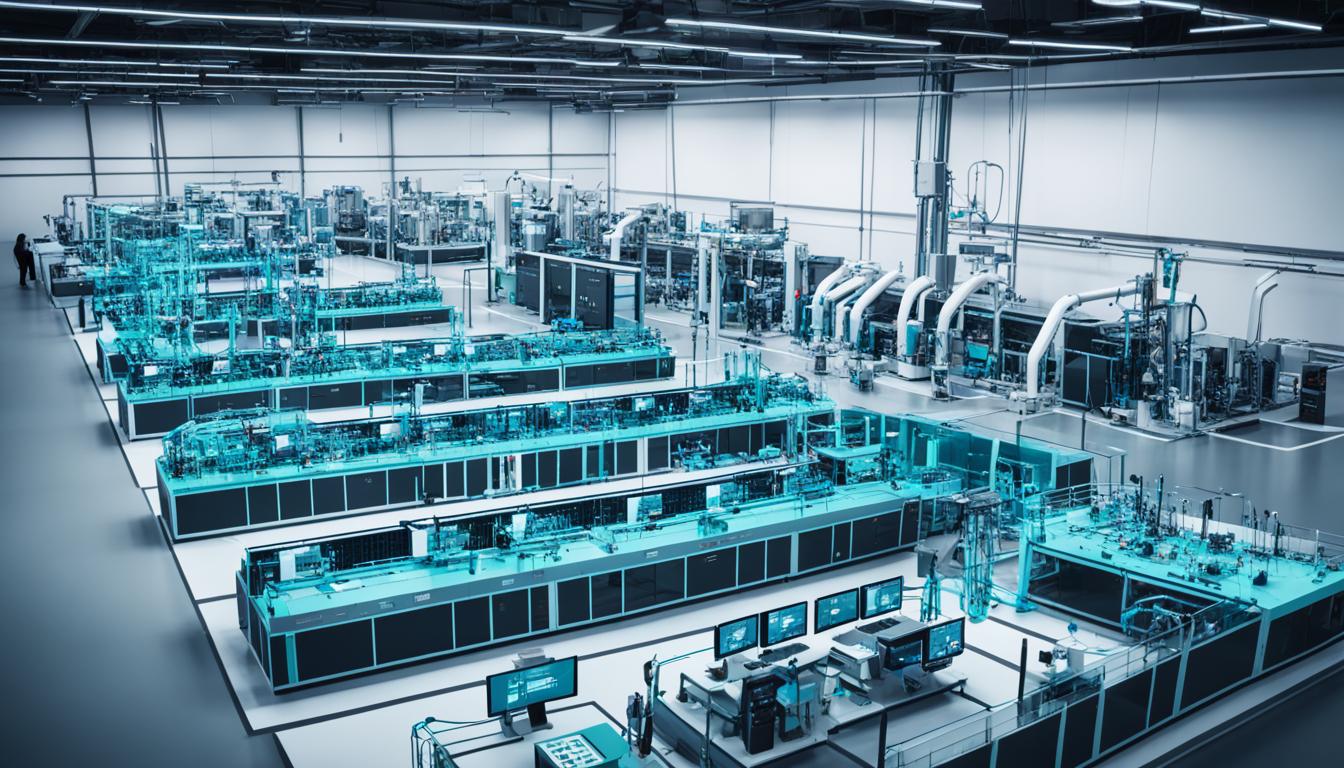
Did you know that the integration of IoT technology into manufacturing processes can lead to a 50% reduction in product defects? The Internet of Things (IoT) has emerged as a game-changer in the manufacturing industry, revolutionizing the way factories operate and paving the way for smart manufacturing. By connecting machines, sensors, and devices, IoT enables real-time data collection and analysis, empowering factory managers to make informed decisions and optimize production.
Key Takeaways:
- The integration of IoT technology in manufacturing processes can lead to a 50% reduction in product defects.
- IoT enables real-time data collection and analysis, empowering factory managers to make informed decisions and optimize production.
- Smart manufacturing, also known as Industry 4.0 or industrial IoT, integrates IoT technology into manufacturing processes to improve efficiency and productivity.
- IoT solutions for the manufacturing industry include smart sensors, IoT devices, and connectivity solutions.
- By embracing IoT technology, manufacturers can reduce waste, enhance product quality, and achieve operational excellence.
The Growth of IoT in Smart Manufacturing
Smart manufacturing, fueled by the Internet of Things (IoT), is experiencing significant growth in the manufacturing industry. With an estimated $200 billion invested in IoT spending by the manufacturing segment in 2019, this sector has surpassed consumer IoT spending. This growth trend is set to continue, with a projected compounded annual growth rate of 12.4% in the smart manufacturing industry through 2025.
Why such rapid growth? In today’s fiercely competitive global markets, full visibility of assets, processes, resources, and products is essential. Smart manufacturing, also known as Industry 4.0, uses IoT technology to achieve this level of visibility. By integrating IoT devices and sensors into manufacturing processes, factory managers gain access to valuable data that allows them to make informed decisions and optimize production.
This growth in IoT adoption in smart manufacturing is driving streamlined business operations, optimized productivity, and improved return on investment (ROI). Manufacturers are embracing IoT solutions to reduce waste, enhance product quality, and improve overall efficiencies in their manufacturing processes.
IoT Spending in Manufacturing
To understand the scale of IoT’s impact, let’s take a closer look at the numbers:
| Year | IoT Spending in Manufacturing |
|---|---|
| 2019 | $200 billion |
As the table demonstrates, the manufacturing sector has invested heavily in IoT to drive smart manufacturing initiatives.
The growth of IoT in smart manufacturing is not only benefiting individual manufacturers, but it is also transforming the manufacturing industry as a whole. Increased connectivity, real-time data analysis, and optimization of processes are revolutionizing the way products are designed, produced, and managed.
Overall, the growth of IoT in smart manufacturing is reshaping the industry and positioning it for a future of enhanced productivity, increased competitiveness, and sustainable growth.
The Role of IoT in Smart Manufacturing
When it comes to smart manufacturing, the Internet of Things (IoT) plays a pivotal role in transforming traditional factories into connected and intelligent production hubs. IoT-enabled smart manufacturing involves the integration of IoT technology into manufacturing processes, allowing for better data collection, analysis, and decision-making.
IoT provides the necessary connectivity to collect real-time data from sensors and machines, creating a comprehensive view of the production environment. This data can be analyzed to gain valuable insights, optimize processes, and drive productivity improvements.
One of the key benefits of IoT in manufacturing is its ability to enable data analysis at scale. By integrating diverse industrial data, manufacturers can uncover valuable patterns, trends, and correlations that can inform strategic decision-making and process optimization. IoT-powered data analysis empowers organizations to identify bottlenecks, reduce waste, and enhance overall efficiency.
IoT also facilitates real-time monitoring and management of manufacturing processes. With IoT-enabled sensors and connectivity, factory managers can remotely monitor equipment performance, identify issues, and make necessary adjustments in real time. This agile approach allows for rapid response to changes in demand, ensuring optimized production plans and improved productivity.
By harnessing the power of IoT, manufacturers can achieve significant benefits in terms of productivity optimization. IoT-enabled smart manufacturing facilitates predictive maintenance, enabling proactive repairs and reducing costly downtime. It also supports predictive analytics, allowing for data-driven forecasting and planning to meet customer demands more effectively.
“IoT provides the necessary connectivity to collect real-time data from sensors and machines, creating a comprehensive view of the production environment.”
Furthermore, IoT opens up new possibilities for innovation and product development. With IoT-powered feedback and insights from connected smart products, manufacturers can gather valuable customer data and gain a deeper understanding of user preferences. This valuable information can inform product enhancements, customization options, and the development of new offerings that better meet customer needs.
Here’s a visualization of the role of IoT in manufacturing:
| Key Benefits of IoT in Smart Manufacturing |
|---|
| Improved data collection and analysis |
| Real-time monitoring and management |
| Optimized production plans |
| Predictive maintenance and analytics |
| Innovation and product development |
The Evolution of the Manufacturing Marketplace
Welcome to the world of Industry 4.0, where the manufacturing sector is undergoing a revolutionary transformation. This evolution, driven by technological breakthroughs like IoT, AI, machine learning, big data, and IoT analytics, is reshaping the manufacturing landscape as we know it.
Imagine a future where automation is the norm, where data exchange seamlessly connects devices, and where cyber-physical systems integrate to create a new era of manufacturing. That future is now, and it’s called Industry 4.0. The boundaries between the physical and digital worlds are blurring, leading decision-makers to reimagine every aspect of product design, production, and management.
“The manufacturing sector is experiencing a technological revolution, and Industry 4.0 is the driving force behind it. From IoT to AI and machine learning, manufacturers are leveraging these innovations to optimize their operations and increase efficiency.” – Industry Expert
In this new era, manufacturers are embracing IoT to collect and analyze vast amounts of data, enabling them to make smarter decisions and optimize production processes. They are utilizing AI and machine learning to automate tasks and improve productivity. Big data and IoT analytics are providing valuable insights that drive innovation and continuous improvement.
This transformation is not just about technology; it’s a cultural shift, a mindset that challenges the status quo and pushes boundaries. Manufacturers must adapt to remain competitive and thrive in the evolving marketplace.
The Implications of Industry 4.0
Industry 4.0 brings a host of benefits and opportunities for manufacturers. Automation enables increased production efficiency, reduced costs, and improved product quality. Real-time data analytics allows for predictive maintenance, minimizing downtime and maximizing uptime. Connected devices enable seamless communication and collaboration across the production line, optimizing workflows and ensuring a smoother manufacturing process.
Embracing Industry 4.0 is a strategic move that not only enhances manufacturing capabilities but also opens up new avenues for growth and innovation.
The Journey Ahead
As the manufacturing marketplace continues to evolve, companies must stay at the forefront of technological advancements. Embracing IoT, AI, machine learning, and other Industry 4.0 technologies is no longer a choice but a necessity for survival.
| Industry 4.0 Technologies | Key Benefits |
|---|---|
| IoT | Greater connectivity, real-time data analysis, improved decision-making. |
| AI | Automation, increased productivity, smarter manufacturing processes. |
| Machine Learning | Predictive maintenance, optimized workflows, continuous improvement. |
| Big Data & IoT Analytics | Valuable insights, innovation driven by data, enhanced operational efficiency. |
Industry 4.0 is not a destination, but a continuous journey of adaptation and innovation. By embracing these technological breakthroughs, manufacturers can unlock their full potential and thrive in an ever-changing marketplace.
Industry 4.0 is revolutionizing the manufacturing marketplace, and those who embrace this revolution will position themselves as leaders in the industry. The future of manufacturing is here, and it’s time to evolve, adapt, and seize the opportunities that Industry 4.0 presents.
The Benefits of 5G in Smart Manufacturing
Prepare to supercharge your smart manufacturing operations with the transformative power of 5G technology. With faster speed, lower latency, and higher bandwidth, 5G is poised to revolutionize the manufacturing industry and propel it into the future.
Imagine the possibilities of real-time communication in your smart factory. With 5G, machines can perform different tasks through remote reprogramming, enhancing collaboration and efficiency. You can receive haptic feedback from robots in real-time, enabling a seamless human-machine interface.
“5G opens up a whole new world of opportunities for machine learning and AI in smart manufacturing,”
says industry expert Sarah Johnson. “It brings unprecedented levels of connectivity and enables the collection and analysis of massive amounts of data, paving the way for intelligent automation and optimization.”
Thanks to the lightning-fast speed and ultra-low latency of 5G, you can achieve instant data transfer, rapid decision-making, and real-time response to production challenges. This level of agility and flexibility will allow you to optimize processes, control costs, and deliver high-quality products more efficiently.
Are you ready to unleash the true potential of smart manufacturing? Embrace the power of 5G and take your operations to the next level of connectivity, productivity, and innovation.
The Key Benefits of 5G in Smart Manufacturing:
- Faster speed, lower latency, and higher bandwidth
- Real-time communication and collaboration
- Unprecedented levels of machine learning and AI
- Enhanced agility, flexibility, and cost control
- Improved product quality and customer satisfaction
| Benefits | Description |
|---|---|
| Faster speed | Accelerates data transfer and decision-making |
| Lower latency | Enables real-time response and seamless human-machine interaction |
| Higher bandwidth | Facilitates the handling of large volumes of data |
| Real-time communication | Enables instant collaboration and problem-solving |
| Machine learning and AI | Unleashes the power of intelligent automation and optimization |
Smart Manufacturing Initiatives and Business Value
In the global battle for smart manufacturing competitiveness, countries like China, the US, and Europe have launched dedicated initiatives to unlock the potential of IoT and Industry 4.0. These smart manufacturing initiatives aim to improve productivity, efficiency, and innovation in the industry, ultimately creating significant business value.
By harnessing the power of IoT-enabled smart manufacturing, these initiatives optimize global manufacturing processes related to performance, quality, cost, and resource management. Whether it’s discrete manufacturing or process manufacturing, all types of manufacturing industries can benefit from the integration of IoT technology.
These smart manufacturing initiatives drive the adoption of IoT initiatives in manufacturing, leveraging advanced technologies to maximize business potential. With IoT, manufacturers gain enhanced visibility, real-time insights, and predictive analytics, enabling informed decision-making and optimized production plans.
“Smart manufacturing initiatives introduce intelligent solutions that optimize performance, quality, cost, and resource management in the fiercely competitive manufacturing landscape.”
Implementing IoT-enabled smart manufacturing enables manufacturers to increase productivity, reduce waste, and streamline processes throughout the supply chain. By embracing digitalization and automation, manufacturers can enhance their market position, improve customer satisfaction, and ultimately stay ahead in the global smart manufacturing competition.
Business Value of Smart Manufacturing Initiatives
The benefits derived from smart manufacturing initiatives go beyond operational efficiency and cost reduction. By embracing IoT technology, manufacturers can unlock new business value and drive sustainable growth. Here are some key advantages:
- Improved Production Efficiency: IoT-enabled smart manufacturing optimizes production processes, reduces downtime, and minimizes errors, leading to increased efficiency and higher output.
- Enhanced Product Quality: Advanced data analysis and real-time monitoring enable manufacturers to identify and rectify quality issues promptly, resulting in improved product quality and lower rejection rates.
- Cost Reduction: IoT-driven process optimization and predictive maintenance help manufacturers minimize downtime, reduce wastage, and optimize resource utilization, ultimately driving cost savings.
- Agility and Flexibility: Smart manufacturing provides real-time visibility and control over production processes, enabling manufacturers to quickly adapt to changing market demands and seize new opportunities.
- Innovation and New Business Models: By leveraging IoT data, manufacturers can gain insights into customer behavior, market trends, and product performance, facilitating innovation and the development of new business models.
Smart manufacturing initiatives have the potential to transform the manufacturing landscape by driving innovation, improving competitiveness, and creating sustainable business value. By embracing IoT initiatives and leveraging the power of Industry 4.0, manufacturers can position themselves at the forefront of the smart manufacturing revolution.
The Importance of Security in Smart Manufacturing
When it comes to smart manufacturing, security is a matter of paramount importance. The integration of IoT devices in manufacturing processes introduces a range of security concerns that must be addressed to protect valuable assets. With the increasing connectivity and data exchange between machines and systems, the risk of cyberattacks and data breaches rises significantly.
Manufacturers must take proactive measures to safeguard their operations and ensure the protection of intellectual property. This includes implementing stringent authentication protocols, establishing secure communication channels, and employing robust cybersecurity solutions. By fortifying their security infrastructure, manufacturers can mitigate potential risks and safeguard their sensitive data from unauthorized access.
However, security challenges have presented obstacles in the widespread adoption of IoT technologies in smart manufacturing. Concerns over data privacy and infrastructure vulnerabilities have slowed down the pace of embracing new business models and organizational changes that could enhance competitiveness and offer innovative services to customers.
“The connectivity and integration of IoT devices in manufacturing processes increase the risk of cyberattacks and data breaches.”
Despite the challenges, addressing security concerns is crucial for the successful implementation and longevity of IoT in the manufacturing industry. By prioritizing cybersecurity, manufacturers can unlock the full potential of IoT and Industry 4.0, effectively leveraging the benefits of increased connectivity and data analytics.
IoT Security Challenges
Securing IoT in the manufacturing sector comes with its fair share of challenges. The complex nature of interconnected devices and systems presents vulnerabilities that can be exploited by malicious actors. Some of the key IoT security challenges in smart manufacturing include:
- Lack of standardized security practices across IoT devices and platforms.
- Insufficient encryption and authentication methods.
- Legacy equipment and systems that lack security features.
- Difficulty in maintaining and updating security patches and firmware.
- Protecting intellectual property from theft or unauthorized access.
To address these challenges, manufacturers must collaborate with technology partners and security experts to develop robust security frameworks. By implementing comprehensive security measures, manufacturers can protect their intellectual property, maintain the trust of their customers, and ensure the integrity of their operations.

| Major Security Concerns | Impact |
|---|---|
| Cyberattacks and data breaches | Loss of sensitive data, disruption of operations, reputational damage |
| Lack of standardized security practices | Increased vulnerability, difficulty in implementing consistent security measures |
| Insufficient encryption and authentication | Potential for unauthorized access, compromised data integrity |
| Legacy equipment and systems | Weakened security defenses, difficulty in integrating with modern security solutions |
| Difficulty in maintaining security patches | Inability to address emerging security threats, increased exposure to cyberattacks |
| Protection of intellectual property | Risk of theft or unauthorized access to proprietary information |
Building a Smart Factory Step by Step
When it comes to building a smart factory, collaboration is key. You’ll need to partner with experienced integrators, technology experts, and automation vendors to ensure a successful implementation. By working together, you can navigate the challenges and complexities of integrating IoT technology into your manufacturing processes.
To connect your equipment, you’ll need to explore various IoT connectivity solutions. This includes options like hardwiring, wireless connections, and industrial interfaces. Each solution has its benefits, so choose the one that best suits your factory’s needs and requirements.
However, it’s important to prioritize security from the very beginning. Implementing a robust security architecture is crucial to protect your smart manufacturing systems from potential cyber threats.
“Collaboration is key in building a smart factory. By partnering with the right integrators, technology experts, and automation vendors, you can overcome challenges and leverage IoT technology to optimize your manufacturing processes.”
One of the most exciting aspects of building a smart factory is the abundance of data generated by connected devices. This data provides valuable insights that can be leveraged to optimize your operations, improve efficiency, and drive innovation. Consider how you can monetize this data and protect your intellectual property to capitalize on its full potential.
By following these steps and embracing the power of IoT, you can lay the foundation for a smart factory that is efficient, secure, and technologically advanced.
Key Players in Smart Factory Automation
| System Integrators | Automation Vendors |
|---|---|
| Siemens | FANUC |
| Rockwell Automation | ABB |
| Schneider Electric | Yaskawa |
The Benefits of Connected Products in Smart Manufacturing
Embrace the power of connected products in smart manufacturing and unlock a world of possibilities beyond traditional offerings. By leveraging the Internet of Things (IoT) capabilities, you can revolutionize your production processes, strengthen relationships with dealers and service ecosystems, and provide value-added services to your customers.
Improved Machine Performance
With connected products, you can optimize machine performance like never before. By gathering real-time data from sensors and machines, you gain valuable insights into their operation and health. This allows you to proactively address maintenance needs, prevent breakdowns, and improve overall efficiency. Say goodbye to costly downtime and hello to uninterrupted, high-performance machines.
Streamlined Machine Service Processes
Connected products enable streamlined machine service processes, making maintenance and repairs more efficient than ever. With real-time data and remote monitoring capabilities, you can quickly identify issues, diagnose problems, and even perform remote repairs. This reduces service response times, minimizes disruptions to production, and keeps your machines running smoothly.
“Connected products bring efficiency and convenience to machine service processes. With real-time data and remote monitoring, you can solve problems faster, saving time and resources.” – John Thompson, Manufacturing Expert
Research and Development Opportunities
Connected products provide a wealth of data that can fuel research and development efforts. By analyzing the data collected from your products, you can identify usage patterns, customer preferences, and areas for improvement. This valuable information allows you to innovate, optimize your product offerings, and stay ahead of the competition.
Integrating connected products into your manufacturing processes has numerous benefits that extend beyond the factory floor. By embracing connectivity, you can enhance customer satisfaction, adapt to market needs, and improve overall business performance. Get ready to revolutionize your manufacturing operations with the power of connected products.
Connectivity and Optimization in Smart Manufacturing
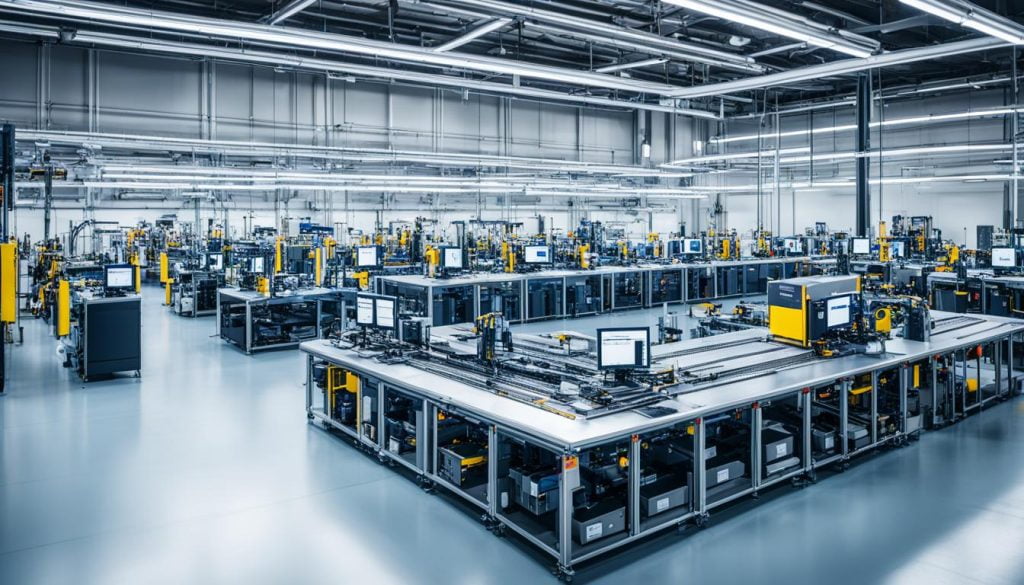
In the world of smart manufacturing, connectivity is the key to unlocking the full potential of your operations. With IoT connectivity solutions, you can achieve complete visibility of your assets, processes, and resources, empowering you to optimize your manufacturing processes like never before.
Imagine being able to collect real-time data from sensors and machines, allowing you to analyze and optimize your production lines on the fly. This level of connectivity enables just-in-time production, ensuring that materials, goods, and labor are available exactly when needed, minimizing waste and streamlining your supply chain.
But the benefits of connectivity don’t stop there. It also tightens the relationship between manufacturers, service providers, and customers. By connecting your operations, you can improve inventory management, increase operational efficiency, and deliver better customer satisfaction.
To illustrate the significance of connectivity in smart manufacturing, let’s take a closer look at the impact it has on three critical aspects:
Optimization of Manufacturing Processes
Connectivity allows you to collect and analyze real-time data from sensors and machines, granting you invaluable insights into your manufacturing processes. With this information, you can identify bottlenecks, inefficiencies, and opportunities for improvement, enabling you to optimize your operations for maximum productivity and cost-effectiveness. By leveraging IoT connectivity solutions, you can achieve a seamless flow of information throughout your production lines, leading to streamlined processes and improved overall efficiency.
Just-in-Time Production
Embracing IoT connectivity solutions opens the door to just-in-time production, a strategy that revolutionizes supply chain management. By ensuring that materials, goods, and labor are available precisely when needed, you can minimize inventory costs, reduce waste, and respond to market demands rapidly. With IoT-enabled connectivity, you can track and manage your entire supply chain in real-time, ensuring that every component of your production process aligns perfectly, resulting in optimized output and enhanced customer satisfaction.
Connected Supply Chain
In the world of smart manufacturing, connectivity extends beyond your factory floor. By integrating your supply chain with IoT connectivity solutions, you can seamlessly connect with suppliers, distributors, and customers, creating a connected supply chain ecosystem. This interconnected network allows for real-time information sharing, predictive maintenance, and demand forecasting, optimizing your inventory management and minimizing risks throughout the entire supply chain.
When it comes to smart manufacturing, connectivity is the linchpin that brings it all together. With IoT connectivity solutions, you can optimize your manufacturing processes, embrace just-in-time production, and create a fully connected supply chain ecosystem. By leveraging the power of connectivity, you can unlock the true potential of your operations and stay ahead in the highly competitive manufacturing landscape.
| Benefits of Connectivity in Smart Manufacturing | |
|---|---|
| Optimization of manufacturing processes | Maximize productivity and efficiency by collecting and analyzing real-time data. |
| Just-in-time production | Minimize waste and improve customer satisfaction by ensuring materials, goods, and labor are available exactly when needed. |
| Connected supply chain | Streamline your entire supply chain, from suppliers to customers, for real-time information sharing and optimized inventory management. |
Conclusion
Congratulations, you’ve reached the conclusion of our exploration into the world of IoT in smart manufacturing! To summarize, IoT has brought about a revolution in the manufacturing industry, commonly referred to as Industry 4.0. This integration of IoT technology has paved the way for improved visibility, enhanced decision-making, and optimized production processes.
By harnessing the power of connectivity and data analysis, IoT enables manufacturers to increase productivity, reduce waste, and improve overall efficiency. With real-time monitoring and management capabilities, adjustments can be made on the fly, resulting in agile and responsive production plans.
However, it is important to address the security concerns and implementation challenges associated with IoT in smart manufacturing. Safeguarding against cyberattacks and ensuring the protection of intellectual property are paramount in fully unlocking the potential benefits of IoT.
Embracing IoT technology and building smart factories step by step holds the key to achieving substantial business value and maintaining competitiveness in the ever-evolving manufacturing marketplace. The implications of IoT in the manufacturing industry are far-reaching, and with the right approach, your manufacturing processes can become smarter, more efficient, and more profitable.
FAQ
What is smart manufacturing?
Smart manufacturing, also known as Industry 4.0 or industrial IoT, integrates IoT technology into manufacturing processes to collect and analyze data from sensors and machines, leading to better-informed decisions and optimized production.
How does IoT technology improve smart manufacturing?
IoT technology enables the flow of data, providing the ability to monitor and manage processes remotely and change production plans in real-time. This improves manufacturing outcomes by reducing waste, improving productivity, and enhancing product quality.
What are the benefits of IoT in smart manufacturing?
IoT in smart manufacturing offers benefits such as increased productivity, reduced waste, improved efficiency, optimized decision-making, real-time monitoring, and management of processes, and enhanced customer satisfaction.
How can IoT be integrated into manufacturing processes?
IoT can be integrated into manufacturing processes by connecting diverse industrial data and equipment, enabling improved visibility, decision-making, and optimization of production plans.
What are some IoT devices for smart factories?
IoT devices for smart factories include sensors, actuators, smart machines, industrial robots, and connected products that provide insights into usage and feedback from consumers.
How can IoT connectivity benefit the manufacturing industry?
IoT connectivity in manufacturing provides full visibility of assets, processes, and resources. It enables real-time data collection, analysis, and optimization of manufacturing processes, leading to improved productivity, cost control, resource management, and customer satisfaction.
What role does security play in smart manufacturing?
Security is crucial in smart manufacturing, as the connectivity and integration of IoT devices increase the risk of cyberattacks and data breaches. Strong security measures must be implemented to protect against infrastructure cybercrime and safeguard intellectual property.
How can a smart factory be built and scaled up?
Building and scaling up a smart factory involves collaborating with experienced integrators, technology partners, and automation vendors. Manufacturers need to connect equipment using various IoT connectivity solutions and implement a security architecture from the beginning.
How do connected products benefit smart manufacturing?
Connected products enable improved and automated production processes, tighter bonds with dealers and service ecosystems, and the provision of value-added services. They optimize machine performance, streamline machine service processes, and provide data for research and development.
What is the importance of connectivity in smart manufacturing?
Connectivity in smart manufacturing enables full visibility of assets, processes, and resources. It facilitates real-time data collection, analysis, and optimization of manufacturing processes, leading to just-in-time production, improved inventory management, operational efficiency, and customer satisfaction.
What are the implications of IoT in the manufacturing industry?
IoT revolutionizes the manufacturing industry with smart manufacturing, improving visibility, decision-making, and optimization of production processes. Embracing IoT technology and building smart factories step by step can result in substantial business value and maintain competitiveness in the evolving manufacturing marketplace.