The Cost of Quality (CoQ) is an essential aspect of quality management in any organization. It refers to the costs incurred to ensure that the products or services meet the required quality standards. Quality assurance (QA) and quality control (QC) are two key components of CoQ, ensuring that the products or services are of the highest quality.
While QA focuses on preventing defects and maintaining quality standards through established practices, QC involves the inspection and testing of products or services to identify any deviations from the established standards. Understanding the difference between QA and QC is crucial for organizations to implement effective quality assurance practices and quality control techniques.
By investing in QA and QC, organizations can reap several benefits. It improves customer satisfaction, enhances brand reputation, increases operational efficiency, reduces waste and rework, minimizes risks, and ultimately, leads to higher profitability.
Key Takeaways:
- The Cost of Quality (CoQ) encompasses the costs incurred to meet quality standards.
- Quality assurance (QA) focuses on preventing defects, while quality control (QC) involves inspection and testing.
- QA and QC are essential for enhancing customer satisfaction and operational efficiency.
- Implementing effective quality assurance practices and quality control techniques reduces waste and improves profitability.
- Investing in CoQ is crucial for achieving long-term success and maintaining a competitive edge in the market.
Calculation of CoQ
The calculation of the Cost of Quality (CoQ) can vary from company to company depending on their specific approach. While some organizations use the total warranty dollars as a percentage of sales to calculate CoQ, this method only takes into account external costs. To gain a more comprehensive understanding, it is important to consider all quality costs involved.
Companies can calculate the CoQ by summing up the costs in four categories: Prevention Costs, Appraisal Costs, Internal Failure Costs, and External Failure Costs. By including all these costs, organizations can obtain a more accurate measure of the CoQ and identify areas for improvement.
Let’s take a closer look at the four categories:
- Prevention Costs: These are the expenses incurred to prevent quality issues from occurring in the first place. They include activities such as quality planning, training, process documentation, and implementing quality management systems.
- Appraisal Costs: These costs are associated with evaluating and measuring the quality of products or services. Examples include inspection costs, testing equipment, quality audits, and supplier assessments.
- Internal Failure Costs: These costs arise from addressing quality issues discovered during the production process. They can include rework, scrap, machine breakdowns, and the time spent on failure analysis.
- External Failure Costs: These costs occur when quality issues are identified after the product or service has reached the customer. They may involve warranty claims, customer returns, product recalls, and the financial impact of damaged reputation.
By considering all these costs, organizations can make informed decisions and allocate resources more effectively to improve their products or services while reducing the overall Cost of Quality.
| Category | Cost Components |
|---|---|
| Prevention Costs | Quality planning, training, implementing quality management systems |
| Appraisal Costs | Inspection, testing, quality audits |
| Internal Failure Costs | Rework, scrap, failure analysis |
| External Failure Costs | Warranty claims, customer returns, product recalls |
Understanding the various cost components is essential for organizations to analyze their quality practices and make strategic improvements. It allows them to identify areas that require more investment and attention to minimize quality-related issues and ensure customer satisfaction.
Cost of Good Quality (CoGQ)
The Cost of Good Quality (CoGQ) includes the costs associated with activities intended to keep failures to a minimum. These can include:
- Establishing product specifications
- Quality planning
- New product development and testing
- Development of a Quality Management System (QMS)
- Employee training
These activities are essential for maintaining high-quality standards and ensuring that products meet customer expectations. By investing in prevention costs, companies can proactively address potential quality issues and minimize the likelihood of failures, defects, or errors.
In addition to prevention costs, the Cost of Good Quality also includes appraisal costs. Appraisal costs are incurred to maintain acceptable product quality levels through activities such as:
- Incoming material inspections
- Process controls
- Quality audits
- Supplier assessments
These appraisal activities help ensure that products meet the specified quality requirements and conform to established standards. By conducting thorough inspections and assessments, companies can identify and resolve any quality deviations before products reach the customer.
By investing in prevention and appraisal costs, companies can effectively manage their Cost of Good Quality (CoGQ) and reduce the overall Cost of Quality (CoQ). This leads to improved product quality, enhanced customer satisfaction, and increased profitability.
Cost of Poor Quality (CoPQ)
The Cost of Poor Quality (CoPQ) is a crucial aspect of any organization’s quality management strategy. CoPQ includes the expenses incurred due to defects found before the product or service reaches the customer (Internal Failures) and defects found after the customer receives the product or service (External Failures).
Internal Failures encompass various costs, such as excessive scrap, product rework, waste resulting from poorly designed processes, machine breakdown, and the financial burden of conducting failure analysis.
External Failures, on the other hand, involve costs associated with service and repair, warranty claims, handling customer complaints, managing product or material returns, rectifying incorrect sales orders, and addressing shipping damage.
Effectively managing CoPQ is paramount for businesses aiming to minimize waste, enhance customer satisfaction, and maximize profitability. By analyzing and addressing both Internal and External Failure Costs, organizations can identify areas for improvement and implement measures to prevent and mitigate quality issues.
Let’s visualize the breakdown of CoPQ:
| Internal Failure Costs | External Failure Costs |
|---|---|
| Excessive scrap | Service and repair costs |
| Product rework | Warranty claims |
| Waste due to poorly designed processes | Customer complaints |
| Machine breakdown | Product or material returns |
| Failure analysis costs | Incorrect sales orders |
| Shipping damage |
By addressing these categories of CoPQ diligently, businesses can not only reduce costs but also enhance their reputation in the market by offering high-quality products and services, thereby ensuring customer loyalty and repeat business.
Investing resources in proactively managing the Cost of Poor Quality can yield long-term benefits and position organizations as industry leaders committed to delivering excellence.
Cost of Quality Equation
The Cost of Quality equation is an essential tool for organizations to understand and manage the financial impact of quality. By calculating the Cost of Quality (COQ), companies can gain insights into the Cost of Good Quality (CoGQ) and the Cost of Poor Quality (CoPQ), enabling them to make informed decisions to improve their quality practices.
The Cost of Quality equation is expressed as:
COQ = (PC + AC) + (IFC + EFC)
Where:
- PC refers to Prevention Costs, which are expenses incurred in activities aimed at preventing quality issues from arising in the first place.
- AC represents Appraisal Costs, which are the costs associated with evaluating and inspecting products or services to ensure they meet the required quality standards.
- IFC signifies Internal Failure Costs, which are the costs incurred when defects are discovered before the product or service is delivered to the customer.
- EFC stands for External Failure Costs, which are the costs incurred when defects are found after the product or service has reached the customer.
Understanding the Cost of Quality equation allows organizations to assess the specific areas where their quality efforts may be costing them, and where improvements can be made to optimize quality performance and reduce overall costs.
Example:
Let’s consider a hypothetical manufacturing company that produces electronic devices. The company invests in various preventive measures such as robust quality planning, employee training programs, and rigorous supplier assessments. These prevention costs (PC) amount to $100,000. Additionally, the company incurs appraisal costs (AC) of $50,000 for activities like quality inspections and audits.
Despite these measures, the company encounters internal failure issues (IFC) that result in rework, scrap, and loss amounting to $75,000. Furthermore, the company faces external failure costs (EFC) such as warranty claims, repairs, and customer returns totaling $40,000.
Applying the Cost of Quality equation, we can calculate the total Cost of Quality (COQ) for this manufacturing company:
COQ = ($100,000 + $50,000) + ($75,000 + $40,000) = $265,000
Therefore, the calculated Cost of Quality (COQ) for this manufacturing company is $265,000.
| Type of Cost | Cost Amount ($) |
|---|---|
| Prevention Costs (PC) | $100,000 |
| Appraisal Costs (AC) | $50,000 |
| Internal Failure Costs (IFC) | $75,000 |
| External Failure Costs (EFC) | $40,000 |
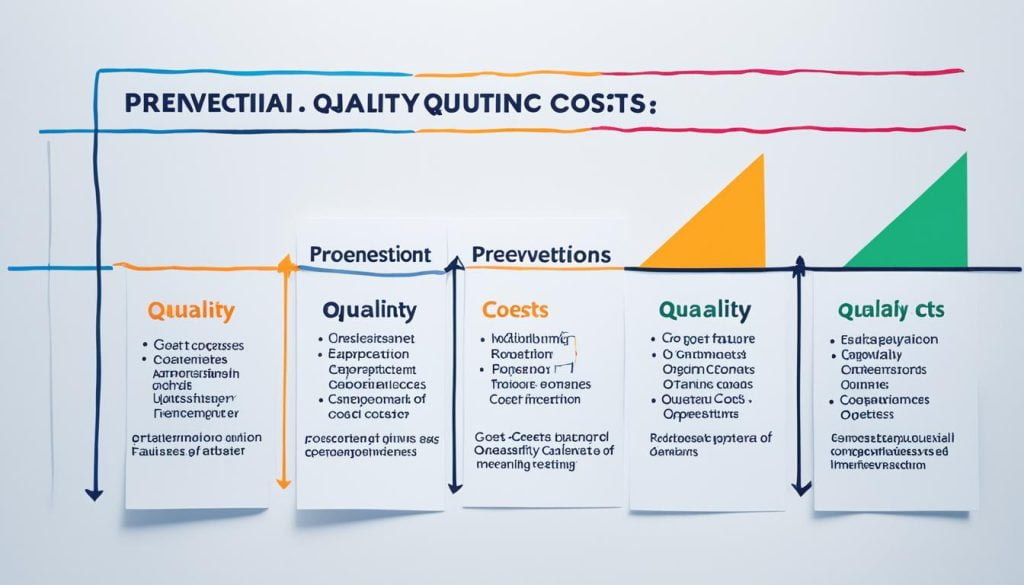
This image illustrates the Cost of Quality Equation, highlighting the four cost categories and their respective amounts to calculate the overall Cost of Quality (COQ).
Nonlinearity of Cost of Quality
The Cost of Quality equation is nonlinear, which means that investing in the Cost of Good Quality does not necessarily increase the overall Cost of Quality. In fact, when resources are invested in the right areas, the Cost of Quality should decrease. For example, preventing or detecting failures before products reach the customer can reduce the Cost of Poor Quality. Therefore, companies should focus on investing in the areas that will have the most significant impact on reducing their overall CoQ.
Investing in the Cost of Good Quality can yield substantial benefits in terms of reducing the overall Cost of Quality. By implementing robust preventive measures, such as rigorous quality control processes and thorough product testing, companies can significantly minimize the occurrence of defects or failures. This, in turn, reduces the amount spent on rectification and customer support, ultimately leading to a decrease in the Cost of Quality.
Importance of Cost of Quality
The Cost of Quality (CoQ) is a critical factor that directly impacts business efficiency, profitability, and competitive advantage. Effectively understanding and managing CoQ enables companies to identify areas for improvement, reduce waste and defects, enhance customer satisfaction, and stay ahead of the competition. By implementing proactive quality assurance practices and employing effective quality control techniques, organizations can optimize their processes, minimize costs, and consistently deliver high-quality products or services to their customers.
Investing in the Cost of Quality provides several significant benefits to businesses:
- Identifying areas for improvement: The CoQ analysis uncovers the weak points in a company’s processes, enabling them to target specific areas for improvement. By addressing these areas, organizations can streamline operations, minimize errors, and achieve higher levels of efficiency.
- Reducing waste and defects: By focusing on CoQ, companies can implement strategies to reduce waste, rework, and internal failures. This helps in improving product or service quality, reducing customer complaints, and minimizing the need for costly remedial actions.
- Enhancing customer satisfaction: High-quality products or services are key to customer satisfaction and loyalty. By managing CoQ effectively, organizations can ensure consistent delivery of top-notch products or services to meet customer expectations and build lasting relationships.
- Increasing competitive advantage: In today’s competitive market, businesses that prioritize quality gain a significant edge over their competitors. By investing in CoQ, companies demonstrate their commitment to excellence, which becomes a unique selling point that attracts customers and differentiates them from competitors.
Ultimately, understanding the importance of the Cost of Quality and implementing strategies to manage it effectively can lead to improved business performance, increased profitability, and long-term success.
Cost of Quality and Different Industries
The Cost of Quality (CoQ) can vary significantly across different industries. This is due to various factors such as industry-specific regulations, market demands, and production processes. Understanding the industry-specific CoQ range is crucial for organizations to benchmark their performance and identify areas for improvement. Let’s take a closer look at how the CoQ differs in various industries.
1. Automotive Industry
The automotive industry, known for operating on narrow profit margins, tends to have a lower CoQ compared to other sectors. This is primarily because the industry has a strong focus on quality management and process efficiency. Automotive manufacturers implement rigorous quality control measures to ensure compliance with safety standards and customer expectations. By investing in preventive measures and adopting advanced quality control techniques, companies in the automotive sector minimize the occurrence of defects and reduce the associated costs.
2. Pharmaceutical Industry
The pharmaceutical industry operates in a highly regulated environment with stringent quality standards. As a result, the CoQ in this industry can be relatively higher compared to other sectors. Pharmaceutical companies invest significantly in quality assurance practices, including research and development, strict manufacturing processes, and rigorous testing procedures. Appraisal costs, such as extensive laboratory testing and compliance audits, contribute to the overall CoQ. However, the prevention costs associated with ensuring drug safety and efficacy can offset the potential failure costs.
3. Food and Beverage Industry
The food and beverage industry faces unique challenges in ensuring product quality and safety. Stringent regulatory requirements and the need for effective supply chain management contribute to the CoQ in this sector. Prevention costs associated with maintaining quality standards throughout the production process, from sourcing raw materials to packaging, are significant. Appraisal costs, such as quality inspections and lab testing, also add to the CoQ. However, the potential high costs of external failures, such as product recalls and customer litigation, make investing in prevention and quality control critical for companies in this industry.
4. Technology Industry
The technology industry, characterized by fast-paced innovation and evolving customer demands, requires companies to maintain high-quality standards while delivering products quickly. Prevention costs in this industry involve investing in research and development, product design, and thorough testing procedures. Appraisal costs include quality control measures, such as software testing and product inspections. The CoQ in the technology sector is strongly influenced by the potential damage caused by internal and external failures, including software bugs, security breaches, and customer dissatisfaction. Therefore, companies in this industry place significant emphasis on quality assurance and continuous improvement.
“Benchmarking off an automotive supplier can provide valuable insights into industry-specific CoQ ranges. However, it is crucial for organizations to accurately estimate their CoQ losses and validate measurement processes to make informed decisions and improve overall quality practices.”
By analyzing the CoQ trends in specific industries, organizations can gain valuable insights into the cost-effectiveness of their quality management practices. Benchmarking against industry leaders and peers enables companies to identify areas where improvements can be made and implement best practices to optimize their CoQ. It is essential for businesses to prioritize accurate measurement and analysis of their CoQ, as well as continuous improvement efforts to stay competitive in their respective industries.
Managing the Cost of Quality
Companies should adopt a proactive approach to manage the Cost of Quality. This involves heavily investing in prevention and appraisal costs to minimize exposure to both internal and external failure costs.
Prevention costs include activities planned and designed to guarantee good quality and prevent the production of bad quality products or services. These can include:
- Establishing quality standards and procedures
- Implementing robust quality control measures
- Training employees on quality assurance practices
- Conducting regular quality audits
Appraisal costs involve measurement and inspection activities to ensure conformance to quality requirements. This can include:
- Testing and inspecting raw materials and components
- Conducting quality inspections throughout the production process
- Performing final product inspections before shipment
- Investing in sophisticated quality control technologies
By eliminating the sources of product defects and focusing on prevention and appraisal, organizations can reduce their overall Cost of Quality.
Implementing effective quality management systems and continuously improving quality practices can minimize the risk of both internal failures, such as production defects or process inefficiencies, and external failures, such as customer complaints or product recalls.
By managing the Cost of Quality, companies can optimize their processes, mitigate the risks of poor quality, and deliver high-quality products or services to their customers, ultimately improving their overall business performance.
Conclusion
The Cost of Quality (CoQ) is a critical component in ensuring business efficiency and profitability. By accurately calculating and effectively managing the CoQ, companies can identify areas for improvement, minimize waste and defects, enhance customer satisfaction, and ultimately gain a competitive advantage in the market.
Investing in prevention and appraisal costs is crucial in reducing both internal and external failure costs. Prevention costs encompass activities specifically designed to ensure high quality and prevent the production of subpar products or services. On the other hand, appraisal costs involve measurement and inspection activities that guarantee conformity to quality requirements.
Continuous improvement of quality practices and the adoption of effective quality control techniques are key to streamlining processes, optimizing costs, and delivering exceptional products or services. By focusing on managing CoQ, organizations can not only enhance their overall quality practices, but also meet customer expectations and drive long-term success.
FAQ
What is the Cost of Quality (CoQ)?
The Cost of Quality is a measure of the costs incurred by a company to ensure that its products meet quality standards. It includes both the costs of producing goods that meet quality standards and the costs associated with producing goods that fail to meet standards.
How is the Cost of Quality calculated?
The methods for calculating the Cost of Quality vary, but it is usually calculated by summing up the costs in four categories: Prevention Costs, Appraisal Costs, Internal Failure Costs, and External Failure Costs.
What is the Cost of Good Quality (CoGQ)?
The Cost of Good Quality includes the costs associated with activities intended to keep failures to a minimum, such as product specifications, quality planning, and employee training. It also includes appraisal costs, which are incurred to maintain acceptable product quality levels.
What is the Cost of Poor Quality (CoPQ)?
The Cost of Poor Quality includes the costs associated with defects found before and after the customer receives the product, such as excessive scrap, product rework, service and repair costs, and customer complaints.
What is the Cost of Quality equation?
The Cost of Quality equation is COQ = (PC + AC) + (IFC + EFC), where PC refers to Prevention Costs, AC refers to Appraisal Costs, IFC refers to Internal Failure Costs, and EFC refers to External Failure Costs.
Is the Cost of Quality linear?
No, the Cost of Quality is nonlinear. Investing in the Cost of Good Quality does not necessarily increase the overall Cost of Quality. In fact, when resources are invested in the right areas, the Cost of Quality should decrease.
Why is the Cost of Quality important?
The Cost of Quality plays a crucial role in business efficiency and profitability. By managing CoQ, companies can identify areas for improvement, reduce waste and defects, enhance customer satisfaction, and increase competitive advantage.
Does the Cost of Quality vary across industries?
Yes, the Cost of Quality can vary across different industries. For example, the automotive industry tends to have a lower CoQ compared to other industries that operate on narrow profit margins. Benchmarking industry-specific CoQ ranges can provide insights into cost optimization.
How can the Cost of Quality be managed?
Companies should adopt a proactive approach by heavily investing in prevention and appraisal costs to minimize exposure to both internal and external failure costs. By eliminating the sources of defects and focusing on prevention and appraisal, organizations can reduce their overall Cost of Quality.
What is the conclusion regarding the Cost of Quality?
The Cost of Quality is a critical aspect of business efficiency and profitability. By accurately calculating and managing the CoQ, companies can identify areas for improvement, enhance customer satisfaction, and gain a competitive advantage. It is essential to invest in prevention and appraisal costs to minimize internal and external failure costs.