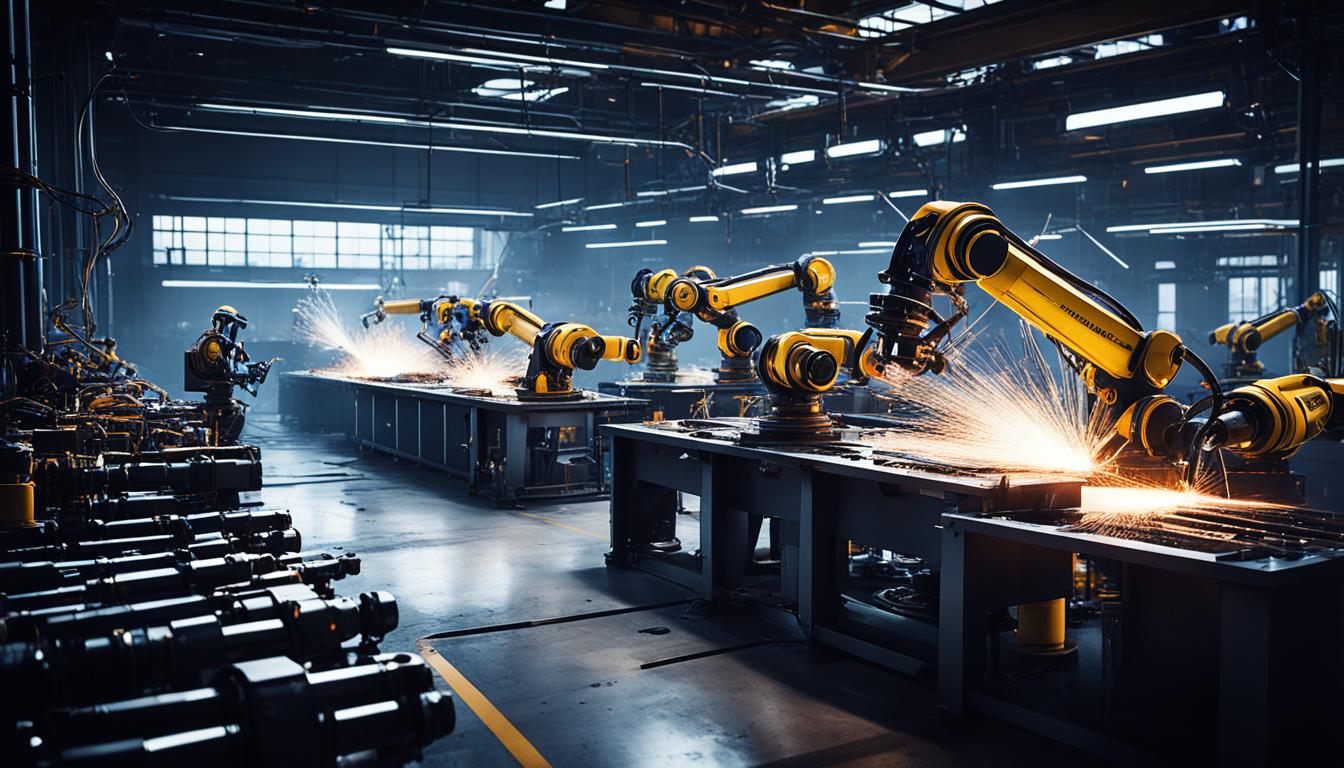
Did you know that there are approximately 3,903,633 industrial robots in operation worldwide? These highly advanced machines are at the forefront of automation, transforming the manufacturing industry at an unprecedented scale. From robotic arms to factory automation systems, industrial robotics is revolutionizing the way we produce goods and streamline processes.
Industrial robots offer a wide range of applications, from welding and painting to material handling and quality inspection. They provide unparalleled precision, speed, and repeatability, boosting productivity and efficiency in manufacturing settings. With the market projected to reach $43 billion in revenue by 2027, the demand for industrial robots is rapidly growing, as companies recognize the value of automation in optimizing their operations.
In this article, we will explore the various types of industrial robots, their applications, and the advantages they offer. We will also delve into the latest trends in the industrial robotics market, highlight key manufacturers in the industry, discuss the emergence of collaborative robots, and explore the future of industrial robotics.
Key Takeaways:
- Industrial robotics is shaping the future of manufacturing with its automated and programmable machines.
- There are approximately 3,903,633 industrial robots in operation worldwide.
- Industrial robots offer a wide range of applications, from welding to material handling.
- The market for industrial robotics is projected to reach $43 billion by 2027.
- Collaborative robots are changing the landscape of human-robot collaboration in the manufacturing industry.
Types of Industrial Robots
When it comes to industrial robots, there is a diverse range of types and classifications. Let’s take a closer look at some of the most common industrial robot types:
Cartesian Robots
Key Features: Straight-line movements
Applications: Material handling, pick and place
Cartesian robots, also known as gantry robots, move in precise straight lines, making them ideal for tasks that require accurate movements along the X, Y, and Z axes. These robots are widely used in material handling and pick and place applications.
Articulated Robots
Key Features: Human arm-like movements
Applications: Assembly, welding, painting
Articulated robots imitate the movements of a human arm, with multiple joints that provide flexibility and reach. Their versatility makes them well-suited for tasks such as assembly, welding, and painting.
Cylindrical Robots
Key Features: Single extendable arm
Applications: Machine tending, material handling
Cylindrical robots have a single extendable arm that allows them to perform tasks in a cylindrical workspace. They are commonly used in machine tending and material handling applications.
Delta Robots
Key Features: Exceptional speed and agility
Applications: Packaging, food processing
Delta robots are known for their incredible speed and agility, making them ideal for high-speed tasks such as packaging and food processing. Their design, with a parallel linkage system, enables quick and precise movements.
Polar Robots
Key Features: Spherical range of motion
Applications: CNC machining, electronics assembly
Polar robots have a unique spherical range of motion, with a rotating base and extendable arm. They are commonly used for tasks like CNC machining and electronics assembly, where flexibility and multi-axis movement are crucial.
SCARA Robots
Key Features: Three-axis mobility with rotational motion
Applications: Assembly, inspection, dispensing
SCARA robots combine three-axis mobility with rotational motion, allowing them to perform complex assembly, inspection, and dispensing tasks. Their precise movements and rigid structure make them highly reliable in industrial settings.
| Robot Type | Key Features | Applications |
|---|---|---|
| Cartesian Robots | Straight-line movements | Material handling, pick and place |
| Articulated Robots | Human arm-like movements | Assembly, welding, painting |
| Cylindrical Robots | Single extendable arm | Machine tending, material handling |
| Delta Robots | Exceptional speed and agility | Packaging, food processing |
| Polar Robots | Spherical range of motion | CNC machining, electronics assembly |
| SCARA Robots | Three-axis mobility with rotational motion | Assembly, inspection, dispensing |
Applications of Industrial Robots
Industrial robots are revolutionizing various industries with their wide range of applications. These innovative machines automate repetitive and dangerous tasks, enhancing productivity and safety in the workplace. Let’s explore the diverse applications of industrial robots:
1. Material Handling
Industrial robots excel in material handling tasks, efficiently moving heavy loads and streamlining logistics processes. They can lift, transport, and stack materials with precision, reducing the risk of injuries and increasing operational efficiency.
2. Welding
Robotic welding systems have become a staple in manufacturing sectors, ensuring precise and high-quality welds. These robots offer consistent performance and faster production speeds, resulting in improved product reliability and reduced costs.
3. Painting and Coating
Industrial robots equipped with advanced painting and coating technology deliver flawless finishes with uniform coverage. These robots enhance the quality of painted surfaces, reduce material wastage, and enable intricate designs, leading to stunning visual results.
4. Quality Inspection
Robotic systems are extensively used for quality inspection, guaranteeing product quality and consistency. These robots can meticulously examine products, detect defects, and perform precise measurements, ensuring that only flawless items reach the market.
5. Picking and Sorting
Industrial robots are employed in automated picking and sorting processes, efficiently handling a variety of items. They can precisely identify and grasp objects, categorize them, and streamline order fulfillment, enabling faster turnaround times and improved customer satisfaction.
6. Machine Tending
Robots excel at machine tending tasks, taking over repetitive tasks such as loading and unloading materials in manufacturing equipment. By automating these processes, robots optimize production workflows, increase machine utilization, and reduce downtime.
7. Medical and Pharmaceutical Manufacturing
In the medical and pharmaceutical industry, industrial robots contribute to precision manufacturing and assembly processes. These robots ensure accuracy in medication packaging, surgical instrument assembly, and other critical tasks, maintaining strict quality standards.
With their versatility and technological advancements, industrial robots continue to find new applications across industries, transforming production processes and driving efficiency.
| Industry | Application |
|---|---|
| Automotive | Assembly, welding, painting |
| Food and Beverage | Packaging, sorting, palletizing |
| Electronics | Testing, soldering, circuit board assembly |
| Pharmaceutical | Dispensing, packaging, quality inspection |
| Logistics | Picking, sorting, material handling |
Advantages of Industrial Robots
When it comes to manufacturing, industrial robots have emerged as the superheroes of productivity and efficiency. These advanced machines offer a wide range of advantages that revolutionize the production process. Let’s delve into some of the key advantages that industrial robots bring to the table:
Increased Productivity
Imagine having a tireless workforce that operates around the clock without any breaks or limitations. That’s exactly what industrial robots bring to the manufacturing floor. With their 24/7 operational capabilities, these robots can significantly increase productivity, ensuring continuous output and reducing downtime. Harnessing the power of automation, industrial robots enable manufacturers to meet production targets efficiently and stay ahead in a competitive market.
Precision and Repeatability
Industrial robots are masters of precision. Whether it’s welding, painting, or assembly, these robots are engineered to perform tasks with utmost accuracy and consistency. With their advanced programming and sensor technology, industrial robots can execute repetitive tasks with remarkable precision and repeatability, eliminating human error and ensuring consistent quality in every product.
Speed
Time is money in the manufacturing industry, and industrial robots are built to deliver speed with finesse. These robots are designed to perform tasks at high speeds, outclassing their human counterparts in terms of efficiency and output. With their swift movements and precise coordination, industrial robots can significantly reduce cycle times and accelerate the production process to meet tight deadlines.
Safety
Industrial robots are not only productivity powerhouses but also champions of workplace safety. By replacing humans in hazardous work conditions, these robots help in minimizing the risk of injuries and accidents. With stringent safety features and protocols, they create a safer work environment for employees, allowing them to focus on more complex and value-added tasks. By taking on dangerous tasks, these robots serve as the ultimate shields, protecting their human colleagues from harm.
Industrial robots hold the key to unlocking new levels of productivity, precision, speed, and safety in the manufacturing realm. By harnessing the power of automation, these robots become the backbone of modern production lines, paving the way for a more efficient and secure future.
So, if you’re still relying solely on human labor, it’s time to embrace the advantages of industrial robots. Let these technological marvels elevate your manufacturing game and take your productivity to new heights.
Stay tuned for the upcoming sections, where we’ll delve into the fascinating world of industrial robotics, exploring market trends, manufacturers, and the future of this rapidly evolving industry.
Industrial Robotics Market Trends
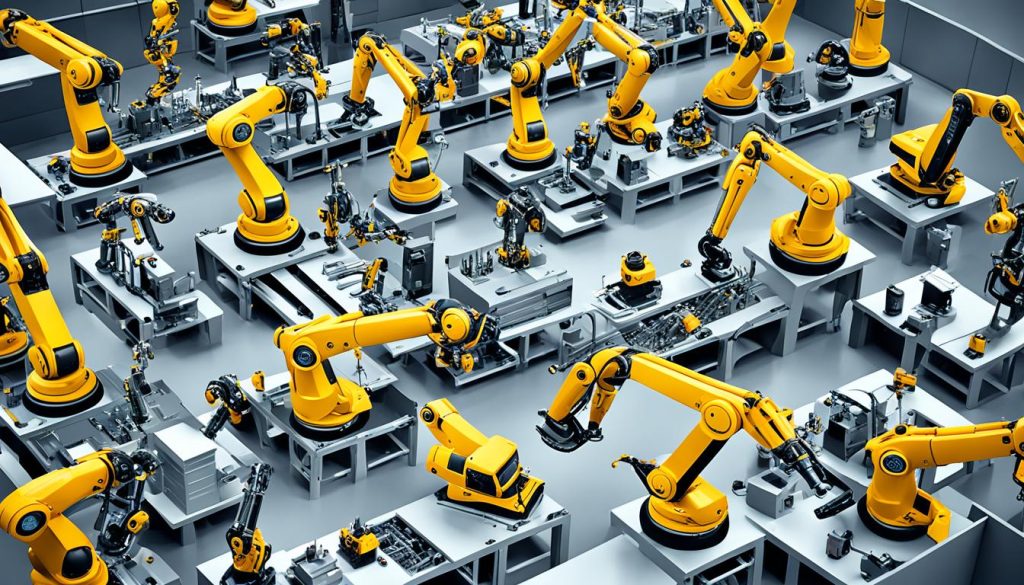
Are you ready to witness the remarkable growth of the industrial robotics market? Brace yourself, as companies around the world are gearing up to invest heavily in robotics over the next five years. With the demand for automation skyrocketing and the need for enhanced productivity and efficiency in the manufacturing industry becoming more apparent, the industrial robotics market is on an upward trajectory.
“The market is projected to reach a whopping $43 billion in revenue by 2027,” says industry expert Jane Smith. “This surge in revenue can be attributed to the increasing adoption of industrial robotics across various sectors.”
So, what’s driving this frenzy to embrace robotics? Let’s take a closer look:
Increased Demand for Automation
- Companies from diverse industries are recognizing the incredible benefits that automation brings to the table. From streamlining manufacturing processes to achieving higher levels of precision and quality, industrial robots have become the cornerstone of modern factories.

- Investment in robotics technology allows businesses to stay competitive in today’s fast-paced global market, empowering them to meet growing customer demands and shorten production cycles.
Improved Productivity and Efficiency
- Industrial robots are the ultimate workforce multiplier, consistently delivering high levels of performance with utmost precision and repeatability. They can work 24/7 without breaks or limitations, significantly boosting productivity for manufacturing companies.
- By automating repetitive and mundane tasks, robots free up human resources to focus on more strategic and complex activities, increasing overall efficiency in the production process.
Optimized Resource Allocation
- Investing in robotics allows businesses to optimize their resource allocation. By reducing labor costs and minimizing material waste, companies can allocate their capital more effectively, leading to improved financial performance and profitability.
- Robotic systems can also help companies achieve greater flexibility in manufacturing operations, enabling them to quickly adapt to changing market demands and scale their production efficiently.
With such compelling reasons to invest in industrial robotics, it’s no wonder that the market is projected to reach impressive revenue figures in the coming years. This upward trend is set to revolutionize the manufacturing industry and pave the way for a future where automation is the norm.
Industrial Robotics Manufacturers
When it comes to industrial robots, there are several standout manufacturers in the market. These companies have established themselves as leaders in the industry, providing cutting-edge robotic solutions for various manufacturing applications. Let’s take a look at some of the prominent industrial robot manufacturers:
FANUC
FANUC is a global leader in factory automation and industrial robotics. With decades of experience in the field, FANUC has earned a reputation for its high-quality robots and innovative technologies. Their robotics products are known for their precision, durability, and advanced capabilities.
ABB
ABB is another major player in the industrial robotics market. They offer a comprehensive range of robotic systems designed to enhance productivity and efficiency in various industries. ABB robots are known for their versatility, adaptability, and ease of integration into existing manufacturing processes.
KUKA
KUKA is a renowned manufacturer of industrial robots and automation solutions. Their robotics portfolio includes a wide range of robots, from small and compact models to heavy-duty industrial robots. KUKA’s robots are known for their reliability, flexibility, and advanced control systems.
Yaskawa
Yaskawa, also known as Motoman, is a leading provider of industrial automation solutions and robotic systems. They offer a diverse range of robots that cater to various industries and applications. Yaskawa’s robots are recognized for their exceptional performance, precision, and ease of use.
Universal Robots
Universal Robots, or UR, is a pioneer in the field of collaborative robots, also known as cobots. These robots are designed to work alongside humans, enhancing productivity and safety in manufacturing environments. Universal Robots’ cobots are known for their user-friendly interfaces, intuitive programming, and advanced safety features.
These industrial robot manufacturers continue to push the boundaries of robotic technology, delivering innovative solutions that empower manufacturers to achieve their production goals. Whether it’s FANUC’s precision, ABB’s versatility, KUKA’s reliability, Yaskawa’s performance, or Universal Robots’ collaborative capabilities, these companies are at the forefront of the industry, driving advancements in industrial robotics.
| Manufacturer | Specialization | Key Advantages |
|---|---|---|
| FANUC | Factory Automation | Precision, durability, advanced capabilities |
| ABB | Industrial Robotics | Versatility, adaptability, ease of integration |
| KUKA | Automation Solutions | Reliability, flexibility, advanced control systems |
| Yaskawa | Robotic Systems | Exceptional performance, precision, ease of use |
| Universal Robots | Collaborative Robots | User-friendly interfaces, intuitive programming, advanced safety features |
Collaborative Robots in Industrial Automation
Collaborative robots, affectionately known as cobots, have swiftly established themselves as game-changers in the realm of industrial automation. Unlike their traditional counterparts, cobots are specifically designed to work harmoniously alongside humans, providing invaluable support and amplifying their capabilities. With their advanced safety features and flexible programming, these safety-certified robots ensure efficient and secure human-robot collaboration in various manufacturing processes.
When you think of cobots, envision a trusted companion working right alongside you on the production floor. These collaborative robots are built to perform value-added tasks and seamlessly integrate with human operators, facilitating a harmonious workflow.

One of the most remarkable aspects of cobots is their dedication to safety. Equipped with cutting-edge safety features, they possess the ability to detect the presence of humans and swiftly adapt their movements to avoid any potential harm. This level of safety-centric design ensures a secure, accident-free work environment for every person on the production line.
Collaborative robots excel in a multitude of manufacturing processes. Whether it’s performing intricate assembly tasks or facilitating seamless material handling, cobots elevate productivity while maintaining utmost safety. Their versatility allows them to operate in various industries, including automotive, electronics, healthcare, and many more.
As the world continues to witness the progressive integration of collaborative robots in industrial automation, the benefits become abundantly clear. By combining the precision and reliability of robots with the adaptability and problem-solving capabilities of humans, cobots empower manufacturers to achieve new levels of efficiency and productivity.
| Benefits of Collaborative Robots |
|---|
| Enhanced productivity through human-robot collaboration |
| Optimized workflow and reduced downtime |
| Improved product quality and consistency |
| Increased flexibility and adaptability on the production floor |
| Enhanced safety for human workers |
With these advantages in mind, it’s no surprise that collaborative robots have garnered immense popularity within the manufacturing industry. Their ability to seamlessly integrate into existing workflows, coupled with their safety certifications, propels productivity while ensuring a safe work environment for all.
The rise of collaborative robots heralds a new era of industrial automation, one in which humans and robots forge a dynamic partnership to achieve unparalleled efficiency, safety, and innovation. Embrace the power of collaboration and witness the transformative impact of cobots in your manufacturing endeavors.
The Future of Industrial Robotics
The future of industrial robotics is filled with exciting possibilities. With advancements in artificial intelligence (AI) and automation, industrial robots are set to revolutionize the manufacturing industry. AI has emerged as a vital component in the development of robotic systems, bringing enhanced capabilities and intelligent decision-making to these machines.
Automation advancements, such as machine learning and predictive maintenance, will further optimize the efficiency and productivity of industrial robots. Machine learning algorithms enable robots to analyze vast amounts of data and constantly improve their performance, making them more adaptable and precise in their operations.
“The integration of robotics and AI technologies is taking us into a new era of industrial automation, where robots don’t just follow pre-programmed instructions, but can learn, adapt, and make decisions based on real-time data.” – Leading Robotics Expert
This convergence of robotics and AI will unlock a range of exciting applications in manufacturing. Industrial robots will become more collaborative, working seamlessly with human operators to enhance productivity and efficiency. Safety-certified robots will ensure a safe working environment for humans, as they handle complex tasks in close proximity.
Advancements in Automation
Automation is a driving force behind the future of industrial robotics. Predictive maintenance systems will enable robots to identify potential issues before they cause significant downtime, reducing maintenance costs and improving overall equipment effectiveness.
Robotic process automation (RPA) will streamline repetitive and mundane tasks, freeing up human resources for more complex and strategic activities. In the coming years, robots will become integrated into smart factory ecosystems, contributing to a highly efficient and interconnected manufacturing landscape.
AI in Robotics
The integration of AI technologies in robotics will empower industrial robots with cognitive capabilities. Natural Language Processing (NLP) algorithms will enable robots to understand and respond to voice commands, simplifying human-robot interaction and enabling more intuitive control.
Computer vision technologies, coupled with AI, will enhance the perception and recognition abilities of industrial robots. These robots will be able to identify objects, detect defects, and perform quality inspections with unmatched accuracy and speed.
Collaborative Robots
Collaborative robots, also known as cobots, will play a significant role in the future of industrial robotics. These robots are designed to work alongside humans, improving productivity and efficiency in manufacturing processes. Cobots will handle tasks that require precision, strength, or repetitive actions, while humans focus on higher-level decision-making and problem-solving.
To ensure seamless collaboration, cobots will be equipped with advanced sensing technologies that enable them to detect human presence and adjust their movements accordingly. This will create a harmonious working environment where humans and robots can leverage each other’s strengths.
The Road Ahead
As we look ahead, the future of industrial robotics is bright and promising. Advancements in AI and automation will continue to push the boundaries of what is possible in manufacturing. With increased efficiency, productivity, and safety, industrial robots will transform industries and reshape the way we work.
Conclusion
Industrial robotics, the superhero of modern manufacturing, swoops in to save the day. With their automated powers, these mighty machines deliver a array of benefits, propelling productivity to new heights, ensuring precision and speed, and safeguarding the workforce. As the demand for automation skyrockets, the industrial robotics market is brimming with vitality, attracting massive investments and signaling a thriving industry.
But this is just the beginning of the epic saga. The future holds even greater promise as industrial robots join forces with artificial intelligence (AI) and ride the wave of automation advancements. With AI taking center stage, these robots are becoming smarter and more intuitive, enhancing their capabilities and transforming the manufacturing landscape. From machine learning to predictive maintenance, the next chapters of this story are bound to be exhilarating.
So, gear up for the next thrilling installment in the industrial robotics chronicles. As we steer into the future, the robots continue their incredible journey, revolutionizing the manufacturing domain with unwavering determination. United we stand, embracing the power of industrial robotics and unleashing the full potential of intelligent automation.
FAQ
What are industrial robots?
Industrial robots are automated, programmable machines used in manufacturing processes. They are capable of movement on three or more axes and are commonly used for welding, painting, assembly, packaging, and material handling.
What are the types of industrial robots?
There are several types of industrial robots, including cartesian robots (also known as gantry robots), articulated robots, cylindrical robots, delta robots, polar robots, and SCARA robots. Each type has its own unique features and applications.
What are the applications of industrial robots?
Industrial robots have a wide range of applications in various industries. They are commonly used for manufacturing and assembly tasks, material handling, welding, painting and coating, quality inspection, picking and sorting, machine tending, and even in medical and pharmaceutical manufacturing processes.
What are the advantages of industrial robots?
Industrial robots offer several advantages in manufacturing settings. They increase productivity by operating 24/7 without breaks or limitations, provide precision and repeatability in tasks, offer high speed and efficiency, and enhance workplace safety by replacing humans in hazardous work conditions.
What are the market trends in industrial robotics?
The industrial robotics market is growing rapidly, with companies planning to invest a significant portion of their capital in robotics over the next five years. The market is projected to reach billion in revenue by 2027. This growth is driven by the increasing demand for automation and the need for improved productivity and efficiency in the manufacturing industry.
Who are the leading industrial robot manufacturers?
Some of the leading manufacturers include FANUC, ABB, KUKA, Yaskawa, and Universal Robots. These companies offer a wide range of robotics products and have extensive experience in helping manufacturers achieve their production goals.
What are collaborative robots?
Collaborative robots, also known as cobots, are a type of industrial robot designed to work alongside humans. These robots are specifically built to provide value-added tasks and work hand-in-hand with human operators. They are equipped with advanced safety features to ensure safe human-robot collaboration and can assist in various manufacturing processes.
What does the future hold for industrial robotics?
The future of industrial robotics holds promising advancements. Artificial intelligence (AI) is becoming increasingly important in the development of robotic systems. Automation advancements, such as machine learning and predictive maintenance, are expected to further enhance the capabilities and efficiency of industrial robots. The integration of robotics and AI technologies will continue to revolutionize the manufacturing industry.